
Ancient City Of Uxmal And Magnificent Pyramid Of The Magician
A. Sutherland - AncientPages.com - Located in the ancient, pre-Columbian city of Uxmal, Mexico, an intriguing Mesoamerican step pyramid is known as the Pyramid of the Magician. It is the tallest and most visible structure in the ancient city of Uxmal.
 Pyramid of the Magician, Uxmal, Yucatan, Mexico. Image credit: - CC BY-SA 3.0
The pyramid is also known under different names, such as the Pyramid of the Dwarf, Casa el Adivino, and the Pyramid of the Soothsayer.
In ancient times, Uxmal was one of the largest cities on the Yucatán Peninsula. At its height, Uxmal was home to about 25,000 Maya, and we find the Pyramid of the Magician at the city's center.
Uxmal was one of the most noteworthy places, though less powerful than cities like Tikal. Even today, the ruins display the city's prominent architecture, which needs to shed more light on Uxmal's mysterious past.
Despite the existence of oral legends and Mayan chronicles, it still needs to be seen when exactly Uxmal was established, how many people lived there, and when it was abandoned.

A dwarf depicted on a Classic Maya vase is shown playing a significant role in an apparent discussion or face-off between groups. Image credit: Mexicolore
Legend Of The Dwarf Magician Who Built The Pyramid
The pyramid's name is derived from ancient legends told by the indigenous Mayan people.
According to one legend, a magician-god named Itzamna was single-handedly supposed to have erected the pyramid in one night, using his strength and magic.
Another intriguing legend also tells that when a particular gong was to sound, the city of Uxmal was destined to fall to a boy "not born of woman." The gong was struck one day by a dwarf born unto no mother but instead hatched from an egg by a childless, older woman (according to a tourist guide in Uxmal, this egg was an iguana egg, and the woman was a witch).
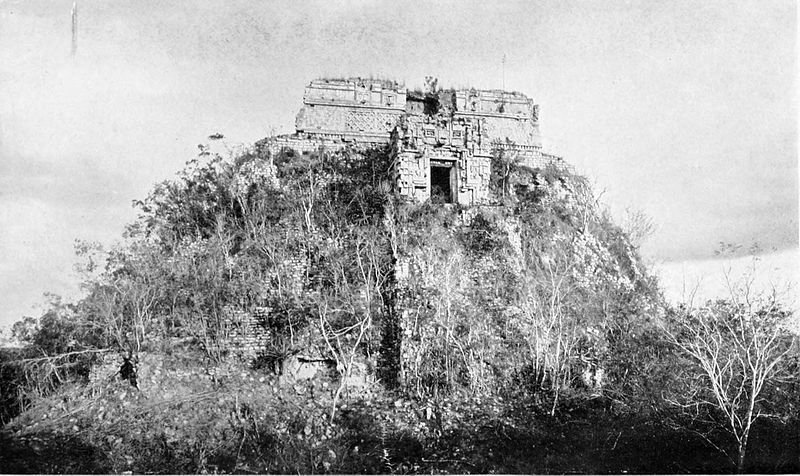 Pyramid of the Magician as it looked in 1913 before it was restored. Image credit: Douglas C. McMurtrie
When the city's ruler heard the sound of the gong, he became frightened and ordered the execution of the dwarf. After a while, the ruler decided the dwarf's life would be spared if he could perform three seemingly impossible tasks. The dwarf was ordered to build a massive pyramid, taller than any building in the city, in a single night. The dwarf ultimately completed all the tasks, including the pyramid's construction. The dwarf was hailed as the new ruler of Uxmal, and the structure was dedicated to him.
Pyramid Of The Magician And Its Five Temples
Many pyramids are scattered worldwide, but this particular one is considered unique because of its rounded sides, considerable height, steep slope, and unusual elliptical base. The exact height of the Pyramid of the Magician is in dispute and has been reported as tall as 40 meters (131 feet) and as low as 27.6 meters (90.5 feet).
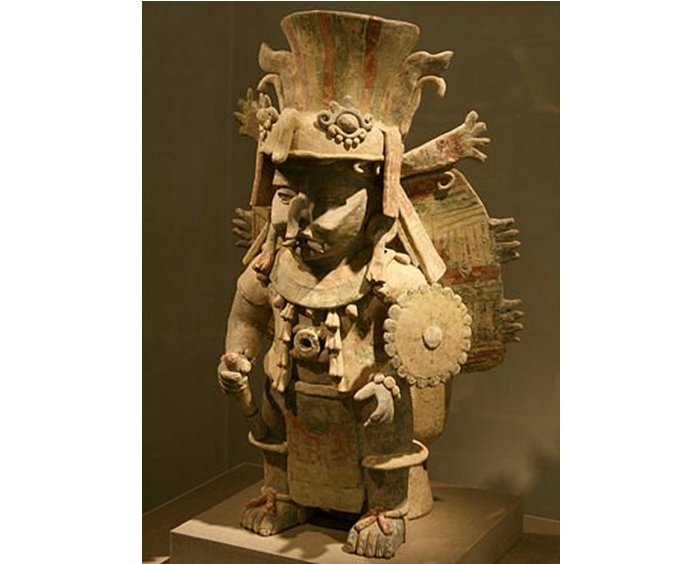
Earthenware effigy urn (an incense burner) of Chaac, 12th-14th century. Image credit: Wikipedia - Leonard G.
The accepted median height is 35 meters (115 feet), with the base measuring approximately 69 by 49 meters (227 by 162 feet). Despite no exact measurements, the pyramid remains the tallest structure at Uxmal.
According to archaeologists and historians, the construction of the first pyramid temple began in the 6th century A.D., and the structure was expanded over the next 400 years.
The pyramid fell into disrepair after 1000 A.D. and was looted during the Spanish Conquest of Yucatán.
As it stands today, the pyramid results from five nested temples. The oldest structure, Temple I, is exposed on the structure's west side, at the pyramid's base. The second temple, Temple II, can be entered through an opening in the upper part of the eastern staircase.
This temple is only partially excavated. Columns support its central chamber, with a roof comb visible through a trench on the floor of Temple V above. Temple III is built onto the rear of Temple II and is not visible outside. It consists of a small central shrine and an antechamber.
 The "Nunnery" in Uxmal, actually a palace complex, stands adjacent to the Pyramid of the Magician. Image credit: Canadian Museum of History
Temple VI has the most decadent decorations and was constructed in Chenes. Chaac is the name of the Maya rain deity. With his lightning ax, Chaac strikes the clouds and produces thunder and rain. Chaac corresponds to Tlaloc among the Aztecs.
Temple V, also known as The House of the Magician or Soothsayer, is the final building phase of the pyramid.
Pyramid Is An Image Of The World
The first detailed account of the rediscovery of the ruins was published by Jean-Frederic Waldeck in 1838. Waldeck's account of Uxmal inspired John Lloyd Stephens and his illustrator friend, Frederick Catherwood, to make two extended visits to the site in 1839-1841 to record and sketch the layout of the complex. Stephens published his now-famous Incidents of Travel in the Yucatan from his notes.
Describing his first view of the ruins, Stephens writes:
"We took another road, and, emerging suddenly from the woods, to my astonishment came at once upon a large open field strewed with mounds of ruins, and vast buildings on terraces, and pyramidal structures, grand and in good preservation, richly ornamented, without a bush to obstruct the view, and in picturesque effect almost equal to the ruins of Thebes... ...The place of which I am now speaking was beyond all doubt once a large, populous, and highly civilized city. Who built it, why it was located away from water or any of those natural advantages which have determined the sites of cities whose histories are known, what led to its abandonment and destruction, no man can tell."
Octavio Paz Lozano, the Mexican poet-diplomat and writer, said about this magnificent structure:
"The pyramid is an image of the world; in turn, that image of the world is a projection of human society. If it is true that man invents gods in his image, it is also true that he sees his image in the images that the sky and the earth offer him. Man makes the human history of the inhuman landscape; nature turns history into cosmogony, the dance of the stars."
The doorway into the temple on the top aligns with the setting sun on April 12 and August 31.
These are essential astronomical dates on the Mayan calendar for tracking the sun's zenith. Like so many other ancient structures worldwide, the Pyramid of the Magician also proves our ancestors' interest in astronomy and observations of celestial objects.
Written by – A. Sutherland - AncientPages.com Senior Staff Writer
Updated on January 6, 2024
Copyright © AncientPages.com All rights reserved. This material may not be published, broadcast, rewritten or redistributed in whole or part without the express written permission of AncientPages.com
Expand for referencesReferences:
Harasta J. Uxmal: The History of the Ancient Mayan City
Harasta J. The Most Famous Cities of the Maya
More From Ancient Pages
-
 Mystery Of Human Evolution – What Can Ancient Genes Tell Us About Who We Are?
-
 Three Grave Steles Unearthed At Istanbul’s 1,500-Year-Old St. Polyeuktos Church
-
 Mysterious Cucuteni-Tyrpillian Culture Burned Their Settlements For Unknown Reasons
-
 Strange Mythical Creature Resembling A Sphinx Discovered In A Medieval Bathroom
-
 Neanderthal Intelligence Revealed By Their Use Of Fire For Cooking
-
 Ancient People In Peru Had A Unique Response To The Looting And Destruction Of Their Ancestors’ Graves
-
 First Cemetery Dated To Roman Period Discovered In North Saqqara, Egypt
-
 Sculpture Of Lord Vishnu Dated To The Early 9th Century Found In Kashmir
-
 On This Day In History: Ruler Of Palenque Yohl Ik’nal Was Crowned – On Dec 23, 583
-
 World’s Oldest Hand Stencils Were Made By Neanderthals In The Maltravieso Cave 66,000 Years Ago
-
 Underwater Secrets Of Lake Lednica And The Unique Wooden Face
-
 Winged Sun Disk: One Of The Oldest And Most Important Solar And Religious Symbols
-
 Obscure History Of Atlantean Statues In Ancient Toltecs’ City Of Tula
-
 Jebel Sahaba: Analysis of 13,000-Years-Old Bones Reveals Prehistoric Violent Raids But Not A Single Armed Conflict
-
 Biblical Mosaic Depicting Miracles Of Jesus Discovered At The ‘Burnt Church’ In Hippos
-
 Unexplained Phenomena Witnessed Around Mysterious Ancient Stone Structures In New York – Can A Sacred Native American Mountain Offer Clues?
-
 Facial Reconstruction Of A 75,000-Year-Old Neanderthal Woman From Shanidar Cave
-
 Mystery Of The Ancient Reptilian Gods Remains A Complex Subject – Memories Of The Past – Part 1
-
 8,000-Year-Old House Remains Discovered In Svinjarička Čuka, Serbia Raise Questions About Europe’s First Farmers
-
 Who Has Stolen Charles Darwin’s Notebooks Worth Millions From The University Of Cambridge?

