
Mysterious Ancient Grave With Unusual Artifacts That Belonged To A Völva – Norse Female Shamans Did Exist
Ellen Lloyd - AncientPages.com - A Völva in Norse mythology was someone everyone feared, even the gods. She was a powerful female shaman and seer, but was she only a mythological figure, or was there any proof of her existence?
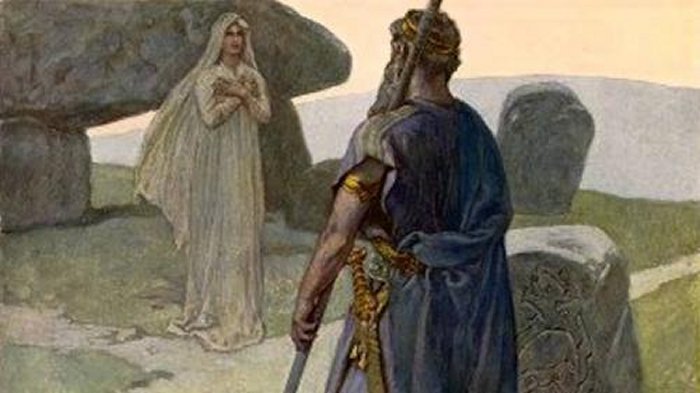
“Odin and the Prophetess” by Emil Doepler (1910)
Sometimes very unusual archaeological finds are made, giving us reason to ponder whether some of our ancestors’ stories are not based on actual events.
A very mysterious grave was discovered in Denmark. Several puzzling ancient artifacts were found in the tomb, indicating whoever was buried there was no ordinary person. What is especially interesting about this particular discovery is that it seems this was the resting place of a Völva.
While excavating near the Fyrkat Viking fortress, archaeologists found about 30 Viking Age graves, but one was more unusual.
A Viking-Age Woman Who Held High Status
Scientists found a woman dressed in fine blue and red clothes inside the tomb adorned with gold thread. Her clothes showed she was important and most likely held royal status. She had been given ordinary female gifts, like spindle whorls and scissors.
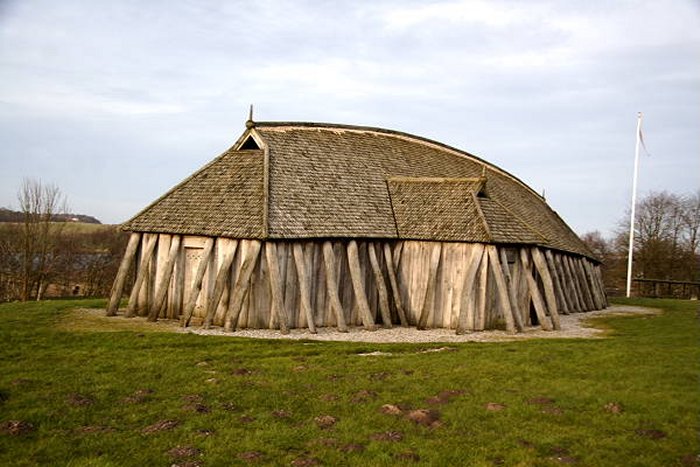
Reconstruction of Fyrkat Viking fortress. Image credit: Malene Thyssen - CC BY-SA 3.0
Being a rich woman, she was buried in the body of a horse-drawn carriage.
The grave contained exotic goods from foreign countries, something only rich people could afford at the time. Her toe rings were made of silver, which has not been found elsewhere in Scandinavia. Among her burial goods were two bronze bowls, which may have come from Central Asia.
Unusual Metal Wand And Poisonous Plants
It would be easy to say this was “only” a rich Viking woman, but some objects inside the grave suggest she was a Norse shaman.
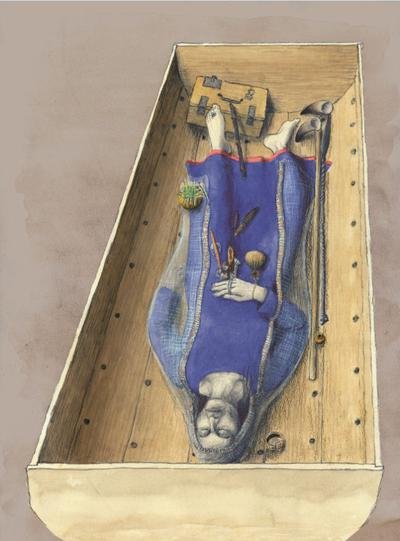
The buried seeress from Fyrkat – reconstruction drawing by Thomas Hjejle Bredsdorff. Image credit: National Museum of Denmark
Scientists discovered an intriguing metal wand and seeds from the poisonous henbane plant inside her tomb.
These two particular accessories are associated with a Norse shaman because the name Völva (vǫlva) is Old Norse and means “wand carrier” or “carrier of a magic staff.” In Norse Sagas, a Völva is often described as an older woman who appears late at night. She is dressed in a dark foot-length cloak and holds a magical staff.
The metal wand in the grave had disintegrated after all those years, but experts could determine it was an iron stick with bronze fittings.

Left: A mysterious small cup, which the woman from Fyrkat also had with her in the grave. Its function is not known, but it may have been a small drinking cup. Right: Bronze cup, possibly originating from Central Asia. It had a grass cover and contained a fatty substance. Image credit: National Museum of Denmark
Inside a small purse, there were henbane seeds. During the Viking Age, such seeds were thrown by shamans into a fire because the plants were known to produce mildly hallucinogenic smoke and euphoric states.
Henbane was often used by the witches of later periods. It could be used as a “witch’s salve” to produce a psychedelic effect if the magic practitioners rubbed it into their skin.
Why was the woman buried with such plants unless she used them?
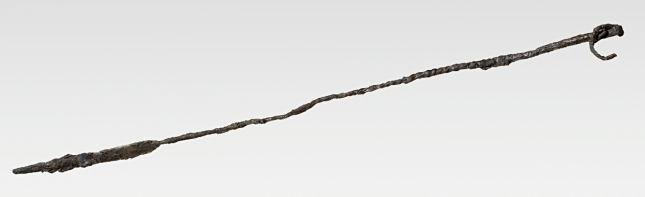
The Viking seeress’s cooking spit. The spit was already slightly bent when it was placed in the burial. Image credit: National Museum of Denmark
White lead was sometimes used as an ingredient in skin ointment in her belt buckle.
Scientists also discovered other mysterious artifacts that support the theory the woman inside the Fyrkat grave was a Völva.
At her feet was a box containing various items, such as owl pellets and small bird and mammal bones. Apart from these was a silver amulet shaped like a magic chair.

A so-called box brooch from Gotland was found in the grave. The völva re-used the hollow brooch as a container for “white lead.” White lead is a white dye that has been used in medicine for more than 2000 years - in skin ointments, for example. It is poisonous in its concentrated form. Image credit: National Museum of Denmark
We may never know the woman’s identity, but her burial goods show she was not a Viking warrior but a Völva. A Völva was a very respected woman, and warriors often visited her before going into battle. Her Poisonous plants could have been used before an important fight to give Viking warriors strength and courage.
It is, without a doubt, a fascinating archaeological discovery that gives a unique glimpse into our ancestor’s beliefs and shows some Norse myths were undoubtedly based on actual events and people.
Written by Ellen Lloyd – AncientPages.com
Updated on April 1, 2023
Copyright © AncientPages.com All rights reserved. This material may not be published, broadcast, rewritten or redistributed in whole or part without the express written permission of AncientPages.com
More From Ancient Pages
-
 Unexplained Phenomena Witnessed Around Mysterious Ancient Stone Structures In New York – Can A Sacred Native American Mountain Offer Clues?
-
 Enigmatic Bronze Age Fulacht Fiadh: ‘Kitchens’ Of The Legendary Irish Warriors
-
 Mystery Of The Forgotten Explorers And Ancient Artifacts That Re-Write History Of North And South America
-
 Horrible Ancient Massacre On The Island Of Chios Led To Greek Independence
-
 New West Papua Findings Provide Insights Into Early Human Migration To The Pacific
-
 Scientists Found Mysterious Prophecies In Ancient Egyptian Pyramid – Are They Linked To The Strange Visions Some Experience Inside?
-
 Legend Of Evil Spearfinger And The Cherokee Who Were Guided By Celestial Beings
-
 The Opening Of Pandora’s Box May Have Been A Real Event
-
 Dunstanburgh Castle: Underground Passageways And The Legend Of Sir Guy The Seeker
-
 Sweden’s Tanum And Skredsvik Petroglyphs: Thousands Of Spectacular And Intriguing Rock Art
-
 Vettuvan Koil Temple Spectacular Monolith Dedicated To Lord Shiva And Built By Pandya Dynasty
-
 Catherine De Medici – Queen Of France Supported Nostradamus, Was Suspected Of Poisoning And Blamed For Horrible Massacre
-
 DNA In Viking Poop Sheds New Light On 55,000-Year-Old Relationship Between Gut Companions
-
 Evidence Reveals Ancient Saudi Arabia Had A Complex, Thriving Society, Contradicting Notions Of A Struggling Population In Barren Lands
-
 Who Was Pseudo-Nero?
-
 Did An Extraterrestrial Spacecraft Land In Ancient China? Remarkable UFO Accounts From The Past
-
 Your Destiny Is Engraved And Stored – Guardians Of The Great Mystery – Part 2
-
 Ancient Manuscript And Controversial Ancient Book Shed New Light On The Mystery Of The Toltecs
-
 Mysterious Vanishings Around The Azores And The Riddle Of The ‘Cosmic Brain’ Influence
-
 Catequil – Inca God Of Thunder And Lightning Who Predicted The Future And Was Cultural Hero Of Inca People

