
Mysterious Chultuns – Ancient Underground Chambers Built By The Maya – But For What Purpose?
Ellen Lloyd - AncientPages.com - The ancient Maya of the Yucatán Peninsula constructed several underground chambers known as Chultuns.
The purpose of the chultuns is still an enigma. It’s not entirely clear for what purpose the pre-Columbian Maya took the time and effort to build these underground chambers.
Suggestions which have been proposed include their use as water cisterns, burial chambers, sweat baths, food cellars, underground religious shrines, and even some form of outdoor plumbing.
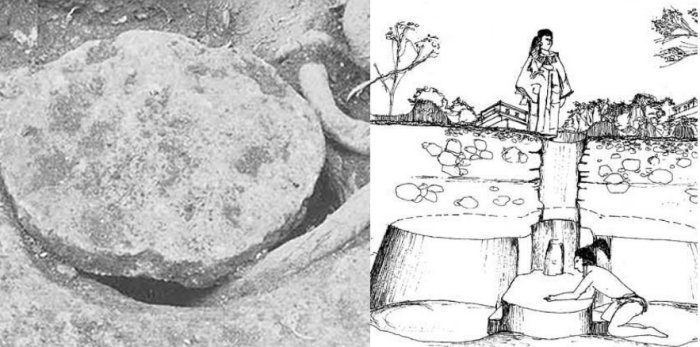
Chultuns Were Not Only Used For Water Storage
Most chultuns were bottle-shaped underground storage chambers, carved out of the relatively soft limestone bedrock. They were often plastered with a thick coating of lime stucco.
Archaeologists have discovered that most chultuns were constructed in places where canotes were absent.
Canotes are sinkholes resulting from the collapse of limestone bedrock that exposes groundwater underneath. Especially associated with the Yucatán Peninsula of Mexico, cenotes were sometimes used by the ancient Maya for sacrificial offerings.
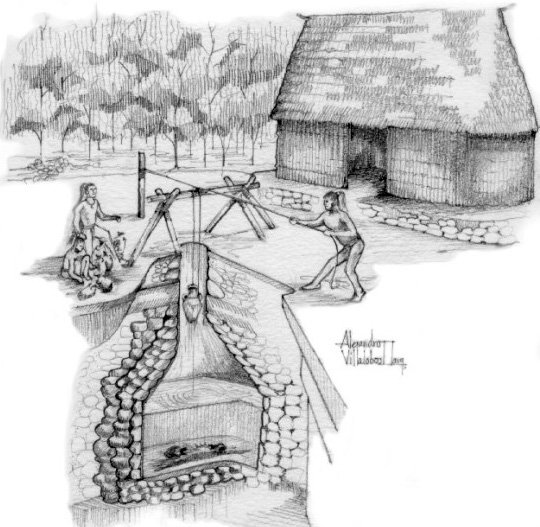
Chultuns were often bottle-shaped.
Chultuns were rather common in southern Mesoamerica and they were most likely used to store rainwater. Many chultuns have been looted by thieves looking for valuable artifacts. The fact that the Maya still use these chambers for disposing waste makes archaeological examinations of the chultuns very difficult.
In addition, nor has any series of artifacts been found in chultuns that might provide clear-cut evidence for a simple answer.
Puleston’s Investigations Of Chultuns Reveal A Surprise
The presence of the stone covering lids points to the probability that whatever went on inside the chultuns required that they be kept closed. If the function of chultuns was the storage of food, the primary use of these lids would have been to keep out rain and possibly vermin. What sort of foods might have been stored in chultuns by the Maya?
In the 1960s, Dennis E. Puleston 1940-1978), American archaeologist and ecologist whose work ranged from experiments in reconstruction and usefulness testing of chultuns.
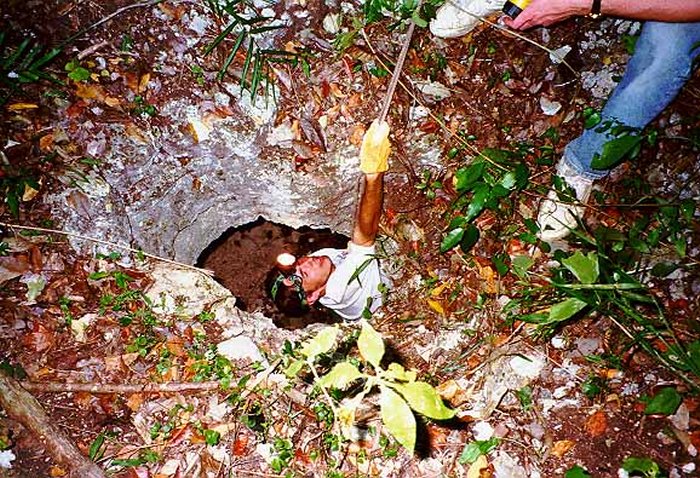
Archaeologists exploring a Chultun (underground cistern) of the Ancient Maya. Image credit: David R. Hixson
Puleston’s studies of chultuns revealed that despite their common name, there were different types of these man-made underground holes. In time, Puleston became convinced that chultuns were used for a variety of purposes. Some of the chultuns which were single chambers with plastered walls were constructed for water storage. However, Puleston noticed that the chultuns in the Tikal region were different in shape, not plastered, and did not hold water.
When Puleston filled a chultun with water and watched it drain away quickly. This lent credibility to his assertion that chultuns of this region were not for water storage.
After many weeks of study, Puleston noticed that the chultun offered valuable protection from vermin. Nevertheless, the underground chambers could not be used for the storage of maize, beans, or squash because these food items were consumed by insects and rodents.
There was no reason to suspect the chultuns were burial chambers. So, why did the Maya construct these enigmatic subterranean holes?
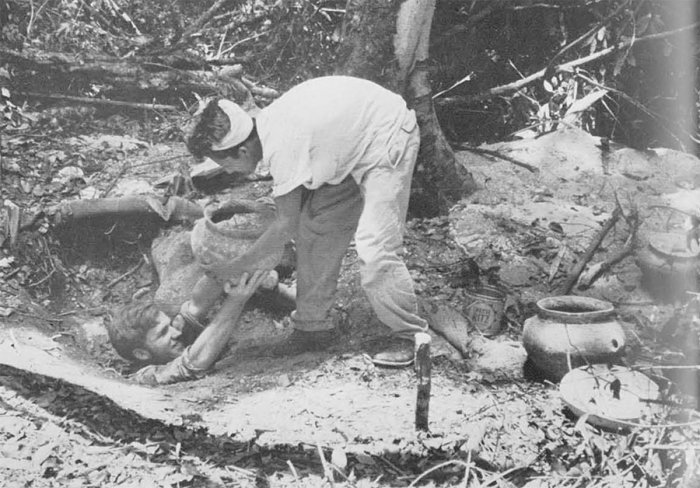
It's very unusual that artifacts are found inside a chultun. In Chultun 3F-6, ancient vessels were discovered. These turned out to be the only examples of this type yet found in Tikal. Image credit: Penn Museum
Puleston had no intentions of giving up. Determined to unravel the mystery of the chultuns, he took some nuts from a local tree and placed them in the storage chamber. Then, he waited. When he returned to the chultun 13 weeks later, he discovered the ramon nuts, not only had survived, but they were still in excellent condition and completely edible.
There are many advantages of using an underground storage system. Puleston’s discovery revealed that the ancient Maya realized some of the underground chambers were particularly effective for long-term storage of ramon nuts.
Written by - Ellen Lloyd – AncientPages.com
Copyright © AncientPages.com All rights reserved. This material may not be published, broadcast, rewritten or redistributed in whole or part without the express written permission of AncientPages.com
More From Ancient Pages
-
 Baku’s Mysterious Maiden Tower – Legend Of The Daughter Of Fire Who Saved The Sacred Temple May Be True
-
 The Cyclades And Their Advanced And Mysterious Society Lost In Time
-
 Ancient City Of Urkesh – Home Of Kumarbi – The Foremost Son Of Anu
-
 Wreck Of Historic Royal Ship ‘Gloucester’ Discovered Off The English Coast
-
 New Study Challenges The Beginning Of Civilization
-
 Levänluhta People Could Survive Fimbulwinter Thanks To Their Diverse Livelihoods
-
 Strange Ancient Structures In The Northeastern U.S. Were Built By Unknown People With Shining Shields, Native Americans Say – Evidence Of Norsemen Or Celts?
-
 Japan’s Ancient Practice Of Cranial Modification: The Case Of The Hirota People In Tanegashima
-
 London Is Twice As Old As Previously Thought – New Discovery Reveals
-
 Impressive Pyramid Of Kukulkan (El Castillo’) At Chichen Itza
-
 Pottery Found On Jiigurru/Lizard Island Rewrites Aboriginal History
-
 Secret Police In Ancient Rome – Frumentarii: Who Were They And What Was Their Role?
-
 On This Day In History: A Solar Eclipse Occurs, As Predicted By Thales Of Miletus – On May 28, 585 BC
-
 Rapa Nui: Despite Its Remoteness, It Was Not As Isolated As We Believed
-
 Extraordinary 5,000-Year-Old Astronomical Event Depicted On Indian Rock Carving
-
 Archaeologists Reveal 12 Exciting Finds From The Gjellestad Viking Ship Dig
-
 10th Century Sculpture Of Sun God Surya Accidentally Found In Farmland In Andhra Pradesh
-
 Goibniu: The Sword Smith Of Tuatha De Danann Who Forged Weapons For Battles In Celtic Mythology
-
 Aphrodite Signified More Than Beauty – Five Other Realms In Which The Greek Goddess Also Reigned
-
 Childhood Home Of Jesus May Have Been Found Underneath The Sisters Of Nazareth Convent

