AncientPages.com - Modern buildings tend to take electricity and air conditioning for granted. They often have glass facades and windows that can’t be opened. And when the power goes out for days in the middle of a heat wave, as the Houston area experienced in July 2024 after Hurricane Beryl, these buildings can become unbearable.
Yet, for millennia, civilizations knew how to shelter humans in hot and dry climates.
As an architectural designer and researcher studying urban resilience, I have examined many of the techniques and the lessons these ancient civilizations can offer for living in hotter and drier conditions.
With global temperatures rising, studies show that dangerously hot summers like those in 2023 and 2024 will become increasingly common, and intense storms might result in more power outages. To prepare for an even hotter future, designers today could learn from the past.
Sumerians: Keeping cool together
The Sumerians lived about 6,000 years ago in a hot and dry climate that is now southern Iraq. Even then, they had techniques for managing the heat.
<center
Archaeologists studying remnants of Mesopotamian cities describe how Sumerian buildings used thick walls and small windows that could minimize heat exposure and keep indoor temperatures cool.
The Sumerians built their walls and roofs with materials such as adobe or mud that can absorb heat during the day and release it during the nighttime.
They also constructed buildings right next to each other, which reduced the number of walls exposed to the intense solar radiation. Small courtyards provided lighting and ventilation. Narrow streets ensured shade throughout the day and allowed pedestrians to move comfortably through the city.
Ancient Egyptians: Harnessing the wind
The ancient Egyptians also used materials that could help keep the heat out. Palaces were made of stone and had courtyards. Residential buildings were made of mud brick.
To cool buildings, the Egyptians developed a unique technology called the mulqaf, which consists of tall wall openings facing the prevailing winds. These openings act as scoops to capture wind and funnel it downward to help cool the building. The entering wind creates air circulation that helps vent heat out through other openings.
The mulqaf principle could also be scaled up to cool larger spaces. Known as a wind catcher, it is currently used in buildings in the Middle East and Central Asia, making them comfortable without air conditioning, even during very hot periods.
Ancient Puebloans: Working with the Sun
Civilizations on other continents and at other times developed similar strategies for living in hot and dry climates, and they developed their own unique solutions, too.
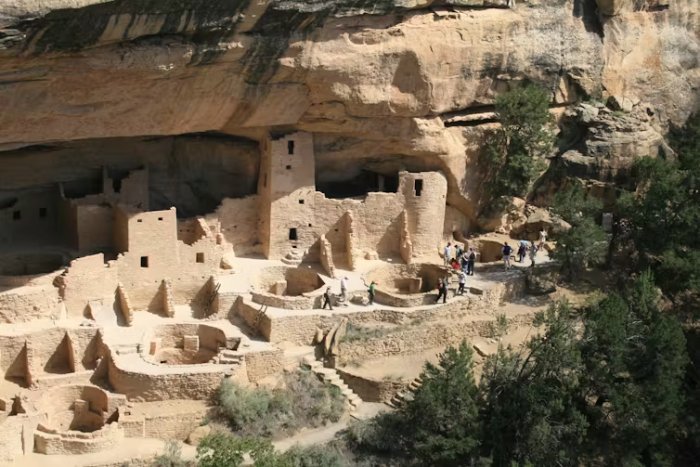
Puebloan cliff dwellings at Mesa Verde offered protection from the elements and, because of their orientation, protection from direct Sun in summer. Andreas F. Borchert, CC BY-SA
The Puebloans in what today is the U.S. Southwest used small windows, materials such as mud brick and rock, and designed buildings with shared walls to minimize the heat getting in.
They also understood the importance of solar orientation. The ancient Puebloans built entire communities under the overhang of south-facing cliffs. This orientation ensured their buildings were shaded and stayed cooler during the summertime but received sunlight and radiated heat to stay warmer during the wintertime.
Their descendants adopted similar orientation and other urban-planning strategies, and adobe homes are still common in the U.S. Southwest.
Muslim caliphates: Using every drop of rain where it falls
Modern water management is also rarely designed for dry climates. Stormwater infrastructure is created to funnel runoff from rainstorms away from the city as fast as possible. Yet, the same cities must bring in water for people and gardens, sometimes from faraway sources.
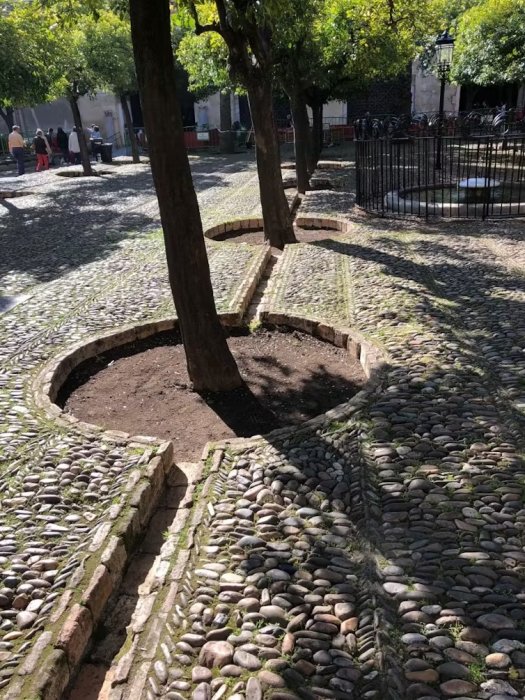
Landscaping in the Mosque of Cordoba, Spain, was designed to funnel rainwater where needed for irrigation. Adriana Zuniga
During the eighth century, the Muslim caliphates in arid lands of northern Africa and the south of Spain designed their buildings with rainwater harvesting techniques to capture water. Runoff from rainfall was collected throughout the roof and directed to cisterns. The slope of the roof and the courtyard floor directed the water so it could be used to irrigate the vegetated landscapes of their courtyards.
Modern-day Mendoza, Argentina, uses this approach to irrigate the plants and trees lining its magnificent city streets.
Mayans and Teotihuacans: Capturing rainwater for later
At the city scale, people also collected and stored stormwater to withstand the dry season.
The ancient Teotihuacan city of Xochicalco and many Mayan cities in what today is Mexico and Central America used their pyramids, plazas and aqueducts to direct stormwater to large cisterns for future use. Plants were often used to help clean the water.

Large cisterns like this one in Xochicalco, a Teotihuacan community in what is now Mexico, were used to capture and store rainwater. Adriana Zuniga
Scientists today are exploring ways to store rainwater with good quality in India and other countries. Rainwater harvesting and green infrastructure are now recognized as effective strategies to increase urban resilience.
Putting these lessons to work
Each of these ancient cultures offers lessons for staying cool in hot, dry climates that modern designers can learn from today.
Some architects are already using them to improve designs. For example, buildings in the northern hemisphere can be oriented to maximize southern exposure. South-facing windows combined with shading devices can help reduce solar radiation in the summer but allow solar heating in winter. Harvesting rainwater and using it to irrigate gardens and landscapes can help reduce water consumption, adapt to drier conditions and increase urban resilience.
Retrofitting modern cities and their glass towers for better heat control isn’t simple, but there are techniques that can be adapted to new designs for living better in hotter and drier climates and for relying less on constant summer air conditioning. These ancient civilizations can teach us how.
Provided by The Conversation
This article is republished from The Conversation under a Creative Commons license. Read the original article.