Conny Waters - AncientPages.com - Archaeologists have recently focused their study on a beautiful artifact dated to the ancient Etruscan civilization that inhabited Etruria in ancient Italy.

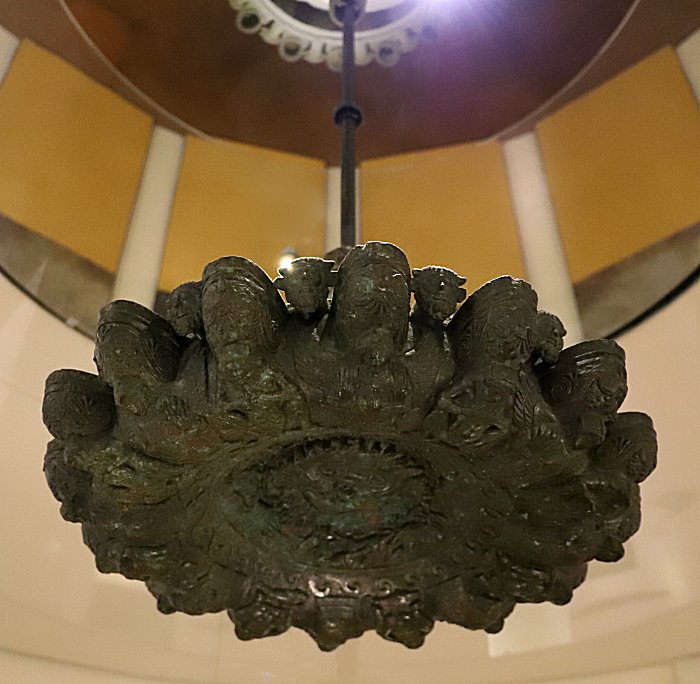
Underside of the bronze lamp of Cortona. Museo dell’Accademia Etrusca e della Città di Cortona (MAEC henceforth), Cortona. Published with the permission of MAEC. (Photo: MAEC webpage, edited by R. Alburz)
This artifact is a large, intricately designed bronze hanging lamp that might have been part of rituals paying homage to the Greek god Dionysus, but it took long time to come up with this conclusion.
The researchers wrote in their paper that the Cortona lamp has a “diameter of 60 cm and weighs 57.72 kg. It was found on 14 September 1840 in an isolated ditch, approximately 2.8 km to the west of Cortona at località La Fratta in central Etruria on land owned by the Cortonese noblewoman Luisa Bartolozzi Tommasi.
The lamp was recovered together with a damaged and inscribed bronze plaque.
For nearly two centuries, many researchers have worked tirelessly to unravel the intricate symbolism of this Etruscan artifact.
For many years it was believed that these figures symbolized the Greek river god Acheloos, usually considered the father of the famous sirens.
The Etruscan lamp of Cortona. Credit: Museo dell'Accademia Etrusca e della città di Cortona
After a comprehensive analysis of literary materials and visual proofs, the researchers concluded that the lamp's decorations probably represent the "thiasos" – a group of devotees associated with Dionysus, the god of wine and festivity.
After thoroughly analyzing literary materials and visual proofs, the team - Ronak Alburz, Ph.D. student and Associate Professor Gijs Willem Tol of the University of Melbourne, Australia, concluded that the lamp's adornments probably represent the "thiasos" – a group of devotees (often dancers, singers) and other followers associated with Dionysus.
The Cortona lamp also contains cosmic symbolism, which has been observed but not fully understood by earlier researchers.

Dionysos and his thiasus. Upper tier of an Attic black-figure krater-psykter. Credit line: 1998 purchaded. Musée du Louvre - Public Domain
Therefore, the recent analysis of the artifact represents a visible depiction of the mysteries' cosmos. The lamp dated to the Late Archaic period (ca. 480 BCE) is a representation of the mysterious cosmos, featuring Dionysus, the sun god, in each of the sixteen segments of the Etruscan sky. It symbolizes the god’s journey through the alternate universe's outermost region.
The Cortona lamp was likely linked to the secretive Dionysus cult. The lamp's design portrays a Dionysian thiasus, possibly participating in a ritualistic act within the mystical universe in honor of Dionysus, according Alburz, the lead author of the study.
Paper: “A Re-Evaluation of the Iconography of the Etruscan Bronze Lamp of Cortona” Etruscan and Italic Studies, 2024. doi.org/10.1515/etst-2023-0019
Written by Conny Waters - AncientPages.com Staff Writer