Conny Waters - AncientPages.com - A new study conducted by researchers from the Universitat Autònoma de Barcelona (UAB), the Barcelona Supercomputing Center (BSC-CNS) and Pompeu Fabra University (UPF) reveals that the characteristic “high-bottomed vessels” of post-Talayotic Menorca contained mainly dairy products.
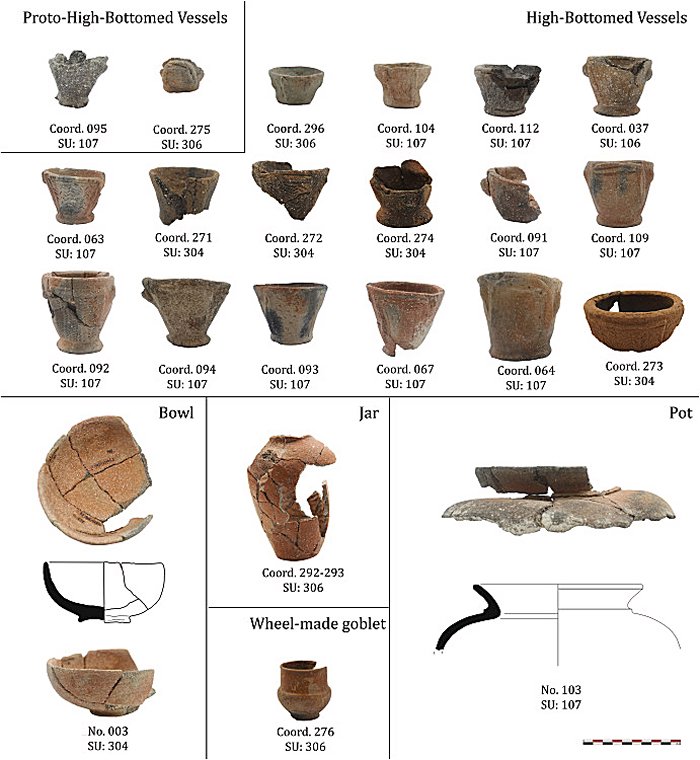
Composition of all the ceramic vessels from the original use levels analyzed in the study, including their ID/Coord. number and the stratigraphic unit (SU) to which they belong. Image source
Other long-standing local ceramic forms also included truncated-conical vessels (TCV), alongside locally produced vessels inspired by other cultures because, in the Late Iron Age, or Post-Talayotic period, over 2000 years ago, Menorca and the other Balearic Islands became increasingly connected to the wider Mediterranean.
Researchers also report the first evidence of wine in funerary rituals on the island, served exclusively in locally produced but foreign-inspired vessels. Despite many changes brought by new trade contacts, Menorcan society continued local funerary traditions, such as burying loved ones in rock-cut tombs or artificial caves. Maintaining a distinct cultural identity was important to the society.
Some of these caves had courtyards outside the burial chambers, where people may have left animal offerings, while perishable foods or liquids were placed in containers such as high-bottomed vessels. To date, researchers have not been able to determine what was inside these ceramic containers.
Foreign ceramic vessels, which Menorca's people used for wine that reached the island through trade networks.
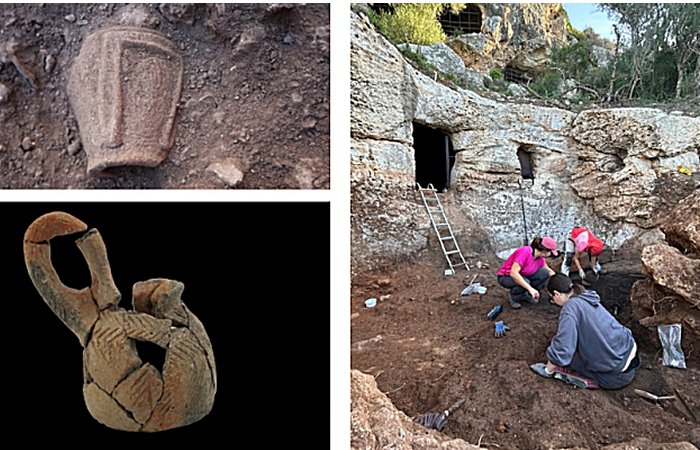
Left: Top, High-bottomed vessel recovered during the 2023 excavation campaign. Bottom: A small, single-handled jar, an object of “inspiration” in which traces of wine were identified. Right: View of the archaeological excavation of the western half of the courtyard of cave no. 45 in the 2024 campaign. Credit: Sònia Carbonell and Margalida A. Coll.
“The introduction of wine does not appear to imply a replacement of local traditions, but rather an adaptation of those elements to their own cultural codes, which highlights the persistence and reaffirmation of a distinct cultural identity in a context of contacts and exchanges,” said Sònia Carbonell, a researcher at the BSC-CNS and co-author of the study. She also
As for milk, the team noted a small, globular-bodied vessel with a pouring spout—previously linked to infant burials in Ibiza—that served as a baby bottle.
"This baby bottle speaks to us of child-rearing and care: of people feeding infants, and of practices that were also incorporated into funerary rituals," explains Margalida Coll, a researcher at UPF and co-author of the study.
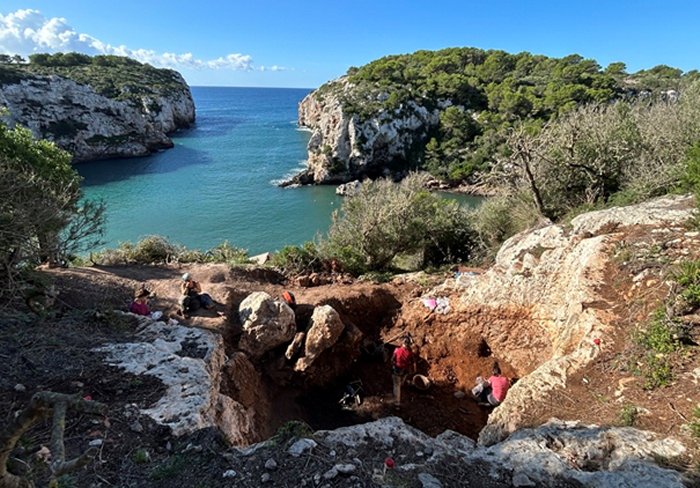
Excavations done at cave no. 45 of the Calescoves site- a sepulchral complex in Alaior, dated to the 4th through 1st centuries BC. Image credit: Sònia Carbonell and Margalida A. Coll.
The high-bottomed vessels found on the island of Menorca are handmade ceramic pieces. Each has its own particularities in dimensions and decoration, but they all share common features, such as a raised base and a decorated cartouche with plant or geometric motifs.
See also: More Archaeology News
They have been documented in various archaeological contexts, both ritual (table sanctuaries) and domestic (in houses, known as “circles”), but they appear most often in funerary contexts.
Were they perhaps a local adaptation of the incense burners documented in the Punic-Hellenistic world? Or were they crafted by specific individuals, so their deposition in funerary contexts could reflect a certain expression of individuality?
Written by Conny Waters - AncientPages.com Staff Writer