Jan Bartek - AncientPages.com - For several years, archaeologists have explored underwater sites in Lake Arendsee in the Altmark region of northern Saxony-Anhalt, Germany. They have found Neolithic fish weirs, a high medieval barge, and a late medieval dugout canoe, all of which have drawn considerable interest.
Mesolithic Discoveries
In the summer of 2026, researchers from the State Office for Heritage Management and Archaeology (LDA) Saxony-Anhalt made another important discovery at the lake. The new artifacts are about 10,500 years old, from a time when people hunted, gathered, and fished rather than lived in permanent settlements. This era, called the Mesolithic or Middle Stone Age, included the shaman of Bad Dürrenberg, and now there is proof that people were already living along the shores of Lake Arendsee.
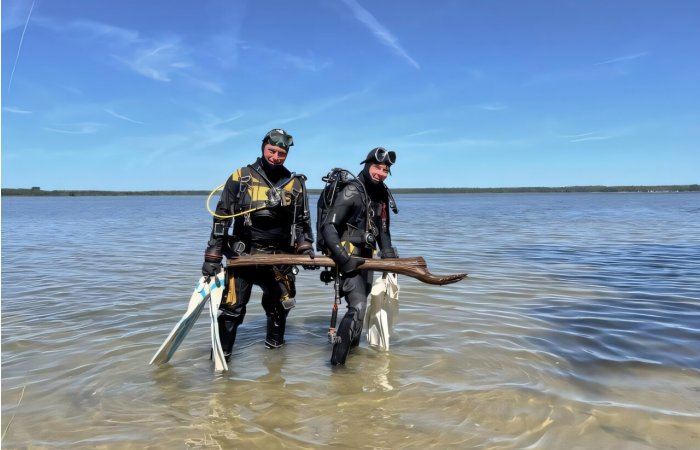
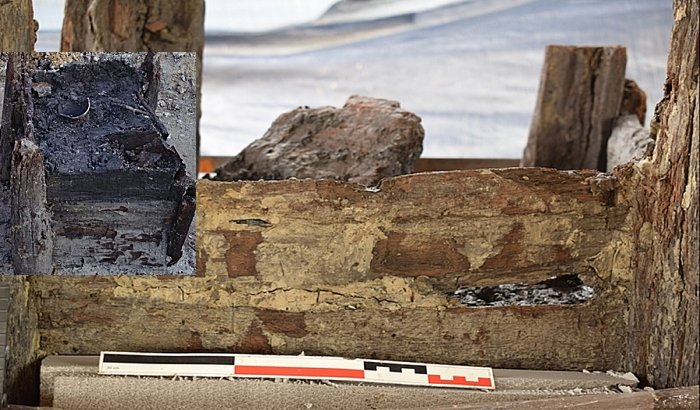
Researchers from the State Office for Heritage Management and Archaeology Saxony-Anhalt recovered Mesolithic wood. Credit: Juraj Lipták / State Office for Heritage Management and Archaeology Saxony-Anhalt
A unique geological feature of the lake has kept traces of settlements and the old shoreline in very good condition. While most inland lakes slowly fill with silt, the bottom of Lake Arendsee is sinking because of a salt dome underneath. This means that Mesolithic artifacts now lie under a thin layer of sediment about 20 meters (66 feet) deep and are very well preserved.
"Besides the usual finds from this period, such as stone tools or animal bones, our divers were able to recover spectacular pieces of wood, which have very rarely survived from this era," explains state archaeologist Harald Meller. "The finds shed a completely new light on the Mesolithic period, for which traces of buildings in central Germany have so far only been known in the form of soil discolorations." According to initial findings, a post 1.60 meters (5.2 feet) high, with felling marks and split boards up to 1.30 meters (4.3 feet) long, could be a remnant of an architectural structure.
Possible Buildings Predate The First Farmers
"Whether we are looking at the remains of huts or other, previously completely unknown wooden structures is the subject of ongoing and future research. If permanent buildings or intensively cultivated living spaces already existed 10,500 years ago—that is, 3,000 years before the arrival of the first farmers with their longhouses in Central Europe—this would have far-reaching consequences not only for our understanding of hunter-gatherers, but also for the origins of modern cultural landscapes," explains Marcel Weiß, project head for the LDA Saxony-Anhalt. "Underwater archaeology at Lake Arendsee offers a unique opportunity to learn about the roots of our modern world."
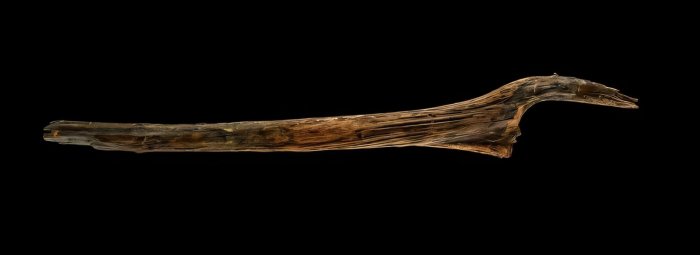
A wooden post about 1.60 meters high, found in Lake Arendsee and bearing traces of felling and working, could have been a supporting element of a Mesolithic structure. Credit: Juraj Lipták / State Office for Heritage Management and Archaeology Saxony-Anhalt
So far, researchers have linked the major shift from natural environments to cultural landscapes to the first farmers who moved to central Germany around 5500 B.C.
DNA Study Sheds New Light On The Mysterious 9,000-Year-Old Shaman Burial In Bad Dürrenberg
Bad Dürrenberg Shaman’s 9,000-Year-Old Spectacular Headdress And Another Surprising Discovery
Evidence Of 9,000-Year-Old Flowers In Bad Dürrenberg’s Shaman Burial
After finding the site in spring 2026, researchers gathered more samples and artifacts to learn about its size and age. Next, together with the Fraunhofer IOSB-AST in Ilmenau, they used an underwater robot to scan the area with sonar and map the old shoreline. By noting where each item was found, the team can spot possible archaeological sites and plan future underwater research.
See also: More Archaeology News
"The support of underwater work with state-of-the-art technologies developed at the Fraunhofer Institute in Ilmenau is invaluable for archaeology," says Sven Thomas, diving operations manager for the LDA Saxony-Anhalt at Lake Arendsee.
The spectacular finds from 10,500 years ago in Lake Arendsee promise new insight into the time of the famous shaman of Bad Dürrenberg, who is currently the focus of a special exhibition, "The Shaman," at the State Museum of Prehistory Halle (Saale).
Source: State Office for Heritage Management and Archaeology Saxony-Anhalt
Written by Jan Bartek - AncientPages.com Staff Writer