
Bayeux Tapestry May Have Served As Monks’ Mealtime Reading, New Study Suggests
Conny Waters - AncientPages.com - The Bayeux Tapestry is an extraordinary example of medieval embroidery, stretching approximately 68 meters (224 feet) in length and weighing around 350 kilograms.
It vividly illustrates the events leading up to and including the Battle of Hastings in 1066, when William II of Normandy invaded England and overthrew Harold II. Next year, this historic artifact will be exhibited at the British Museum—a significant event as it marks the first time the Tapestry has returned to the UK since its creation nearly a millennium ago.
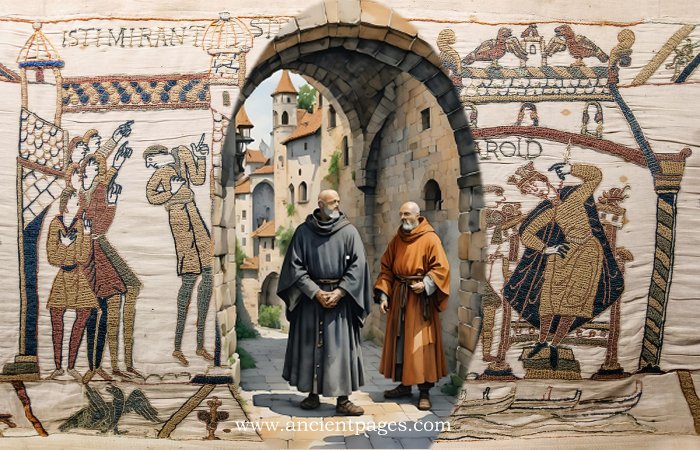
While much is known about its dimensions, subject matter, and historical significance, questions have long remained about its original purpose. In a recent study, Professor Benjamin Pohl from the University of Bristol's Department of History explores this enduring mystery. He considers various possible locations for which the Tapestry may have been intended, most notably suggesting that it could have been designed for display on the walls of St Augustine’s Abbey’s refectory in Canterbury.
In such a setting, he proposes that monks might have used its narrative as a moral or historical reading during their meals. This new perspective offers valuable insight into one of history’s most fascinating artifacts.
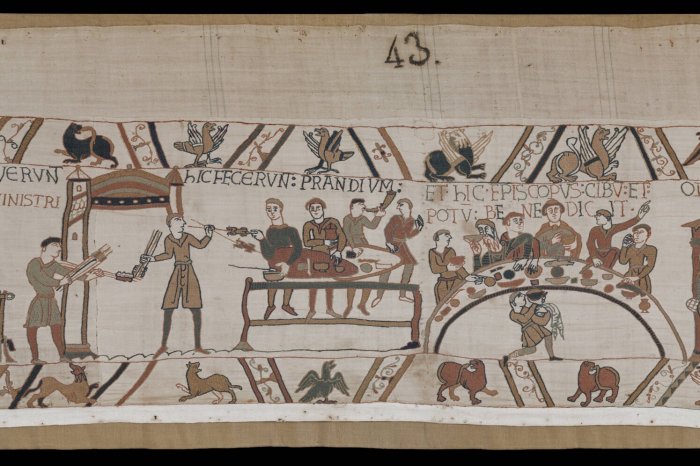
A scene from the Bayeux Tapestry that shows a medieval dining scene involving Bishop Odo. Credit: Wikimedia Commons
As with the debates surrounding the origins of the Bayeux Tapestry, there are various theories regarding its possible locations before its first documented appearance at Bayeux Cathedral in a 1476 inventory. Scholars continue to explore where the tapestry may have been displayed before this recorded date, but no definitive evidence has yet emerged.
"The truth is: we simply do not know where the Bayeux Tapestry was hung—or indeed if it was hung anywhere at all—prior to 1476. My article offers a new explanation by arguing that the most suitable place for displaying and engaging with the Bayeux Tapestry would have been in the monastic refectory of St Augustine's during mealtimes," Professor Pohl said.
This idea began during a seminar where students examined the Bayeux Tapestry and assessed theories about its origins and display locations, including St Augustine's and others. They explored alternative possibilities, considering various monastic spaces besides the main abbey church—such as the dormitory, chapter house, and refectory—that could have housed the artifact.
"The more we talked about this, the more I wondered whether a refectory setting could help explain some of the apparent and puzzling contradictions identified in existing scholarship: for example, was the Bayeux Tapestry intended for a religious or a secular audience? Did this audience have to be literate in order to engage fully with the artifact and its narrative? Does it tell an English or a Norman story, or both/neither?

There are no actual architectural remains of St. Augustine's Norman refectory, but this photo shows the area where it would have once stood. Credit: Wikimedia Commons
Many, and perhaps all, of these conflicts and contradictions can be resolved by embracing the refectory setting proposed in my new article. To be clear: we have no concrete evidence of the Bayeux Tapestry's presence at St Augustine's, though this may well be due a combination of circumstances which meant that the abbey's new refectory, designed in the 1080s—perhaps specifically to exhibit the Tapestry—was not completed until the 1120s." Professor Pohl said.
He further explained that, as a result, the Tapestry may have been stored away for over a generation and forgotten until it resurfaced in Bayeux three centuries later. To this day, there is no definitive proof of the Bayeux Tapestry’s location before 1476, and such evidence may never be found. However, the information presented here positions the monastic refectory of St Augustine’s as a strong possibility.
See also: More Archaeology News
In medieval times, as today, mealtimes were significant events for socializing, reflection, hospitality, entertainment, and the reinforcement of communal identities. Within this context, the Bayeux Tapestry would have been well-suited to such an environment.
The study was published in the journal Historical Research
Written by Conny Waters - AncientPages.com Staff Writer
More From Ancient Pages
-
 Beautiful 2,300-Year-Old Gold Ring Found In The City Of David
-
 Trolls – Fascinating Mythical Creatures Of Scandinavia
-
 Italian Sailors Knew Of America 150 Years Before Christopher Columbus – Ancient Documents Reveal
-
 Underground City And Pyramid Discovered At Tiahuanaco, Bolivia
-
 World’s Oldest Fairy Tale – The Smith And The Devil Has Survived For Several Millennia
-
 Mysterious Great Pyramid Of China: Almost Totally Unknown Even To Most Chinese
-
 Researchers Provide New Insights On The Evolution Of Ancient Egypt’s Karnak Temple
-
 Mystery Of Ancient Carved Shiva Lingas In India And Cambodia
-
 World’s Earliest Evidence Of Food Fermentation Discovered In Southern Sweden
-
 New Insight Into Genetic History And Social Structures In Neolithic And Bronze Age Croatia
-
 Never-Ending Battles Between God Ra And Indestructible Apophis In Ancient Egyptian Beliefs
-
 Biblical City In Zanoah Offers Archaeological Evidence Of Moses’ Journey To The Promised Land
-
 Discovery Of Camouflaged Ancient Stone Chest In Egyptian Temple May Reveal Hidden Royal Tomb – Who Is Buried Near Hatshepsut’s Temple?
-
 Mysterious High-Energy Particles Detected In Antarctica – Evidence Of Ancient Nuclear Technology Or Something More Frightening?
-
 Mysterious Melchizedek: ‘King Of Righteousness’ And Heavenly High Priest In Bible And Dead Sea Scrolls
-
 The Untold Story Of Sacsayhuamán – Falcon’s Place Is Not What It Seems
-
 Major Discovery Reveals Neanderthals In Italy Engaged In Plant Food Processing
-
 Romans Were Early Pioneers Of Recycling – New Evidence Reveals
-
 Lost Kingdom Of Idu And Its Seven Unknown Kings
-
 Scientists Reconstruct The Climate Of The Ancient World Using Small Wooden Artifacts And Mummies

