
Munkholmen: Island With Intriguing Yet Dark And Scary History
Ellen Lloyd - AncientPages.com - A place must not be of great size to have a long and rich history. Munkholmen is certainly proof of that. Located in the Trondheim fjord, Norway, Munkholmen is today a beautiful small island and a popular tourist destination. However, this was by no means the case in the past.
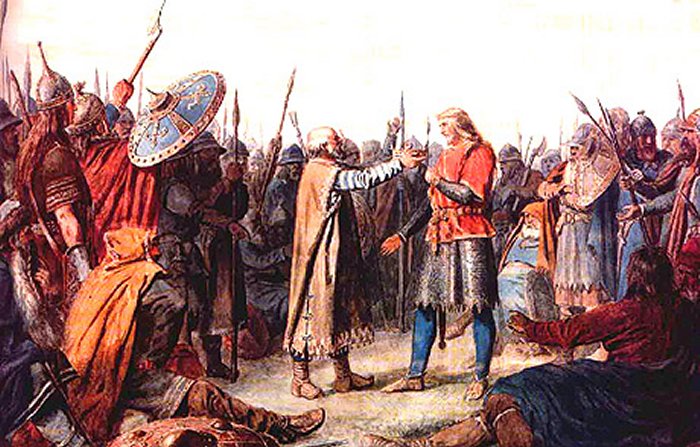
Olav Tryggvason becomes king of Norway. Painting 1860 - credit: Peter Nicolai Arbo (1831–1892)
Most wanted to avoid visiting Munkholmen at all costs. The small island has an intriguing yet dark and scary history.
Heads On Stakes As Warning To Enemies
Before the 12th century, Munkholmen was used as the Court. of Justice. It was also the central place for execution. Heads of enemies of the state were placed on stakes as a warning to potential enemies. Among them were also heads of Haakon Sigurdsson and Tormod Kark to warn visitors. It happened by order of the Viking King of Norway, Olav Tryggvason.
According to legends, those who visited the island must spit on the heads to pay tribute to King Olav Tryggvason. The tradition of displaying severed heads on stakes continued for some years. What changed was that the heads of criminals and political enemies were placed to face the city of Trondheim instead.
It was considered an efficient method to deter citizens from committing crimes.
One Of The First Monasteries In Scandinavia
Later, a monastery was established on Munkholmen, but who came up with the idea is a question of historical disagreement.

Munkholmen fortress, in the Trondheim Fjord, Norway. Image source
According to English sources, King Cnut the Great established the monastery in 1028.
Suppose we rely on Norwegian and Icelandic sources. In that case, we learn that it was one of Magnus Berrfot's men, Sigurd Ullstrengson, the founder of Holm (Nidarholm) monastery in the early 12th century. This monastery was part of the Cluniac order and worshipped Saint Benedict and Saint Lawrence.
With a monastery on the island, one would think the bloody history of Munkholmen had ended. However, this was not the case.
The island continued to be used for keeping prisoners. King of Norway Magnus IV Sigurdsson (ca. 1115-1139), also known as Magnus the Blind, was captured and placed on Munkholmen as a prisoner between 1135 and 1137. Later, he joined the monastery as a monk.

A lighthouse was later built. Image credit: Aslak Raanes from Trondheim, Norway - CC BY 2.0
The monastery on Munkholmen was one of the first monasteries in the Nordic countries. However, it was damaged by fire on several occasions in 1216, 1317, and 1531.
Sometimes, people who tried to escape the prosecution of the Reformation fled to Munkholmen and hid in the monastery, but they always had to surrender in the end.
An Impressive Fortress
Following the Swedish siege of Trondheim in 1658 and the city's reconquest by Danish and Norwegian troops the following year, a fortress was erected on Munkholmen.
The fortress was completed in 1707, and much of it has survived until today.
In the 17th and 18th centuries, the island was used as a State Prison.

Munkholmen Image credit: Trondheim
Those who were transported to Munkholmen were, in most cases, political prisoners. The most famous who served time here was Peder Griffenfeld, a Danish statesman who was imprisoned on Munkholmen for 18 years. Urban legends tell the ghosts of those who died still haunt this place.
Today, when you set foot on the island, you will find a lovely beach, a restaurant, and a café, but the place is of great historical importance, and one is constantly reminded of the events that took place there.
Written by Ellen Lloyd – AncientPages.com
Updated on September 7, 2024
Copyright © AncientPages.com All rights reserved. This material may not be published, broadcast, rewritten or redistributed in whole or part without the express written permission of AncientPages.com
More From Ancient Pages
-
 Ancient Cave Church Complex In Basarabi, Romania
-
 7,000-Year-Old Unique Lipnik Idol Statuette Unearthed In Moravian Gate Valley, Czech Republic
-
 Roman Woman Depicted On Ancient Marble Sculpture Found In Crimea Identified
-
 2,500-Year-Old ‘Dragon Bed’ Restored By Chinese Archaeologists
-
 Large Underwater Site That Was Home To 500,000 People About 14,000 Years Ago Identified Northwest Of Australia
-
 Unique Statue Of Roman Emperor Trajan Unearthed In Ancient City Of Laodicea,Turkey
-
 4,000-Year-Old ‘Woodhenge’ Discovered In Denmark Is An Extraordinary Find!
-
 On This Day In History: Battleship USS Maine Explodes And Sinks – On Feb 15, 1898
-
 Modern Pesticide Accelerates Corrosion Of Ancient Roman Bowl
-
 Mysterious 70-Million-Year-Old Underground Village And Magnificent Tower Of Eben-Ezer In Belgium
-
 Unexplained Dangerous Secret In The Great Smoky Mountains
-
 TB Was Transmitted in South America – DNA Study Shows How It Happened
-
 Mystery Of The Blue Blood Gods: Why Did They Have A Different Blood And Skin Color?
-
 Zagros Mountains: Home To Tribes, Kingdoms And Empires For Thousands Of Years
-
 Identity Of The Shining Ones – One Of The Greatest Secrets Ever Kept From Mankind
-
 Impressive Ancient Underground Tombs And Chapels Unearthed In Saqqara, Egypt
-
 What Can Languages And Grammar Reveal About Our Ancient History?
-
 Yakhchals: Ingenious Ancient ‘Refrigerators’ Could Store Ice In The Hot Desert
-
 ‘Saimaluu-Tash’ Time Capsule: Largest Millennia-Old Collection Of Petroglyphs In Central Asia
-
 On This Day In History: Simon Fraser – The Last Man In Britain To Be Executed On Tower Green, London – On Apr 9, 1747

