
Sirens: The Secret Of The Power In Their Captivating Song That Heralded Death
A. Sutherland - AncientPages.com - Usually, the Sirens were considered daughters of the river god Achelous, either by the Muse Terpsichore, Melpomene, Calliope, or by Sterope, daughter of King Porthaon of Calydon.
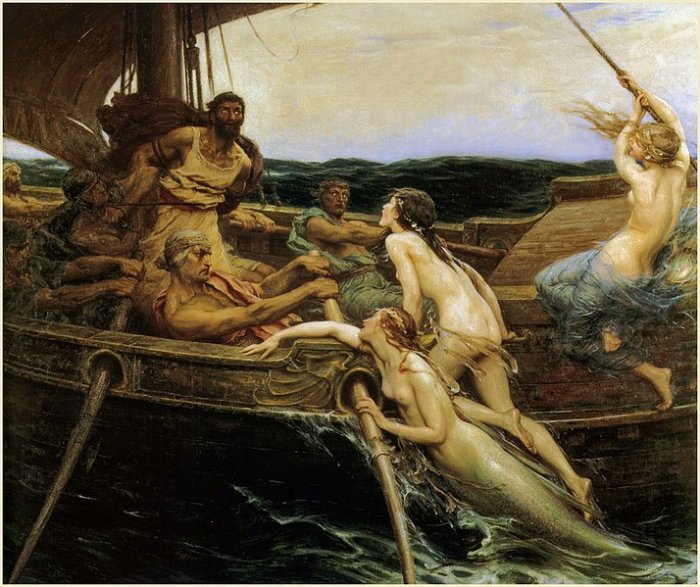
Ulysses and the Sirens. Herbert James Draper (1863–1920). Image uploader: Fanfwah - Public Domain
Their number is variously reported from two to eight. These creepy and not particularly beautiful mythological creatures initially had bird features, including feathered wings, clawed feet, and occasionally sparrow-like tails.
'Some say that the Sirens, who had lost their wings as a result of an unsuccessful singing contest with the Muses, sponsored by Hera, committed suicide because of their failure to outcharm Orpheus; yet they were still on their island when Odysseus came by a generation later...' 1
As time went on, the Sirens had fishtails and upper human bodies, and they were described and painted as beautiful young women. They came to be depicted with looks to match their wonderful voices, their temptations therefore magnified.
Where did these fascinating creatures come from? Their origin varies from source to source, but they tend to be claimed as the daughters of one god or another, with the sea god Phorcys or river god Achelous both contenders. Angels or women who stray from the path of righteousness were also linked with sirens and were said to be doomed to become one on the Day of Judgement.
In ancient Greek mythology, their image is undoubtedly appealing but also ruinous. According to one version of the story, searching the sea floor around their island would turn up ships wrecked as they made attempts to come closer to the Sirens.

Odysseus and the Sirens. Detail of an Attic red-figure stamnos by the Mermaid Painter (eponymous vase), circa 480-470 BC. AD Provenance: Vulci. Credit: British Museum; Image uploader: Jastrow - Public Domain
Few stories even describe the creatures as physically attacking humans, or perhaps their captivating song had dramatic consequences for sailors. Did they try to lure sailors to their deaths? Could it be another motif behind their enchanting song?
Was their song a kind of revenge, or perhaps it symbolized grief?
The sirens were exiled to a small, flowery, but lifeless islet of Anthemoesse, where they were forced to live alone. The sirens were usually seen on the sharp rocks off the coast. Possibly, they used their song as revenge for their unhappy life and all the wrongdoings committed against them.
As a result, they could become monsters and destroy the others' lives. Were the Sirens lonely, so they tried to attract men to accompany them on the island? Could it work with the help of an amazing song?
Sirens were almost always found at sea. Perhaps this is because sailors become defenseless in vast water realms and, therefore, more easily affected by the charms of sirens.
It is said that Anthemoessa was found covered with human remains; however, no sign that the mythical sirens killed these people was ever seen.

D. W. Waterhouse , Odysseus and the Sirens , 1891 - Public Domain
The sailors could die of starvation because their ships were destroyed in the area. In one account, Anthemoessa was the island home of the Sirens. Still, in others, their home was associated with the Sirenuse islands near Paestum, the island of Ischia, or Capri, located in the Gulf of Naples.
All these locations were described to be surrounded by dangerous cliffs and rocks and exposed to storms and strong winds.
Supernatural Abilities Of The Sirens
The Sirens had the ability to turn into beautiful and captivating temptresses.
Their delightful voice caused the sailors to be totally bewitched. Forgetting everything, the men crashed on the rocks.
In his "Seers, shrines and Sirens," American researcher John Pollard writes that the works of art often have demonstrated the connection of sirens with various symbols. These symbols are preserved in literature, not counting the depictions of sirens on ancient tombstones. The sirens are associated with Odysseus and his companions, often depicted next to Theseus, Dionysus, Artemis, and Athena.

Damaged siren sculpture. Athens, 370 BC e. Image credit: Marsyas - CC BY 2.5
These creatures were almost always depicted as females. However, in earlier times, they had beards, heralding death and leading to death. They even caused mysterious pleasure caused by their singing.
Traveling to Ithaca, Odysseus must have passed by the island, the seat of the mermaids. But he knew what danger lurked in these hellish seductresses. So he ordered his companions to cover their ears with wax so they would not hear the siren singing; thus, they were not susceptible to his charm.
However, Odysseus himself decided not to waste his only chance. He ordered himself to be tied with strong naval lines to the mast and ordered that no one under no circumstances tried to untie him. At least he begged for it. As the boat drifted closer, the sirens began their deadly chant.
However, no one heard anything. Odysseus, at this time, was tearing up and struggling horribly. He shouted and ordered it to be removed. But no one listened to him. Thanks to this trick, a group of travelers avoided this mortal danger. Odysseus, on the other hand, could be proud that he was the only living man to hear the wonderful siren singing.
Written by – A. Sutherland - AncientPages.com Senior Staff Writer
Copyright © AncientPages.com All rights reserved. This material may not be published, broadcast, rewritten or redistributed in whole or part without thexpress written permission of AncientPages.com
Expand for referencesReferences:
- Graves, Robert. The Greek Myths
Pietro Pucci, The Song of the Sirens and Other Essays
Kopaliński W: Słownik mitów i tradycji kultury.
More From Ancient Pages
-
 Paleolithic Cave Dwellers And Light They Could Get In Darkness
-
 Why Was Lovesickness A Feared Disease During The Middle Ages?
-
 Last Of The Giant Camels And Archaic Humans Lived Together In Mongolia Until 27,000 Years Ago
-
 Hunter-Gatherers Used Open Habitats Millennia Before Stonehenge Monuments Were Built
-
 Amazing Archaeological Discovery In Washington Confirms Thousand-Year-Old Legend
-
 Ancient Syriac Epitaphs Discovered In Tomb Of Priest Monoha Shed New Light On The Assyrian Empire
-
 University Of Warsaw Archaeologists Return To Study Large Ancient City Of Ptolemais
-
 Colosseum-Like Structure Unearthed In 2700-Year-Old Ancient City Of Mastaura
-
 Reliefs And Engravings Of Celestial Bodies And A Zodiac On Walls And Ceilings Of Luxor’s Esna Temple
-
 Mysterious Ancient Inscriptions Never Meant To Be Read – Biblical Secrets Revealed
-
 Queen Mama Ocllo: Legendary Wife Of Sapa Inca Manco Capac In Beliefs Of Andean People
-
 Archaeological Mystery – Why Has Only One Such Puzzling Ancient Object Been Found In Norway?
-
 Rare Phoenician Necropolis Discovered In Andalucia, Spain Is Extraordinary, Scientists Say
-
 Leonardo da Vinci’s 280-Meter Long Bridge Design – Tested
-
 Sarcophagus Of Pharaoh Ramesses II Found In Abydos, Egypt
-
 Re-Writing History Of England’s Domesday Book Of William I The Conqueror
-
 Unique Early Alemannic Chamber Grave Discovered In Gerstetten, Germany
-
 Why Was Napoleon Bonaparte Defeated At Waterloo?
-
 Remains Of A Roman Ship Discovered In Serbia
-
 Mummified Crocodiles Provide Insights Into Mummy-Making Over Time

