
Well Of Urd (Urdarbrunn): Abode Of Fate Goddesses And Powerful Symbol In Norse Beliefs
A. Sutherland - AncientPages.com - In Norse mythology, Hvergelmir (located in Niflheim) is a "bubbling boiling spring."
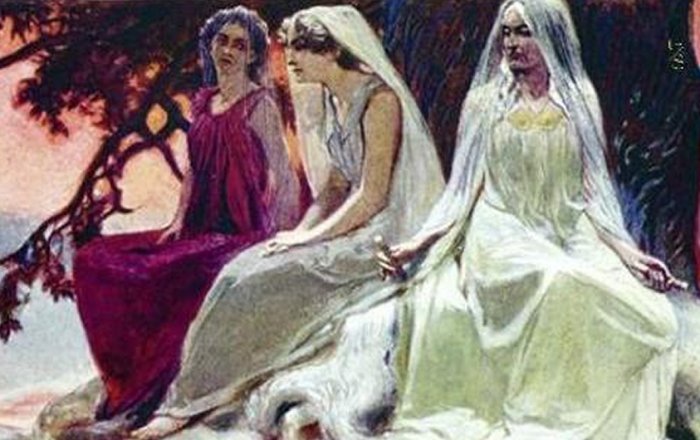
The Norns and the World-Ash. Image credit: Carl Emil Doepler, Jr. (1905) - Public Domain
According to Prose Edda, the spring is one of the three significant springs at the primary roots of the cosmic tree Yggdrasil. Ancient fairy tales in Norse mythology say that this fantastic sacred ash tree had three roots, which sucked water from three different sources.
The other two crucial sources of Yggdrasil's well-being are Mímisbrunnr (Mimir Well) and Urðarbrunnr (Well of Urd, also known as Well of Fate), inhabited by the Norns.
Mímisbrunnr (Mimir Well) keeps wisdom and understanding of the world. The well and Mimir's abode are located beneath the second root of Yggdrasil. Mimir is an enigmatic figure in Norse beliefs, and it is unclear if he is a god or one of the giants. However, he has to guard the well, drink from it daily, and gain wisdom from this source.
The Hvergelmir spring and Mimir Well are sacred, as is the 'Well of Urd' (Urdarbrunnen), a holy place at the base of the sacred ash, Ygdrassil.
The Norns Have Done Both Good And Evil In This World
The three Norns are spinning goddesses and likely live near the sacred 'Well of Urd' in a magnificent hall. They probably originate from a 'dis,' a female ghost or spirit associated with Fate who can be benevolent or hostile.
Norns and Valkyries are sometimes called the so-called 'diser' that have some connection with Fate, and mortals can never avoid it.
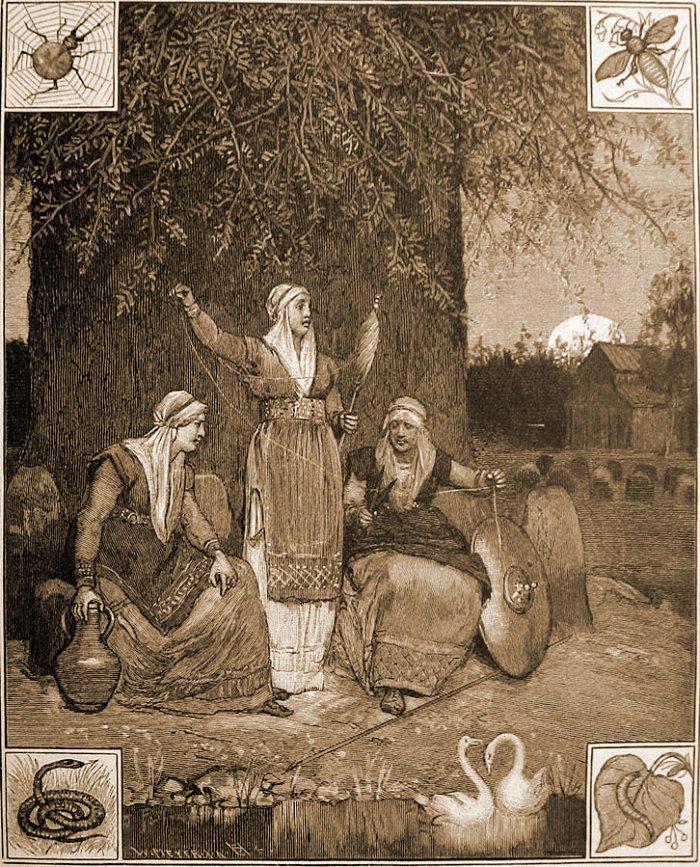
The trio of Norns at the well Urðarbrunnr is depicted in Fredrik Sander's 1893 translation of the Poetic Edda. Wood engraving by L. B. Hansen. PublicDomain
The Norns - three Fate goddesses - are Urd ('Fate'), Skuld ('Being, need/ought to be/shall be'), and Verdandi ('Necessity'), but the origin of the name 'norn' remains uncertain. However, it is reasonable to consider these goddesses in some way connected with the past, present, and future.
In Norse beliefs, they were members of the old fertility family, the Vanir. These ladies devoted all their time to spinning the threads of people's lives, and their job was to take care of people's lives. During the birth of heroes, they made gifts for them or cast curses.
The Gylfaginning (Old Norse: 'The Beguiling of Gylfi') is the first part of the 13th-century Prose Edda and deals with the creation and destruction of the world of the Æsir and many other issues of Norse mythology.
In Gylfaginning, an essential mythological source, it is said that besides the three well-known Norns, others also come to each person at birth to determine his destiny. Some of them are of the race of the gods, others of the Elves or the Dwarfs.
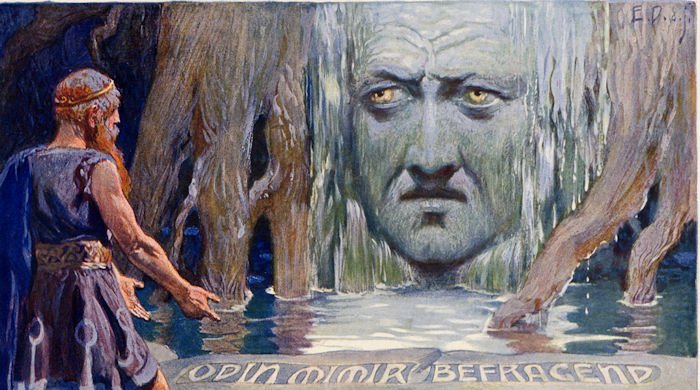
Odin Questions Mimir. Image credit: Carl Emil Doepler, Jr. (1905) - Public Domain
When it comes time for someone to die, they cut off the person's life thread. Sometimes, it gets tangled up, and problems begin in that person's life.
It is worth noting that the Norns have striking and standard features with the Greek and Roman goddesses of Destiny -- the Moirai (Moirae) and the Parcae, the female personifications of destiny who governed the lives and deaths of humans and gods.
Urd spun the thread with the spindle, closely associated with several well-known ancient goddesses, including Frigg and Freya, Egyptian Isis, Greek Artemis, and Athena.
Norse Norns worked with yarns that represented people's lives.
As Mimir's duty was to care for Yggdrasil, the three fate goddesses had to do the same. They draw water and mud from the spring of Urd daily and wet the ash tree, keeping its branches from withering. The water in the 'Well of Urd' was sacred, so everything that entered the source was white. Two swans lived in the Urd spring, and according to an ancient legend, the whole breed of birds once originated from it.
Urdarbrunn - A Powerful Symbol In Norse Mythology
Its waters flowed out at the base of one of the three great roots of the World Tree.
The well contained great powers and was named after Urd, the eldest of the Norns. Perfectly aware of the well's supernatural power, the gods rode their horses to this well each day and sat near the well of Urd, discussing judgment over the world.
The Norns - three Fate goddesses - are Urd ('Fate'), Skuld ('Being, need/ought to be/shall be'), and Verdandi ('Necessity'), but the origin of the name 'norn' remains uncertain. However, it is reasonable to consider these goddesses in some way connected with the past, present, and futur
Written by – A. Sutherland - AncientPages.com Senior Staff Writer
Updated on January 21, 2024
Copyright © AncientPages.com All rights reserved. This material may not be published, broadcast, rewritten or redistributed in whole or part without the express written permission of AncientPages.com
Expand for referencesSturluson, Snorri, Gylfaginning
Baeksted A. Nordiska gudar och hjältar
Barry B. Powell - Classical Myth
Leeming, David. The Oxford Companion to World Mythology
Nicos Walsh - Greek Mythology: Greek Gods Of Ancient Greece And Other Greek Myths
Brate E. Eddan, De nordiska guda- och hjältesångerna
More From Ancient Pages
-
 Intriguing Collection Of Petroglyphs And Dinosaur Footprints Found At The Serrote do Letreiro Site, Brazil
-
 ‘Vandal’ Of Norwegian Viking Graves Identified But Charges Have Been Dropped!
-
 Was 4,000-Year-Old Seahenge In Norfolk Built To Battle Climate Change?
-
 Jars With 2,600-Year-Old Vanilla Remnants Discovered In The City Of David
-
 DNA Study Reveals 250 Siberians Became The First Native American Population
-
 Çatalhöyük – 9,000 Years Ago: Overcrowding, Infectious Diseases, Violence And Environmental Problems Of Early Farmers
-
 3,000-Year-Old Twisted Gold Torc Discovered In Essex
-
 Ancient Monuments The World Is Not Allowed To See – Reason For Denial? – Part 1
-
 First Dream Of The New Year – Japanese Hatsuyume Tradition
-
 Djémila – Lost City Of The Ancient Kingdom Of Numidia
-
 400-Year-Old Documents Reveal Japanese Opium Was Produced For Medical Purposes
-
 Unique Roman Oil Lamp Decorated With A Crafted Mask Discovered In The Netherlands
-
 Mysterious Grave Of King Valdemar IV Atterdag – Will The 600-Year-Old Historical Puzzle Ever Be Solved?
-
 Australia’s First Marine Aboriginal Archaeological Site Questioned
-
 What Can Ancient DNA From Copán Reveal About The Maya Collapse?
-
 Treasure Of 1,753 Roman Silver Coins Accidentally Discovered In Poland
-
 3,200-Year-Old Mycenaean Statuette Sheds New Light On The Hittites
-
 Investigation Of The Elusive Will-o’-the-Wisp Leads To A Surprising Discovery
-
 Meteora – A Sanctuary Of Harmony And Quietness “Hanging” In The Sky
-
 Longstanding Cultural Continuity At Oldest Occupied Site In West Africa – New Study

