
Young Warrior’s Grave Dated To A Sixth Century Unearthed At Langobard Necropolis In Czech Republic
Conny Waters - AncientPages.com - An almost intact skeleton of a young warrior has been unearthed during archaeological excavations in the vicinity of Pasohlávky in the Brno-Country District in the South Moravian Region of the Czech Republic.
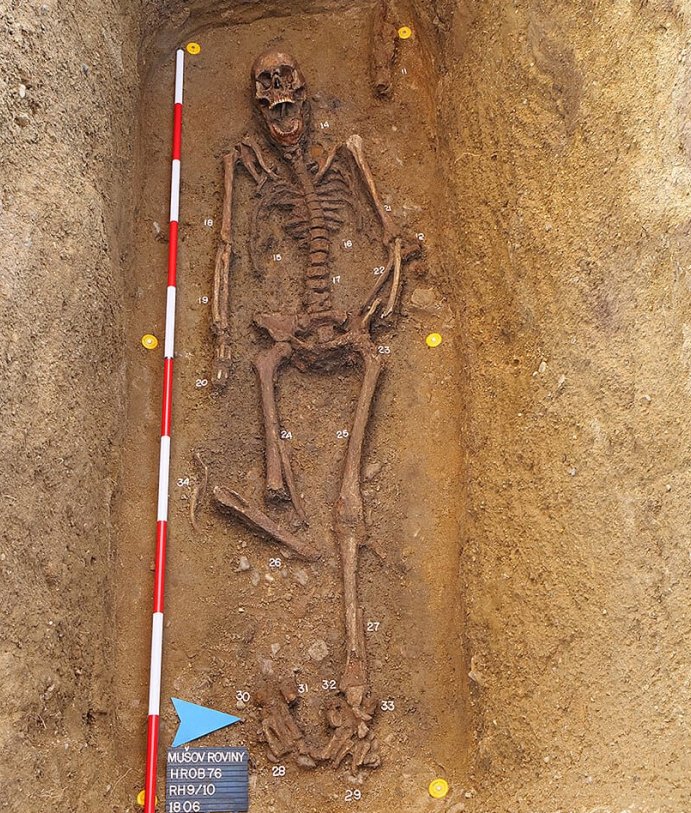
Germanic Langobard burial site | Photo: Zuzana Loskotová, Archaeological Institute of the Academy of Sciences of the Czech Republic. Photo via Radio Prague International
The grave dated to the sixth century contains a skeleton of the man buried with his spear, two dogs, and a horse bridle. The burial place belongs to one of the country's largest Germanic Langobard burial sites. Located on the southern bank of the Nové Mlýny reservoir, this burial ground is dated to the so-called Migration Period on the territory of the Czech Republic, writes Radio Prague International.
The so-called Migration Period was critical in European history, marked by large migration movements that saw the fall of the Western Roman Empire and subsequent settlement of its former territories by various tribes.
This historically significant period (from 375 AD (possibly as early as 300) to the end of 568 AD, refers to the migration, invasion, and settlement of various tribes, including the Franks, Goths, Alemanni, Alans, Huns, the early Slavs, Pannonian Avars, Magyars, and Bulgars within or into the former Western empire and Eastern Europe.
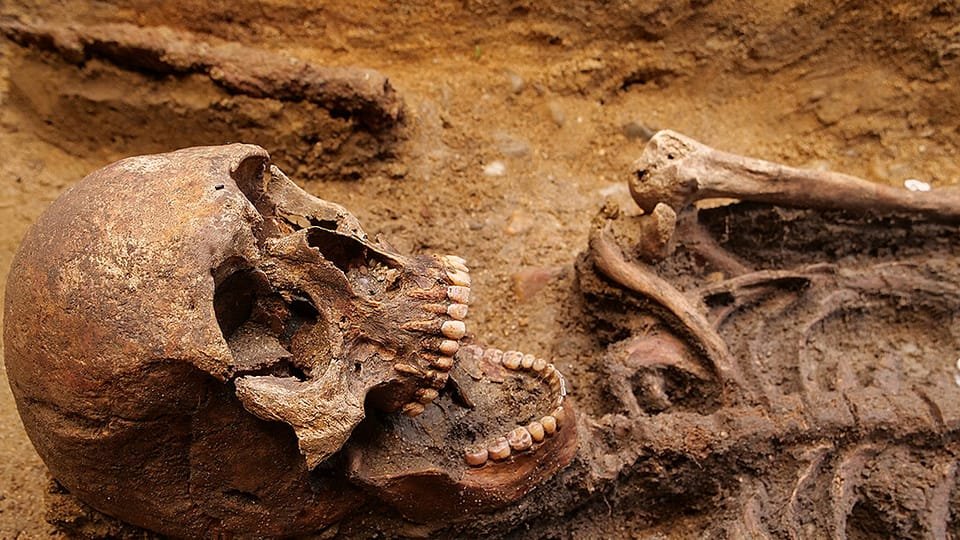
Image credit: Zuzana Loskotová, Archaeological Institute of the Academy of Sciences of the Czech Republic. Photo via Radio Prague International
Excavations at the Langobard necropolis began in May this year and revealed some 250 graves in the area. Archaeologists use geophysical research and aerial photography, and most probably, the total number of graves at the site is much higher.
According to Zuzana Loskotová from the Brno Institute of Archaeology, which is part of the Czech Academy of Sciences, unfortunately, many graves were already looted during the Migration Period.
The grave of the young warrior, unearthed in the vicinity of the Nové Mlýny reservoir, was found exceptionally well-preserved, giving the researchers a unique opportunity to understand better the Langobard population, including their health and eating habits.
"We are undertaking a number of analyses, including strontium analyses, where we can investigate where the inhabitants came from or whether they are of local origin.
"Then there is carbon and nitrogen isotope analyses that might tell us something about the diet of the inhabitants. We will also carry out paleopathological analyses, which looks at what diseases they had and what injuries they suffered during their lifetime."
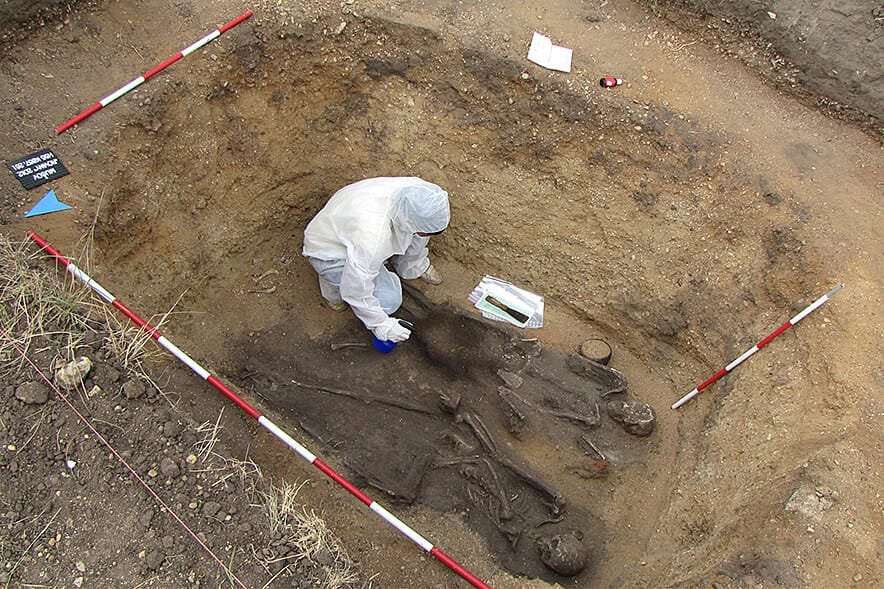
Image credit: Zuzana Loskotová, Archaeological Institute of the Academy of Sciences of the Czech Republic. Photo via Radio Prague International
Balász Komoróczy, director of the Brno branch of the Institute of Archaeology, explained that "all of a sudden, new cultural and ethnic groups appear, and large entities move over a considerable territory of Europe. And at the end of this process, sometimes at the end of the 6th century, practically a new world appears, out of which medieval and even modern Europe is being built."
According to Komoróczy, studying the migrating tribes of the era could help shed light on the processes that led to the disappearance of civilizations and the emergence of new cultures. It can also shed light on the possible causes of migration. He says:
"We can examine, for example, whether it was related to climatic conditions. It is a period in which we can examine phenomena that we do not see in stable eras when populations settle in one place for a long period of time."
The current research of Germanic burial sites in Moravia is part of a larger European project called HistoGenes. The project analyses the genetics of Central and Eastern European populations from the 5th to the 8th century and will contribute more important information about life in early medieval Europe.
Earlier, archaeologists discovered another intact grave of a Langobard warrior also dated to the sixth century. The grave was located in a wooden chamber, and the man was buried with a sword, a spear, and a shield. The Langobard warrior, his horse and a dog lay above him.
Further excavations revealed a large burial ground with over a hundred graves. Most of them, however, had been already looted long time ago. The remaining finds from these graves show that the area belonged to a high aristocratic class.
Archaeologists found jewellery such as clasps, buckles and beaded bracelets.
The ancient sources confirm that the Langobards were one of the West Germanic tribes from the lower Elbe. In 568, they conquered northern Italy and founded an empire that existed until the end of the eighth century.
Later Charlemagne conquered the region and established there the Kingdom of Italy. Between the 4th and 5th centuries, the Langobards decided to leave their settlements in the Labe region. They moved south to the Austrian Danube, passing Bohemia and Moravia in the modern Czech Republic on their way.
Written by Conny Waters - AncientPages.com Staff Writer
More From Ancient Pages
-
 On This Day In History: Copernicus’ s Book Banned By Catholic Church – On Mar 5, 1616
-
 Unusual Medieval Knife Used Like An Eraser Discovered In Poland
-
 Evidence For A Divergence Between Eastern And Western Mediterranean Indo-European Languages Finally Provided By Ancient Genomics Study
-
 First Evidence Of Canoe Burial With Remains Of A Woman Discovered In Argentinian Patagonia
-
 Oklahoma’s Mysterious Hollow Hill – The Unexpected – Part 2
-
 The Ebers Papyrus – Most Famous Plant Medicine ‘Encyclopedia’ Of Ancient Egypt
-
 Common Ancestor Of Neanderthals And Humans That Lived 700,000 Years Ago Holds Clues To A DNA Mystery
-
 Stunning 3,400-Year-Old Palace Of the Kingdom Of Mitanni Discovered Thanks To Drought
-
 Lake Biwako Reveals Some Of Its Secrets: Ancient Jar Discovered By Robot Baffles Japanese Researchers
-
 On This Day In History: First Battle Of The Mexican War Was Fought At Palo Alto – On May 8, 1846
-
 People Of Old Dongola Recycled And Dyed Clothes
-
 Hoards Of Viking Coins Discovered On The Island Of Saaremaa
-
 MaizeCODE Sheds Light On How Corn Was Domesticated 9,000 Years Ago
-
 Vordingborg: Denmark’s Biggest Royal Castle Re-Writes History And Puts King Canute VI In The Spotlight
-
 Legend Of Jin Chan: The ‘Golden Toad’ – Money Frog That Brings Luck And Is A Feng Shui Charm
-
 Cave Of The Stone Sepulcher – ‘Actun Tunichil Muknal’ And Its Dark History
-
 Vindelev Treasure – Surprising Evidence Of Nordic Connection With The European Iron Age Elite
-
 Mysterious Secret ‘Square’ Discovered Beneath Avebury Stone Circle
-
 The Ruins Of Pennard Castle And The Tale Of Faeries’ Curse
-
 Secrets Behind 2,000-Year-Old Roman Water Management Revealed

