
Decebalus – The Brave One’ – Last Mighty King Of Dacian People
A. Sutherland - AncientPages.com - Described in numerous literary works, movies, public monuments, and other memorials, Decebalus is considered a national hero in Romania.

At the beginning of the third century, 150 years after the affirmation of Decebalus, Dio Cassius (164-c.235): a Roman senator of Greek descent, historian, and author of 'Roman History' wrote about the mighty king Decebalus as follows:
"He was very skilled in the war and skillful work, knowing how to choose the occasion to attack the enemy and withdraw at a time. Abil in traps was valiant in battle, to use skillfully knowing a victory and finally escaping a defeat for the things he has long been a fierce adversary of the Romans ".
Decebalus (Decebal) - 'the brave one' - was the last king of Dacians, a people who lived in the territory known presently as Romania.
He was also one of the mightiest rulers of this ancient kingdom. He ruled the Dacians 87-106, but the first year of his reign was especially difficult because the Dacian Kingdom crumbled into four or perhaps five principalities and was weak.
After reuniting fragmented Dacian tribes into one nation, he led them in three wars against the Roman Empire and its two emperors, Domitian and Trajan.
He immediately organized an army and attacked the Roman province of Moesia (southeastern Balkans), killing its governor, Oppius Sabinus.
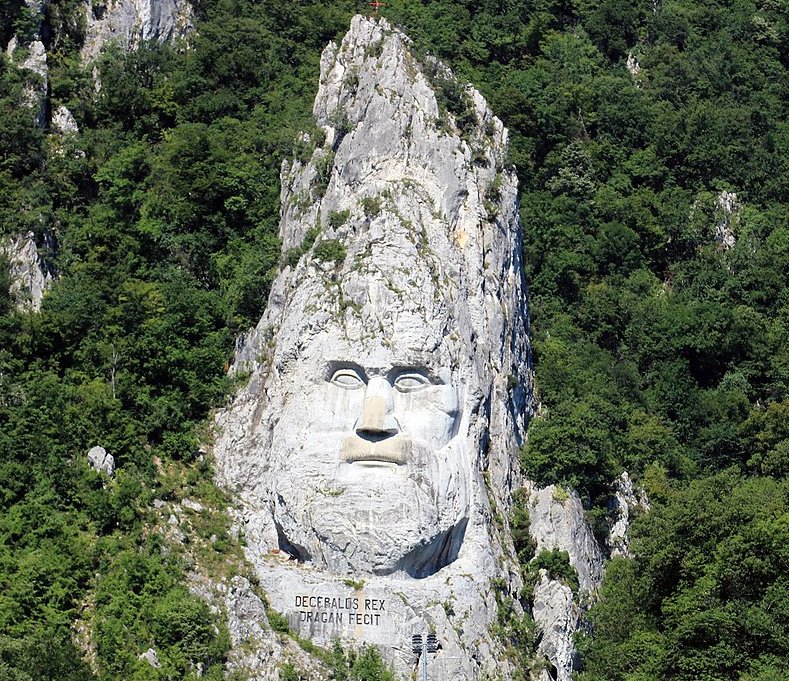
The rock sculpture of Decebalus at the Iron Gates. Image credit: Sadko (made the image in the immediate vicinity of the sculpture) - CC BY-SA 4.0
'During his reign, an accelerated process of the state centralization occurred in the face of the imminent Roman danger. For two decades, the confrontation with the Dacian state constituted the major problem of the Roman foreign policy.'
He fought victoriously against Domitian's general, Cornelius Fuscus. Still, new dangers came, and in 89, Decebalus was eventually defeated and forced to sign a peace treaty that made the Dacian kingdom a client of Rome. According to these terms, the Dacians receive Roman money and technical support in exchange for recognition of Roman overlordship.
During the next 12 years of peace, Decebalus consolidated power and rule.
Decebal (Decebalus) (ruled 87-106) was the last king of Dacia. The Romans defeated the Dacians at Topae, set fire to several towns, and moved towards Sarmizegetusa, the kingdom's capital. The Romans laid siege to the city and cut Sarmizegetusa's water supply.
After almost three years of preparations at the southern boundaries of Dacia, at the beginning of the year 101 in Moesia Superior, Emperor Traian concentrated 13-14 legions and many auxiliary units (circa 150 000 soldiers) to conquer Decebal's reign.
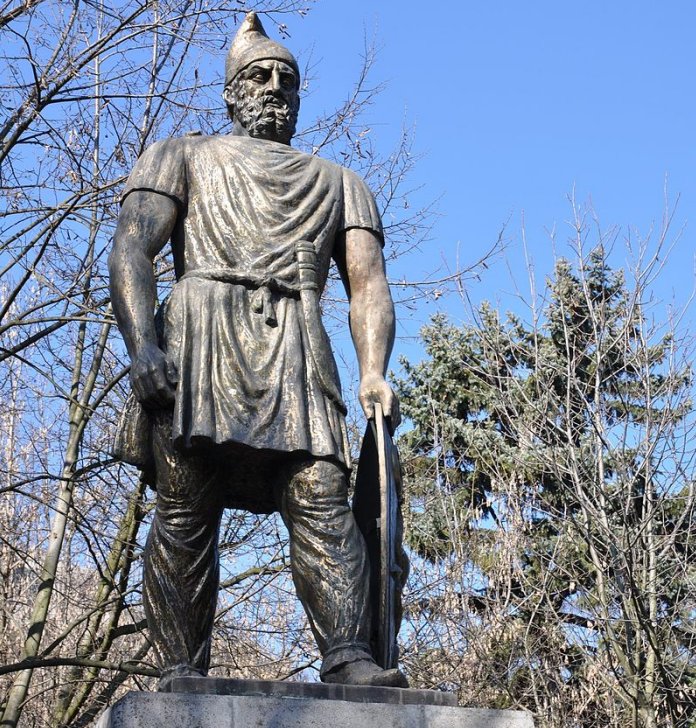
Statue of Decebalus in Deva, Romania. Image credit: - CC BY-SA 3.0
In 101, Trajan led an invasion of Dacia, and thus, the First Dacian War began. The capital of Sarmizegethusa (in modern Romania) was captured. In 102, Decebalus was forced to accept Roman occupation garrisons.
In 105, the mighty Decebalus was once powerful enough to defeat the occupation forces and invade Moesia. It was the Second Dacian War.
The Dacians, led by Decebal, resisted heroically. On the other hand, Roman Emperor, Trajan, threw all the Empire's resources into the fight to be victorious. Dacia's gold was essential, but he first wanted to eliminate the threat from the Dacians and their allies at the eastern border.
After Trajan seized Sarmizegethusa a second time in 106 and the Dacians' fortress of the Orastie's Mountains fell, some defenders, including Decebal, managed to leave the city, trying to continue resistance against the Romans within the country. Being chased by the Romanian cavalry, Decebal commits suicide because death is better than falling alive into his enemies' hands.
Dacia capitulated and became a Roman province.
There is a mighty 40-meter-tall bearded stone face overlooking the Danube River in Romania.
It is the statue of the Dacian king Decebalus. From 1994 to 2004, it took ten years for twelve sculptors to finish it. The figure is the tallest rock sculpture in Europe. It is located on the Danube's rocky bank near Orsova, Romania.
Today, 2000 years later, the great Dacian king keeps watch on the borders of those lands he defended.
Written by – A. Sutherland - AncientPages.com Senior Staff Writer
Updated on January 25, 2024
Copyright © AncientPages.com All rights reserved. This material may not be published, broadcast, rewritten or redistributed in whole or part without the express written permission of AncientPages.com
Expand for referencesReferences:
Dando-Collins S. Legions of Rome: The definitive history of every Roman legion
M. Dumitrana, 'Romanian Cultural Identity and Education for Civil Society'
More From Ancient Pages
-
 India’s Mysterious Stonehenge: Prehistoric Complex Of Gigantic Standing Stones Of Willong Is An Enigma
-
 Spectacular Giant Bronze Age Hall Found Near Berlin, Germany May Be Connected To Legendary King Hinz
-
 Ancient History Of The Samurai Armor
-
 Gold Coins Shed Light On The Mystery Of Sandby Borg And Massacre On The Swedish Island
-
 Machu Picchu Was Built With The Royal Unit System – New Research Suggests
-
 Was Napoleon Bonaparte Defeated At Waterloo Because Of Volcanic Eruption?
-
 Hundreds Of Rock Paintings Found In Tanzania By Polish Archaeologist
-
 Who Is Buried In The Extremely Well-Preserved 2,600-Year-Old Celtic Chamber Tomb Found Near Riedlingen, Germany?
-
 Mythical Danaides: Daughters Of Danaus Condemned In Hades To Eternal Punishment
-
 Walls Of Lugo: Finest Example Of Late Roman Fortifications – Stands The Test Of Time
-
 Unique Viking Silver Treasure With Beautiful Jewelry And Rare Coins Found In Täby Outside Stockholm, Sweden
-
 Cruithne: Legendary King, His Seven Sons And The First Celtic Tribe That Inhabited British Isles
-
 Archaeologists Will Soon Excavate Biblical Site Where Ark Of The Covenant Once Stood
-
 Huge Ancient Hydraulic System Built By The Liangzhu Culture May Be World’s Oldest And Predate Mesopotamian Water Systems
-
 Is There An Ancient Secret Connection Between The Statue Of Liberty And The Anunnaki Goddess Inanna?
-
 Trapped 70,000-Year-Old Artifact Reveals Hidden Information About Early Humans
-
 Mysterious Location Of The Amazing Land Of Punt – Can This Puzzle Be Solved One Day?
-
 13,000-Year-Old Engraving May Depict First Paleolithic Social Group Of Humans
-
 Vikings’ Self-Image Was Influenced By Ancient Rome – Intriguing Grave And Artifacts Reveal
-
 Unusual Power Of Seidr: Norse Shamans Used Magic To Alter Destiny And See The Future

