
Etruscan City Of Cerveteri With Magnificent House-Like Tombs Decorated With Scenes From Life And Death
A. Sutherland - AncientPages.com - Today, the town of Cerveteri is particularly famous for the numerous Etruscan cemeteries located on the surrounding hills.
We know about the Etruscan civilization, after Rome conquered it, thanks to its tombs in massive necropolises outside the Etruscan cities.
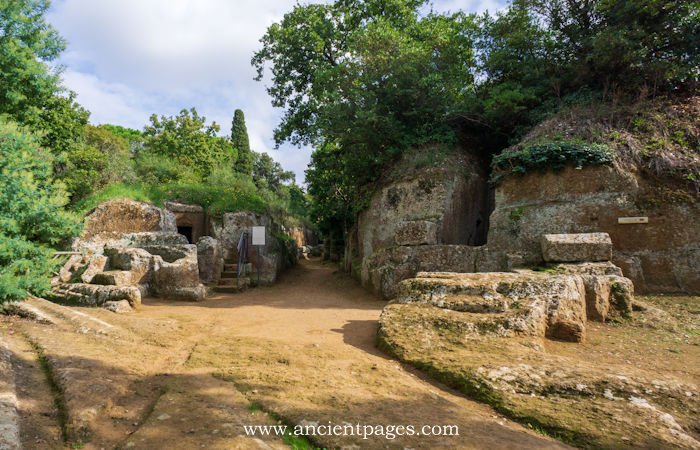
Necropoli were massive graveyards in which the Etruscans buried their family members to preserve their bodies and souls. Other surviving sources of their architecture are the remains of temples, city walls, houses, and even roads carved in stone.
The ancient Etruscan city of Caere (now Cerveteri) was, according to tradition, founded by Pelasgians in c. 1400 BC.

This is a preview of our premium article available only to members of Ancient Pages.
Become a member to read more - Click here
If you are already a member and have logged in to your account, you can access the article here

See also:
Termessos: City Where History And Mythology Marked People’s Daily Lives
Castro People: Intriguing Life Of The Female-Dominated Society In Ancient Iberia
More From Ancient Pages
-
 Biblical Mystery Of The Forbidden Fruit And The ‘Deep Sleep’
-
 Mystery Of The Hidden Wooden Hieroglyphic Tablets And The Unknown White Bearded Men – The Civilization That Died Twice – Part 2
-
 Large Ancient Statues And Artifact With Foreign Inscription Found In A Swamp In Michigan
-
 Frigg: Chief Norse Goddess Who Knew Secrets Of Humans’ Fates
-
 Ancient Egyptian Village That Is Far Predating Egypt’s Oldest Known Pyramid – Discovered
-
 Mysterious 3,000-Year-Old Underwater Urartu Castle Discovered
-
 Unravelling The Mystery Of The Yellow Emperor And His Connection To Regulus
-
 Unknown History Of Gigantic Obelisks Created With Ancient Lost Technology
-
 Time Capsule – Best Preserved 3,000-Year-Old Dwelling Ever Found In Britain
-
 Legendary And Mysterious Stone Of Brutus – The London Stone Refuses To Give Up Its Secrets
-
 Mystery Of 3,000-Year-Old African Civilization Garamantes And Its Ancient Secrets
-
 Incredible Sedlec Ossuary – Church Of Bones Reveals More Gruesome Secrets
-
 Ancient City Of Timgad: Largest Roman Settlement Ever Built In North Africa
-
 California’s Mysterious Ancient Wisdom Teacher And His Puzzling Connection To The Stars
-
 Medieval Grave And Skeleton With Arrow In Chest Unearthed In Ancient City Of Plovdiv, Bulgaria
-
 Was Biblical Adam A Giant Who Emerged From An Underground World?
-
 On This Day In History: ‘Sea King’ Ragnar Lodbrok Seizes Paris – On March 28, 845
-
 Does A Renaissance Painting Offer Proof Of Unknown Advanced Technology?
-
 What Can Fossil Footprint Discoveries Tell Us About The Past?
-
 Women’s March On Versailles: One Of The Most Significant Events Of The French Revolution

