
Sarmizegetusa And Its Andesite Sun Artifact Similar To The Mayan Calendar
A. Sutherland - AncientPages.com - Sarmizegetusa (today Gradistea Muncelului) County was the capital of pre-Roman Dacia, located in the Orastie Mountains, in present-day Romania. Before the wars with the Roman Empire, Sarmizegetusa was also the most important military, religious and political center of the Dacians.
It's a complex of sanctuaries situated on a cliff at an altitude of 1200 m, with a leading, large round sanctuary and the so-called "andesite sun" artifact.

The sanctuaries were located on a terrace, which had been linked previously mentioned gate by a paved road. Today, it's unknown if Sarmizegetusa had seven or eight quadrilateral sanctuaries because the Romans destroyed them
The fortress, a strategic center of defense, has a quadrilateral (a four-sided polygon) shape and massive stone blocks with 3m thick and approximately 4-5m high walls, constructed on five terraces, an area of almost 30,000 m².
The sacred zone of Sarmizegetusa includes several rectangular temples, and the bases of their supporting columns are still visible in regular arrays.
Perhaps the most enigmatic construction at the site is the large circular sanctuary. It consisted of a set of timber posts surrounded by a timber circle which in turn was surrounded by a low stone curb.
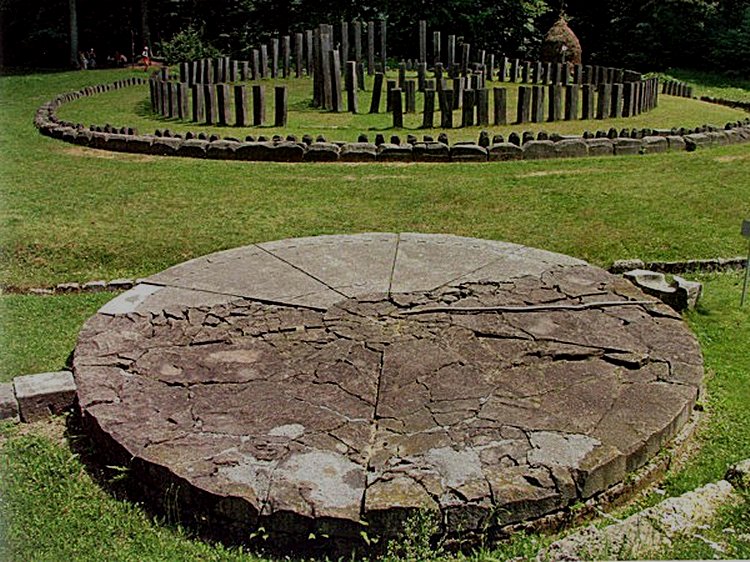
The andesite sun and the great round sanctuary from Sarmizegetusa Regia. (photo from The cultural Heritage of Romania, (Cluj-Napoca, 2004)
The layout of the timber settings of the Sarmizegetusa fortress bears an intriguing resemblance to the stone monument at Stonehenge in England.
We find another curious resemblance at Sarmizegetusa's most crucial artifact, "andesite sun," which was probably used as a sundial. The artifact is very similar to the famous Mayan calendar. The Dacian culture was influenced by contact with Hellenistic Greece. The sundial may have resulted from the Dacians' exposure to Hellenistic learning in geometry and astronomy. The capital of Dacia was conquered and destroyed by the Roman army in 106 AD.
Its ruins were unearthed for the first time in 1923 due to excavations under the leadership of prof. DM Teodorescu of the Department of Archaeology, the University of Cluj-Napoca, followed by other diggings until 1944.

Since it is known that Dacian culture was influenced by contact with Hellenistic Greece, the sundial may have resulted from the Dacians’ exposure to Hellenistic learning in geometry and astronomy.
Sarmizegetusa Regia also had a residential area of 3 km, with dwellings and workshops. It was a vast civil settlement with many homes, workshops, warehouses, barns, and a water reservoir.
People lived below the citadel in settlements built on artificial terraces and a system of ceramic pipes channeled running water into the nobility's residences. The archaeological inventory found at the site demonstrates that Dacian society had a relatively high standard of living.
At 100 meters to the east of the complex, there was the city and shrines of various shapes and sizes. The sanctuaries were located on a terrace linked with the gate by a paved road. Today, it's unknown if Sarmizegetusa had seven or eight quadrilateral sanctuaries because the Romans destroyed them.
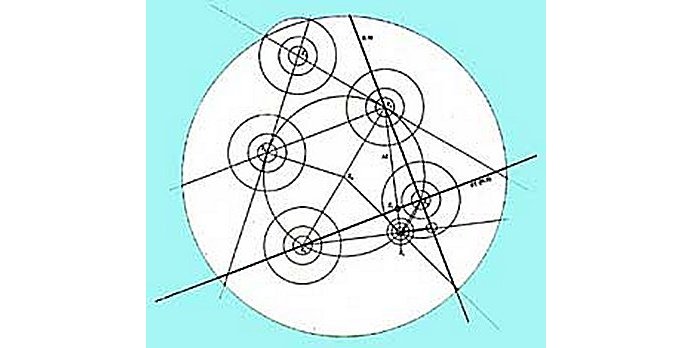
The mathematical pattern of Sarmisegetusa includes all cyclopean buildings of the Dacians built at an altitude of 1,045m). The line of the North coincides precisely with the arrow of the so-called Andesite Sun.
At the ancient site of Sarmizegetusa, we encounter evidence of our ancestors' knowledge of cosmogonical topography, divine geometry, and cosmic harmony and several artifacts offering proof that the Dacians were an advanced society.
The Dacians were skilled metalworkers. Excavations conducted in the area revealed tools such as meter-long tongs, hammers, and anvils used to make 400 metallic artifacts — scythes, sickles, hoes, rakes, picks, pruning hooks, knives, plowshares, and carpenters' tools.
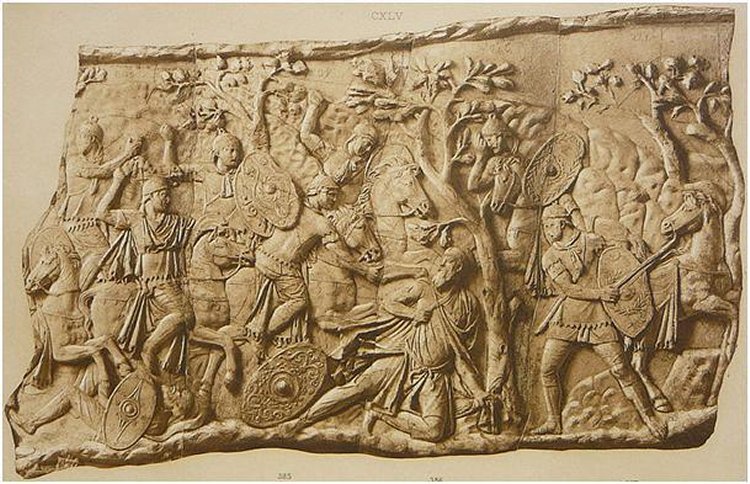
Decebalus’ suicide, from Trajan’s Column (Scene CXLV)
However, among the most important finds unearthed at the site, is a medical kit, in a brassbound wooden box with an iron handle, containing a scalpel, tweezers, powdered pumice and miniature pots for pharmaceuticals, and a large funerary vessel (0.6 m) high and 41 in (1 m) across, bearing an inscription in the Roman alphabet: DECEBAL PER SCORILO, i.e. 'Decebalus, son (cf. Latin puer) of Scorilus'.
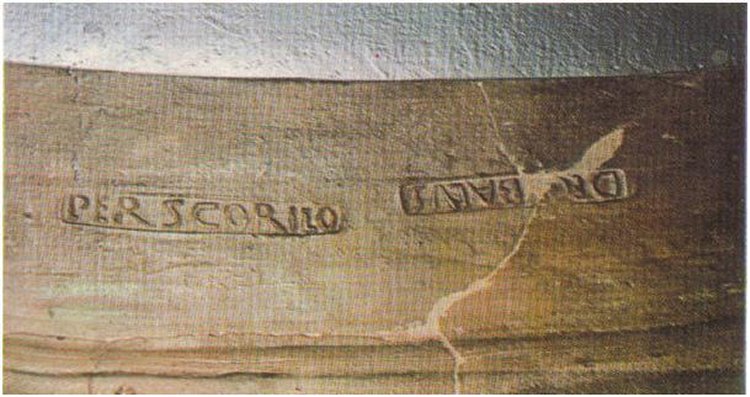
The Decebalus per Scorilo inscription. The Decebalus inscription was stamped on a huge vase twenty-four inches (0.6 meters) high and forty-one inches (1 meter) across. It is stamped in mirror-writing, in the Latin alphabet. image source
Decebal (Decebalus) (ruled 87-106) was the last king of Dacia. The Romans defeated the Dacians in the Battle of Tapae in 88; they set fire to several towns and moved towards Sarmizegetusa, the kingdom's capital.
The Romans laid siege to the town and cut Sarmizegetusa's water supply. The Dacians eventually surrendered, and Decebalus committed suicide. Dacia became a Roman province.
Dacian Fortress Sarmizegetusa is on the UNESCO World Heritage list.
Written by – A. Sutherland - AncientPages.com Senior Staff Writer
Copyright © AncientPages.com All rights reserved. This material may not be published, broadcast, rewritten or redistributed in whole or part without the express written permission of AncientPages.com
Expand for referencesReferences:
I. Grumeza, "Dacia: Land of Transylvania, Cornerstone of Ancient Eastern Europe"
More From Ancient Pages
-
 New Light On Appearance Of Scythians In Northern Black Sea Region
-
 Secrets Of Hermes Trismegistus Who Brought Divine Wisdom To Mankind
-
 Weapons Of Ancient Aztec Warriors Of Mesoamerica
-
 Clues What Tiggered Climate Change 8,000 Years Ago Found In Scotland
-
 Native Americans’ Visions Of Distant Explorers May Unravel Some Ancient Mysteries Of North America – Archaeological Evidence – Part 2
-
 Remarkable Discovery Of Unusual “Hammer Of Thor” Finally Solves An Ancient Mystery
-
 Ancient Wooden Sculpture Unearthed In Peru’s Chan Chan
-
 Valkyries Sigrdriva And Brynhildr: Brave Warriors Who Were Punished By God Odin In Norse And Germanic Mythology
-
 Early Christian Landmark – Re-Evaluation Of Its Architecture And Practices
-
 Why Is Caganer, The Pooping Man Part Of The Catalonian Christmas Tradition And Nativity Scene?
-
 The Helm Of Awe – Powerful Viking Symbol For Physical, Mental And Spiritual Protection
-
 Fall Of The Ancient Maya Civilization Not Caused By Climate Change And Environmental Degradation – Scientists Say
-
 Hapi: Early Egyptian God Of The Nile And Bringer Of Fertility, Abundance And Life
-
 The Invisible Plant Technology Of The Prehistoric Philippines
-
 Jurassic Sea Creature Unearthed In A Quarry Near Peterborough, UK
-
 Never-Ending Haunting Of A Dangerous Viking Draugr Who Terrorized A Whole Community – Scary Story From A Norse Saga
-
 Ancient Town Pontefract, England Reveals Some Of Its Secrets
-
 African Kingdom Of Axum – Ancient Ruins Of Early Churches Unearthed
-
 Ancient Pathogens Released From Melting Ice Could Wreak Havoc On The World – New Analysis Reveals
-
 On This Day In History: Isaac Asimov Creator Of Science Fiction Was Born – On Jan 2, 1920

