
Cosimo di Giovanni de’ Medici – Exile Of The Generous, Intelligent Banker Caused Fury In Renaissance Florence
Ellen Lloyd - AncientPages.com - Shortly before Giovanni di Bicci de' Medici died, he told his son Cosimo di Giovanni de' Medici never to go against the will of the people. It is an advice Cosimo followed all his life, and maybe it was one of many reasons why this quiet, calm, and balanced man was popular in Renaissance Florence.
Cosimo di Giovanni de' Medici Loved Books, Languages And Art
Born on June 3, 1421, in Florence, Italy, Cosimo inherited the banking genius that helped his father flourish. In time, he became so powerful that he took complete control over Florence. Pope Pius II called Cosimo a “king in all but a name”. Even though Cosimo was a successful banker, he was also a great intellect who appreciated art and culture.

Members of the Medici family were powerful Renaissance godfathers, and Cosimo showed interest in books, languages, and art when he was a young boy. He was always interested in learning for its own sake, and his thirst for knowledge stayed with him all his life. There is no doubt Cosimo di Giovanni de' Medici turned Florence into a global power center and a cultural jewel in Renaissance Europe. His achievements and work contributed to the Medici family's long-lasting legacy that ruled Florence for roughly 250 years.
Though the Medici family is long gone, symbols of their power can still be encountered in many countries. “If you have visited or passed a pawn shop you may have noticed the three golden balls suspended from a bar. These three spheres are the pawnbrokers' symbol and their history can be traced to the powerful Medici family.” 1
Accusation Of Treason, Death Threat And Exile Of Cosimo di Giovanni de' Medici
Unlike many other Medici family members, Cosimo was not a man who caused scandals and intrigues. Despite the power he possessed, he was a quiet person who appreciated solitude but being a man of great importance; it was in his home most political decisions were made. He used his money to buy political influences, making sure everyone voted according to his will in issues that mattered to him.
Even though Cosimo preferred to stay in the shadows and keep a low profile, he was a man who had enemies. The Medici family held a firm grip on Florence, but the House of Borgia and the Pazzi family were also highly influential. When a man is wealthy and powerful, greedy enemies are always lurking behind every corner, waiting for an opportunity to strike.
Cosimo started to become much too important and dangerous to his rivals.
When Cosimo refused to support Rinaldo degli Albizzi (1370–1442) in a war against Lucca and Milano, he suddenly faced real problems that money could not solve, or at least that is what many people thought at the time.
In September 1433, Cosimo was invited to the Signorina for talks. Once he arrived there, he was arrested. When he was put on trial, he stood accused of treason, and once the guilty verdict was announced, Rinaldo sought the death penalty, but this did not happen. Cosimo, his family, and associates were exiled for twenty years from Florence.
“Less than a year later, Cosimo was the absolute master of Florence. The Florentine citizens soon became to miss his wealth and patronage, as well as his apparently populist ideas for government of the city. And within months of his exile, Cosimo’s amici came good for him.
In the late summer of 1434, the Signoria came under the control of a Medici majority and they soon told Rinaldo that they intended to bring Cosimo home. When Rinaldo tried to stage an armed coup, the amici were ready for him while Pope Eugen IV told him to back down, afraid he would lose the financial backing of the Medici.
By the end of September, Cosimo’s exile was formally ended, and his rival was expelled from Florence. Soon after his return, he made one the few overtly political gestures of his career when he decided that the election to the Signoria would reside with him alone, arguing that the move was needed to protect Florence’s security. He was now in complete control of the city, marking the start of 30-year period when, despite never being formally declared leader he ran every part of Florentine life.” 2
Once Florence was secured and he was certain nothing or none could threaten him again, Cosimo focused his attention on what he did best and loved most. He spent time expanding the Medici bank bringing in profits and investing in culture of Florence.

Medici chapel in Florence. Credit: Adobe Stock - Tupungato
Cosimo di Giovanni de' Medici was a generous man who once said, “spending money gave him far more joy than earning it, and he used his wealth to furnish his city with some of the finest buildings and paintings in Western Europe.” 2
The Medici were always patrons of artists, scientists, and even occultists. They tried to protect Galileo Galilei from the Inquisition, but they failed, and Galileo was arrested. Catherine de Medici, who shared her family’s great love for art, was fascinated with occult knowledge, and she supported Nostradamus, who became her counselor.
Cosimo di Giovanni de' Medici was a patron of the architect Michelozzo di Bartolomeo, one of the great pioneers of architecture during the Renaissance. Michelozzo was the Medici’s architect for almost 40 years, and in 1445, he was “commissioned as the key designer for the Palazzo Medici.” 3
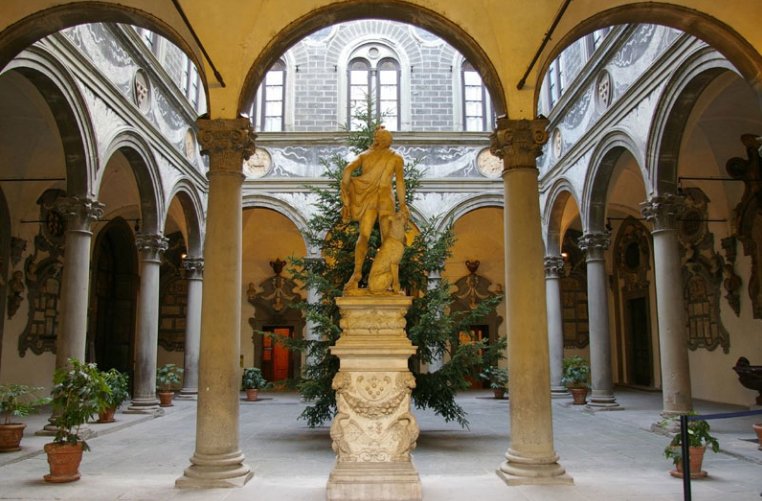
Interior of Palazzo Medici. Credit: Museums in Florence
“While spending money in a princely manner on works of art, public libraries and buildings, Cosimo lived as simply as any other citizen.” 4 This was most likely one of the main reasons why the public held him in high regard.
Cosimo di Giovanni de' Medici died at the age of 43 on August 1, 1464. His love of learning gave tremendous joy, but when his younger son Giovanni died in 1463, Cosimo was devasted, and his health deteriorated.
When people learned Cosimo had passed away, the whole of Florence was in deep mourning. A great man who had done so much for their beloved city was gone.
Written by Ellen Lloyd - AncientPages.com
Copyright © AncientPages.com All rights reserved. This material may not be published, broadcast, rewritten or redistributed in whole or part without the express written permission of AncientPages.com
Expand for references- Conny Waters - Why Is The Three Golden Balls Symbol For A Pawn Shop Connected To The Medici Family? AncientPages.com
- All About History Book of Medici -1st Edition
- Phoebe Ollerearnshaw - The Legacy of Renaissance Architect Michelozzo, Arts and Collections
- Janet Ross - Lives of the Early Medici: As Told in Their Correspondence
More From Ancient Pages
-
 Mysterious Standing Deer Stones Of Mongolia -Their Purpose And Creators Remain Unknown
-
 Mount Nemrut: ‘Throne Of The Gods’ – Mysterious Royal Tomb Surrounded By Gigantic Sculptures
-
 Ancient Mystery Of Pharaohs And Gods With Two Left Or Two Right Hands – A Deeper Investigation
-
 600-Year-Old Axe Heads Used In The Battle Of Grunwald Found in Poland
-
 Secrets Behind 2,000-Year-Old Roman Water Management Revealed
-
 On This Day In History: Canute – Cnut The Great – Danish King Of England Died – On Nov 12, 1035
-
 Aboriginal ‘Memories’ Of Australia’s Coastline Go Back More Than 7,000 Years
-
 Never-Before-Seen Colorful Inscriptions And Reliefs At The Esna Temple, Egypt Revealed After Restoration
-
 7th Century Old Cistern Among Recent Finds In Medieval City Of Beçin, Turkey
-
 Amazing 4,500-Year-Old Egyptian Bead-Net Dress Found In Giza Tomb Restored
-
 Machu Picchu Was Built With The Royal Unit System – New Research Suggests
-
 Mystery Of The Bloody Island Poveglia – A Place Of Hell In Ancient And Modern Times
-
 Archaeologists Investigate A Fascinating Ice Age Mystery In A Cave Beneath A British Castle
-
 Niches With Six Figures Cut In Rock Discovered At Gebel Al-Silsila, Aswan
-
 What Can Fossil Footprint Discoveries Tell Us About The Past?
-
 Who Were Persian ‘Sparabara’?
-
 Evidence Of Europe’s Earliest Human Presence, Dating Back 1. 3 Million Years Found At Venta Micena, Iberian Peninsula
-
 Curious Ancient Prairie Mystery In Washington Scientists Cannot Solve – Maybe You Have An Idea What Happened?
-
 Colossus Of Standing Falcon-Headed God Horus Unearthed In Egypt’s Luxor
-
 How Did A Rare 2,000-Year-Old Gem Seal Depicting God Apollo End Up In The City Of David?

