
Mystery Of The 290-Million-Year-Old Zapata Footprint In New Mexico
Jan Bartek - AncientPages.com - Fossilized footprints are often a subject of heated debates, especially if they are millions of years old and you cannot determine who made them.
In New Mexico, an extraordinary track is made in the mud. It's known as the Zapata footprint, and it is estimated "someone" made it about 290 million years ago.
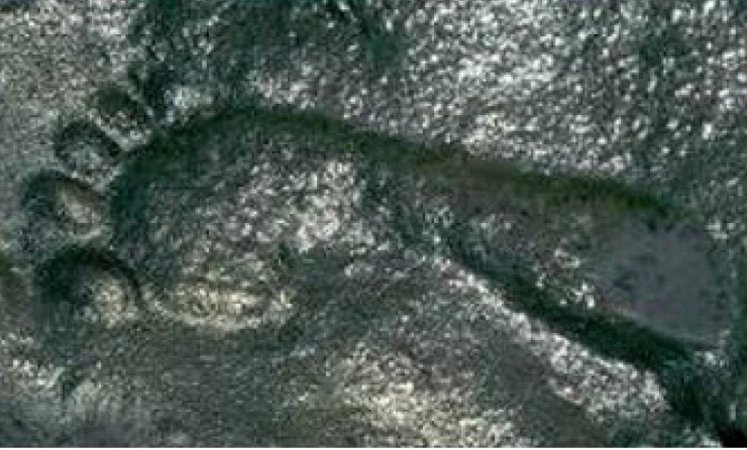
The strange Zapata footprint is believed to be 290 million years old. Credit: Footprints in stone
Did human-like beings walk the Earth millions of years ago?
Is it a human footprint, or did a long-gone extinct animal make it? What did Earth look like 290 million years ago?
It was a time when the Earth's continents were fused in the supercontinent Pangea. Pangea broke into smaller continents in the Triassic period when dinosaurs first evolved. All plants and animals in those days would be unrecognizable to us.
The Zapata footprint was discovered many years ago by a hunter who informed his friend Don Shockey about the unusual find. Shockey, who knew about archaeology and anthropology, decided to investigate the footprint in the wilderness of New Mexico. He gathered a science team consisting of several experts. Two of the team's participants were Dr. Don Patton and Dr. Carl Baugh.

Stunning View Of What Supercontinent Pangea Looks Like Mapped With Modern Borders - Read More
Dr. Patton was an experienced geologist who had worked in several countries investigating fossils and participated in dinosaur excavations in Colorado, Texas, Wyoming, and Canada.
Dr. Baugh is the discoverer and excavation director of sixteen dinosaurs, including Acrocanthosaurus in Texas and Diplodocus in Colorado.
With such experienced science members, there should be an excellent chance to determine what kind of creature had left the footprint. The investigations should have been easy, but it wasn't due to several obstacles researchers encountered.
Soon after the science team obtained a mining permit to excavate in the area where the track was located, a local armed landowner threatened them for trespassing private land, claiming they were on this private land.
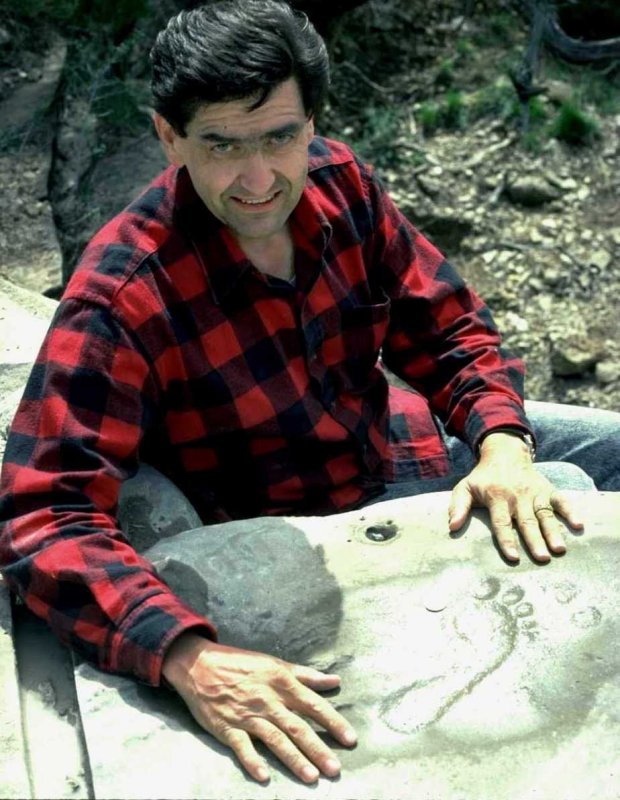
Examination of the Zapata fooprint. Credit: Footprints in stone
Shockey and his team showed the angry man their permission to excavate at the site and explained this was the BLM (Bureau of Land Management) property. Unfortunately, the landowner had a different opinion and told them to leave immediately. The team managed to take some photographs, but researchers were forced to interrupt the documentation, and they left the place in a hurry.
From an archaeological point of view, this was a tragedy because the hunter who had originally reported the discovery "had also reported that he had seen several other human footprints in the rock around the same area and showed Dr. Patton several photographs to validate his story." 1
According to Dr. Patton, the Zapata footprint is exceptionally shallow, making it very difficult to photograph.
So, who made the Zapata footprint? A majority will say humans did not exist millions of years ago. Could the Zapata footprint belong to a bipedal dinosaur? Maybe it can, but as we said at the beginning of this article, this happened during the age of Pangea, and scientists have concluded dinosaurs inhabited the world for some 160 million years. It means the Zapata footprint predates the dinosaurs.
Strange tracks in rocks have been found before, and they often pose a challenge to our historical timelines.
Some years ago, scientists discovered a set of controversial human-like footprints on Crete. These tracks are now putting the theory of human evolution to the test.
"The footprints are about 5.7 million years old from Trachilos in western Crete and have an unmistakably human-like form. It is especially true of the toes. The big toe is similar to our own in shape, size, and position. It is also associated with a distinct 'ball' on the sole, which is never present in apes." 2
Is it possible humans appeared much earlier than previously thought, or did unknown human-like beings leave behind footprints scientists cannot identify?
Written by Jan Bartek - AncientPages.com Staff Writer
Updated on April 4, 2023
Copyright © AncientPages.com All rights reserved. This material may not be published, broadcast, rewritten or redistributed in whole or part without the express written permission of AncientPages.com
Expand for referencesMore From Ancient Pages
-
 Unique Over 1,000-Year-Old ‘Telephone’ Invented By A Lost Forgotten Civilization With No Written Language
-
 Pre-Inca Societies In The Andes Lacked Hierarchical Leadership And Shared Power Before The Incas Arrived
-
 Function Of “Chopping Tools” Found At Prehistoric Site Of Revadim Israel – Studied
-
 Never-Before-Seen Amazon Rock Art Reveal People Lived With Giant Ice Age Animals
-
 A 1.3 kg Heavy Bronze Sword Unearthed On Funen Island, Denmark
-
 2,250-Year-Old Iron Age Settlement Discovered Near Upton-Upon-Severn
-
 Paleolithic Humans May Have Understood The Properties Of Rocks For Making Stone Tools
-
 Mysterious Inca Citadel With Platforms, Passages And Walls Discovered In Peru’s Rainforest
-
 Previously Assumed Turkic Origin Of The European Huns – Refuted; They Had Ancient Siberian Roots
-
 Stalagmites In Mexican Caves Shed New Light On The Ancient Maya Collapse
-
 Still Intact 460-Year-Old Bow Found Underwater In Alaska Baffles Scientists – Where Did It Come From?
-
 Shengavit Of Kura Araxes Culture: One Of Armenia’s Historical Sites Inhabited Since At Least 3200 BC
-
 Hidden Detail Discovered In Da Vinci’s The Vitruvian Man – Has A 500-Year-Old Mystery Been Solved?
-
 Gilded Coffin Of Nedjemankh, Priest Of Ram-God Heryshef Recovered By Egyptian Authorities
-
 Ancient Wooden Sculpture Of Queen Ankhesenpepi II Discovered At Saqqara, Egypt
-
 Jade Emperor – Supreme Ruler Of Heaven In Chinese Mythology
-
 DNA Offers Insights Into The Use Of Plants By Humans In The Paleolithic Age
-
 Wonderful And Unique Viking Silver Treasure Uncovered In Täby In Stockholm, Sweden
-
 5,500-Year-Old Ceremonial Site Of Murayghat Discovered in Jordan
-
 1,800-Year-Old Buddhist Stupa And Relics Discovered Near Bazira, The Ancient City Of Alexander The Great

