
Ancient Secrets Of The Damascus Steel – Legendary Metal Used By Crusaders And Other Warriors
Ellen Lloyd - AncientPages.com - When the Crusaders reached the Middle East in the 11th century, they discovered swords made of a metal that could slice a hair in half in mid-air, and yet it was strong enough to strike fear into even the bravest and most persistent warrior.

A shamshir (Persian/Iranian sword with a radical curve. The Royal Armoury, Stockholm, Sweden. Unknown author - LSH 77113 - Public Domain
Knowledge of the legendary metal spread, and it became known to the Europeans as the Damascus steel, named after the capital of Syria. Sometime in the 18th century, the formula for Damascus steel was lost, and the original method for producing Damascus steel remains an ancient secret.
Through the ages, armorers who made swords, shields, and armor were rigidly secretive regarding their method, and the formula of the Damascus steel was only known to a few persons.
Many modern attempts have been made to reproduce the metal, but no one has succeeded due to differences in raw materials and manufacturing techniques.
Damascus Steel And Its Remarkable Characteristics
From around the fourth century A.D., Damascus steel was manufactured in several regional locations. The swords produced with Damascus steel were extraordinary because the blades remained devastatingly sharp through battle after battle.
The Damascus steel gave rise to many legends, such as the ability to cut through a rifle barrel or to cut a hair falling across the blade. According to Dr. Helmut Nickel, curator of the Arms and Armor Division of the Metropolitan Museum of Art in New York, legend had it that the best blades were quenched in "dragon blood."
The swords were easily recognized by a characteristic watery or" damask" pattern on their blades." Damascus steel was not only a remarkable feat of engineering but also a thing of aesthetic beauty.
The metal was derived from Wootz, a type of steel originating in India unusually rich in carbon.
Based on archaeological evidence, it has been determined that the production fit the steel started in present-day Tamil Nadu before the start of the Common Era.
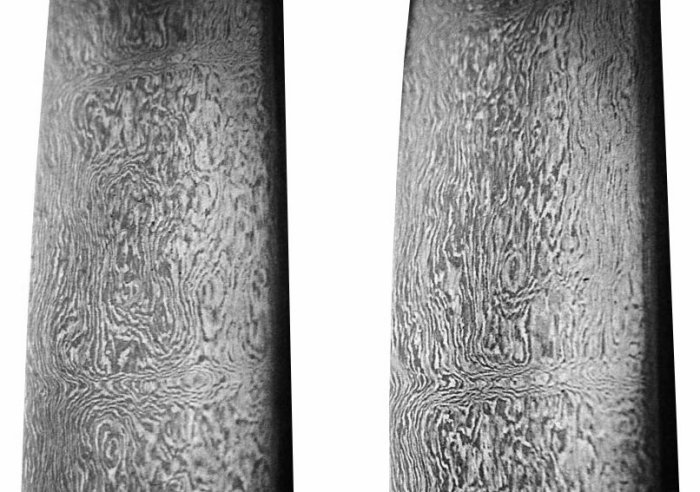 Watered pattern on iranian sword blade. Close-up of an 18th-century Persian-forged Damascus steel sword. Image credit: - GFDL
The Arabs introduced the Indian wootz steel to Damascus, where a weapons industry thrived. Wootz steel was highly prized across several regions of the world over nearly two millennia, and one typical product made of this Indian steel came to be known as the Damascus swords.
From the 3rd century to the 17th century, India was shipping steel ingots to the Middle East.
Lost Knowledge Of The Damascus Steel Formula
By 1750, the production of Damascus swords gradually declined, and the process was lost to metalsmiths.
Why the swords were no longer produced is still a mystery. It has been suggested that Damascus steel production declined because firearms replaced blades, and there was less demand for metal. Another option is that the knowledge of the Damascus steel formula was only known to a small group and thus lost with time. Swordmakers succeeded in concealing their techniques from competitors and posterity.
It is also possible that the trade routes supplying Wootz from India were disrupted or that raw material supplies no longer had the same essential characteristics.
Modern Attempts To Re-Create Damascus Steel
A significant problem in scientific experiments on Wootz Damascus steel is the inability to obtain samples for study. Such a study requires that the blades be cut into sections for microscopic examination, and small quantities must be sacrificed for destructive chemical analysis.

A sword maker of Damascus, Syria. Image source
When researchers at the Technical University of Dresden used X-rays and electron microscopy to examine Damascus steel, they discovered the presence of cementite nanowires and carbon nanotubes. The study showed that these nanostructures are a result of the forging process.
Jeffrey Wadsworth and Oleg D. Sherby, two metallurgists at Stanford University, may have unraveled the mystery of the Damascus steel. According to Dr. Wadsworth, as suspected by several early metallurgists, an essential requirement is a very high carbon content.
Dr. Wadsworth and Dr. Sherby believe it has to be from 1 to 2 percent, compared to only a fraction of 1 percent in ordinary steel. Another critical element in Damascus blade production is forging and hammering at relatively low temperatures - about 1,700 degrees Fahrenheit. After shaping, the blades were reheated to about the same temperature, then rapidly cooled, as by quenching in a fluid.
"Modern Damascus" is made from several types of steel and iron slices welded together to form a billet, and currently, the term "Damascus" (although technically incorrect) is widely accepted to describe modern pattern-welded steel blades in the trade. The patterns vary depending on how the smith works the billet. The billet is drawn out and folded until the desired number of layers is formed. To attain a Master Smith rating with the American Bladesmith Society, it is necessary to forge a Damascus blade with a minimum of 300 layers.
Recreating Damascus steel is a subfield of experimental archaeology. Many have attempted to discover or reverse-engineer the process by which it was made, and several researchers have come a long way, but to completely reproduce the process has so far not been possible.
Damascus steel is, without doubt, magnificent art and cutting-edge technology that may be lost to humankind forever.
Written by Ellen Lloyd – AncientPages.com
Updated on Aug 13, 2023
Copyright © AncientPages.com All rights reserved. This material may not be published, broadcast, rewritten or redistributed in whole or part without the express written permission of AncientPages.com
Expand for referencesMore From Ancient Pages
-
 Isotope Analysis Helps Tell The Stories Of Aboriginal People Living Under Early Colonial Expansion
-
 DNA Reveals Participants In California’s Gold Rush Dined On Salted Atlantic Cod
-
 Enigma Of Mount Ararat – Researchers Are Determined To Reveal The Truth To The World
-
 Unusual Parcel With 500-Year-Old Horn Container Discovered In South Africa Sheds Light On Pre-Colonial Khoisan Medicines
-
 For The Ancient Maya, Cracked Mirrors Were A Path To The World Beyond
-
 Mysterious Lost Civilization Of Chu And Its Powerful Kingdom
-
 Scientists Can Finally Answer What Bronze Age Daggers Were Used For
-
 Oldest Door Lock Comes From Ancient Egypt
-
 Discovered Inscription On Ancient Stone Vessel Reveals Location Of Legendary Tomb Of Chinese Emperor
-
 On This Day In History: American Astronomer Edwin Hubble Announced Existence Of Other Galaxies – On Dec 30, 1924
-
 Europe’s Oldest Time Capsule Discovered Inside A Statue Of Jesus In Spain?
-
 How The Great Sphinx Gave Thutmose IV Power To Become Pharaoh
-
 God Patecatl – Father Of ‘Four Hundred Rabbits’ In Aztec Beliefs
-
 New Massive Duck-Billed Dinosaur Species Identified
-
 Life Of Galilean Sages Described On 1,800-Year-Old Hebrew Inscriptions Can Confirm Ancient Legends
-
 On This Day In History: Treaty Of Seville Signed – On Nov 9, 1729
-
 On This Day In History: American General Benedict Arnold Commits Treason – On Sep 21, 1780
-
 Knights Templar’s Legendary Sword In Stone In Terminillo Mysteriously Disappeared – Where Is It Hidden?
-
 Mystery Of The Delphi Oracle Prophecies: Was Pythia On Drugs While Guiding Ancient Greek Civilization For Thousands Of Years?
-
 Ancient Andean People Had A Plant-Based Diet And Were Not Hunter-Gatherers

