
Why Were The Jews Exiled To Babylon?
A. Sutherland - AncientPages.com - After many successful campaigns in the region of the Levant (of today’s Syria, Jordan, Lebanon, Israel, and Palestine), Nebuchadnezzar suffered a heavy defeat at the hands of the Egyptians in 501 BC and had lost control of some of his vassal states. In this situation, he decided to retaliate.
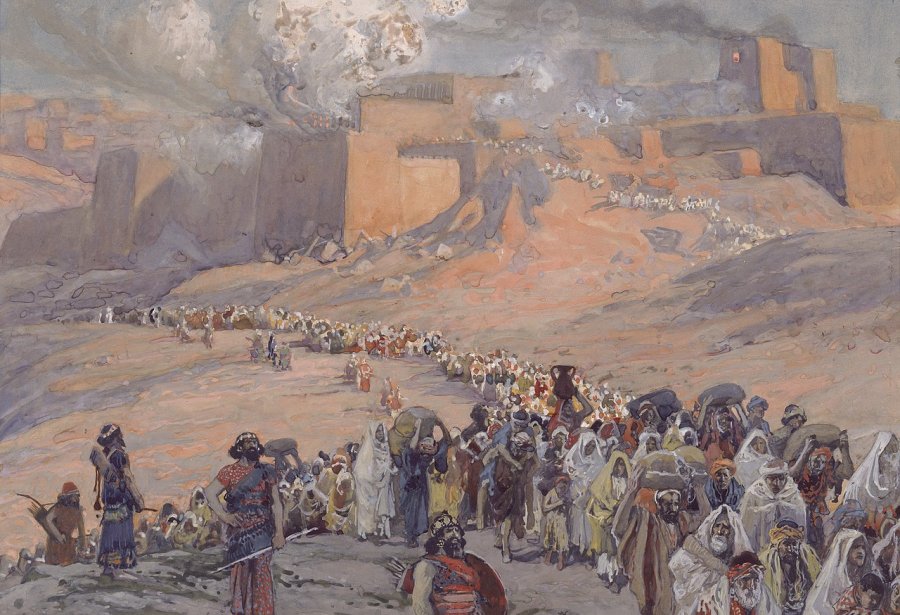 An artist's depiction of the deportation and exile of the Jews of the ancient Kingdom of Judah to Babylon and the destruction of Jerusalem and Solomon's temple. Jewish Museum, New York, NY. Public Domain
In 597 BC, Nebuchadnezzar II (c.634 BC - c.562 BC), the Chaldean king of Babylon in Mesopotamia from 605 BC, attacked Judah, captured Jerusalem, and deported the Jews to Babylon. Pharaoh Apries made an attempt to help the Kingdom of Judah but failed.
It started the so-called ‘Babylonian Exile’ with the deportation of Jehoiachin (Jeconiah), a king of Judah, who reigned only three months and ten days, from 609 to 598 BC), along with his family. As told in 2 Kings 24:12–16, almost 10,000 prominent Jewish citizens like professionals, the wealthy, priests, and craftsmen were also forced to relocate to the city of Babylon.
The Judean prophet Ezekiel was also exiled to Babylon.
As part of his efforts to keep the region under his control (apparently, it was not easy to subordinate this country, Nebuchadnezzar appointed Zedekiah as King of Judah in his place, who reigned from 597 to 586 BC, Zedekiah was the last king of Judah before the destruction of the kingdom by Babylon.
After nine years of his reign, Zedekiah led Judah in rebellion against the king of Babylon one final time. He made attempts to organize opposition among the small states in the region but in vain.
At this time, Jerusalem and the temple were destroyed, and all the houses burned. The majority of the Jewish people were taken captive, but, again, Nebuchadnezzar left a remnant of poor people to serve as farmers and vinedressers (2 Kings 25:12).
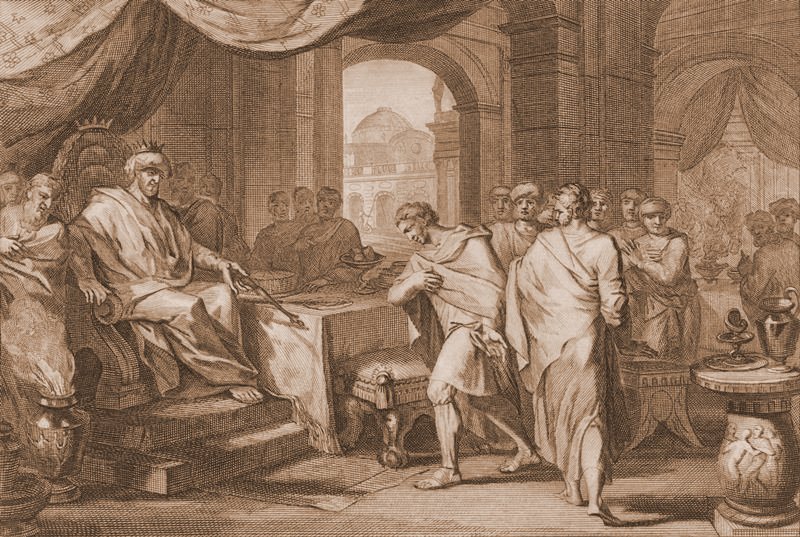 Jehoiachin king of Judah bows in thanks to the Babylonian king Evil-Merodach son of Nebuchadrezzar, for giving him amnesty. Print by Jan Luyken 1700. Rijksmuseum.nl via The Torah
On the other hand, Nebuchadnezzar took some of the vessels in the Jewish temple, bringing them to Babylon and dedicating them to Marduk.
Jerusalem fell in July 587 or 586 BC, and King Zedekiah was taken captive to Babylon after seeing his sons killed before him and then having his eyes plucked out.
The Jewish rebellion ended tragically, according to 2 Kings 24–25.
“…So in the ninth year of Zedekiah’s reign, on the tenth day of the tenth month, Nebuchadnezzar king of Babylon marched against Jerusalem with his whole army. He encamped outside the city and built siegeworks all around it. The city was kept under siege until the eleventh year of King Zedekiah.”
“…By the ninth day of the fourth month, the famine in the city had become so severe that there was no food for the people to eat. Then the city wall was broken through, and the whole army fled at night through the gate between the two walls near the king’s garden, though the Babylonians were surrounding the city…”
“…the Babylonian army pursued the king and overtook him in the plains of Jericho. All his soldiers were separated from him and scattered, and he was captured.

According to the Babylonian Chronicles, "the seventh year (of Nebuchadnezzar – 598 BC.) in the month Chislev (Nov/Dec) the king of Babylon assembled his army, and after he had invaded the land of Hatti (Syria/Palestine) he laid siege to the city of Judah. image source
He was taken to the king of Babylon at Riblah, where the sentence was pronounced on him. They killed the sons of Zedekiah before his eyes. Then they put out his eyes, bound him with bronze shackles, and took him to Babylon. The events are also described in the Book of Jeremiah.
The deportations of the Jews did not involve the entire nation of the Jews. The so-called “people of the land” (‘am-hares’) were allowed to stay in Judah. It is believed that in the Kingdom of Judah during this time lived between 120,000 and 150,000, and less than one-quarter of the population was actually taken into exile.
The Jews sent into exile, remained as a single group, which helped them preserve their cultural identity by living in their community in Babylon, until being finally allowed to return home in 538/539 BC, at the time, when the Persians overthrew the Chaldeans.
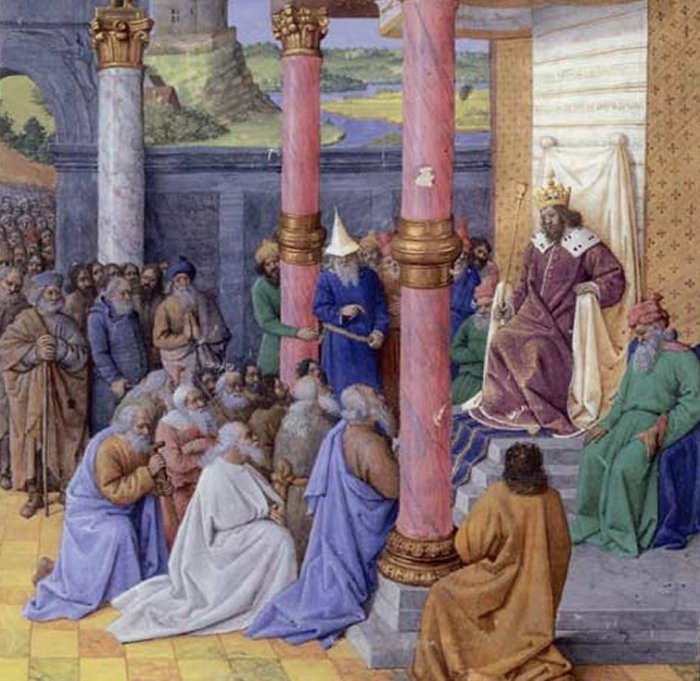 Cyrus the Great is said in the Bible to have liberated the Jews from the Babylonian captivity to resettle and rebuild Jerusalem, earning him an honored place in Judaism. Image credit: Jean Fouquet/Public Domain
The exile period had a profound and long-lasting influence on the Jews’ development outside their homeland. Ancient sources confirm that some of the Jewish population adopted the Chaldean religion by giving names to their offspring after Chaldean deities.
Generally, however, the community remained united in its common faith in Yahweh.
As prophesied in Scripture, the Jews would be allowed to return to Jerusalem after 70 years of exile, and so it happened. The prophecy was fulfilled in 537 BC, and the Jews were permitted by King Cyrus of Persia to return to Israel and begin rebuilding the city and temple.
For many Jews, it was traumatic and painful to understand their tragic situation. Yahweh had promised to preserve the Jews in Judah, and yet, he permitted their removal. The prophets Jeremiah and Ezekiel had argued (even before the fall of the city of Jerusalem) that the Jews would be punished for having fallen below the required standards.
See also: More About History
In the Hebrew Bible, the captivity in Babylon is presented as a punishment for idolatry and disobedience to Yahweh, comparable to the presentation of the enslavement of the Israelites in ancient Egypt. Many regarded exile as Yahweh’s use of foreign powers to punish his people.
"God fulfilled the promise of nationhood by leading the Israelites to victory against the Canaanites and the Philistines. A glorious kingdom flourished but then began to falter as Israel's kings persisted in disobeying God's will. God, therefore, punished Israel by allowing to suffer defeat and exile by Babylonian forces..." (Rue Loyal D. "Religion is Not about God")
Written by – A. Sutherland - AncientPages.com Senior Staff Writer
Updated on July 3, 2021
Copyright © AncientPages.com All rights reserved. This material may not be published, broadcast, rewritten or redistributed in whole or part without the express written permission of AncientPages.com
Expand for referencesRue Loyal D. Religion is Not about God
Roberts Carlos C., Christian Education Teaching Methods - From Modern to Postmodern
More From Ancient Pages
-
 Unexplained Forest Mystery In Oregon Baffles Scientists
-
 The Oseberg Tapestry And Other Artifacts Show Intense Colors Were A Viking Symbol Of Status And Wealth
-
 Small Figurine Reveals How A Viking’s Hair And Beard May Have Looked
-
 Poles conduct mural restoration in the villa buried by the ashes of Vesuvius
-
 Mystery Of The Bar Hill Comb Solved
-
 Roman ‘Backwater’ Challenges Major Assumptions About The Ancient Empire’s Decline
-
 On This Day In History: Macbeth, King of Scots Killed At The Battle Of Lumphanan – On August 15, 1057
-
 Prehistoric Spread Of Millet From East Asia To Central Europe – New Study
-
 America’s First Civilization Was Made Up Of ‘Sophisticated’ Engineers – New Evidence
-
 On This Day In History: Battle Of San Domingo Was Fought – On February 6, 1806
-
 The Red Dragon Of Wales – Ancient Symbol Dating Back To Roman Times
-
 Pre-Inca Temple With Colored Paintings And Carved Sculptures Discovered At The Los Paredones Archaeological Complex, Peru
-
 Mystery Of The Delphi Oracle Prophecies: Was Pythia On Drugs While Guiding Ancient Greek Civilization For Thousands Of Years?
-
 Noppera-bo: Odd Intimidating Human-Like Faceless Yokai In Japanese Folklore
-
 Viking Burial With An Unusual Box And Spectacular Grave Goods Found In Aarhus, Denmark
-
 Spectacular Statue Of Sea God Triton Found In Roman Mausoleum In Kent
-
 New Guineans And Aboriginal Australians Descend From Two Groups Who Arrived On The Supercontinent Sahul 60,000 Years Ago
-
 Anansi The Spider: Trickster And Spirit Of Knowledge In African Mythology
-
 2,000-Year-Old Lost City Of Bassania Described By Roman Historian Livy Investigated By Archaeologists
-
 Ancient Wooden Toy Boat And Ancient Shoes That Dates Back To The Reign Of King St. Olav – Found

