
Monstrous Nomoli Figures Left By Unknown Culture That Vanished Long Ago
A. Sutherland - AncientPages.com - The so-called Nomoli figures were found in Sierra Leone, West Africa.
The Nomoli are mysterious stone figures from 2,500 years to approximately 15,000 BC and even 17,000 BC. They seem to prove the existence of an advanced ancient civilization in West Africa.
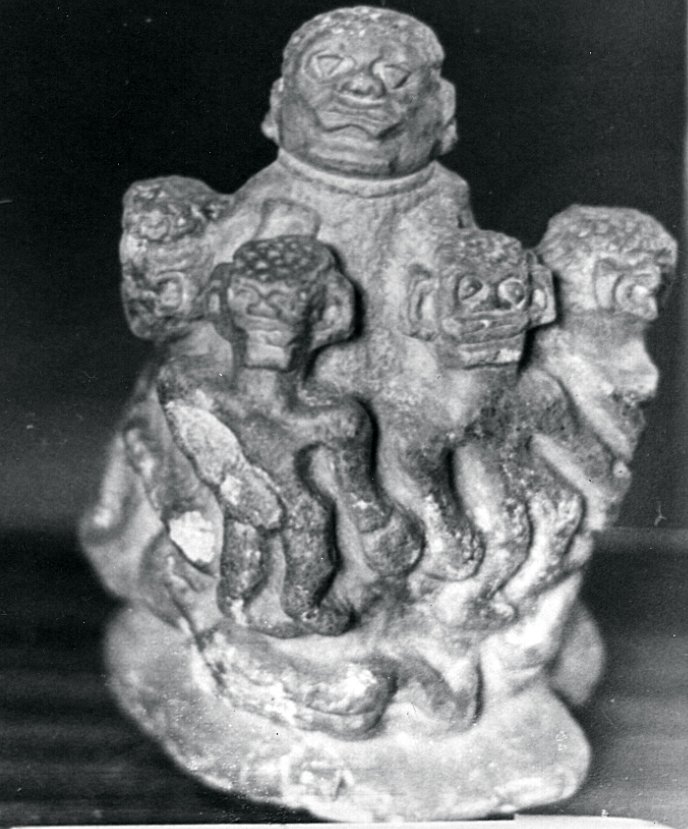
Nomoli (Musée national de Sierra Leone). Image credit: — Soapstone "Nomoli" figure from Sierra Leone (West Africa) - CC BY-SA 2.0
People of Africa also have memories of the giants who once lived on Earth. African legends describe these mighty beings as courageous and strong men with shining eyes, and their voices could be heard from one town to another.
An exciting discovery was made when a small metal ball was found in a hollow space inside the Nomoli figurine.
A legend tells that:
"They wandered without let or hindrance to places where no man had ever been before. One could not look them in the face because their eyes were so bright that it hurt one's own eyes to look at them. It was like looking at the sun."
Another legend says about divine creatures banned from the celestial empire and sent to Earth, which leads us to a representation of the "fallen angels" mentioned by various cultures.
This civilization, capable of reaching very high melting temperatures, also used the right tools for modeling perfectly spherical objects like those found inside the figures.
An analysis by the Museum of Natural History in Vienna, Austria, revealed that it is made from chrome and steel.
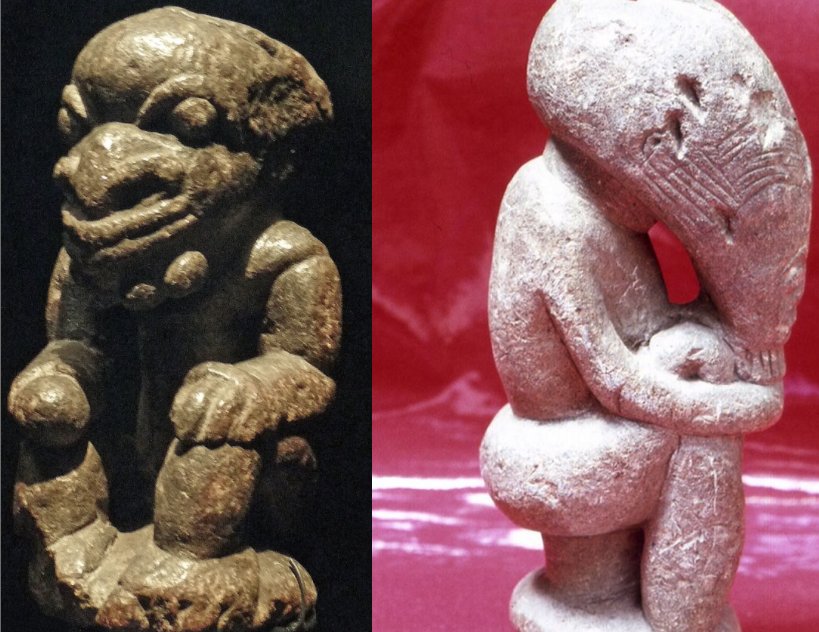
Left: Nomoli people, Mende, Sierra Leone; Right: Nomoli - Soapstone "Nomoli" figure from Sierra Leone (West Africa). Image credit: John Atherton, photo: British Museum, London, June 1970. - CC BY-SA 2.0
The earliest known production of steel is a piece of ironware unearthed in Anatolia (Kaman-Kalehoyuk) and is about 4,000 years old. How did it get there? And much more important - where did the metal come from?
The Somali - some were discovered at depths of 50 meters - depict mostly different human races from the so-called Caucasian to Negroid or their heads. Still, sometimes they resemble semi-human or semi-animal "monsters" and animals like monkeys, leopards, and elephants.
Some figurines depict lizards with human heads, and human figures with heads disproportionate to the rest of the body are usually shown in squatting or kneeling positions; one of the most common depictions represented by the Nomoli is a frightening-looking adult with a child.
Most Nomoli figures were made of soapstone or diverse kinds and colors of steatite, from dark green to light yellow-brown and almost white.

The Michael C. Rockefeller Memorial Collection, Bequest of Nelson A. Rockefeller, 1979 - CC0 1.0
The stone contains a high percentage of iron available in various parts of Sherbro Island in the Atlantic Ocean, located in Bonthe District off the Southern Province of Sierra Leone, West Africa.
Additionally, it is worth mentioning that none of these oral traditions indicates that the territory - now inhabited by the Mende - was previously occupied. It raises some critical questions: were there any earlier inhabitants?
Who were they? And what happened to them? Some scholars claim that these earlier inhabitants were the manufacturers of the mysterious Nomoli figurines carved in soapstone and found throughout the area now inhabited by the Mende people.
Those who sculpted the Nomoli figurines probably once occupied much of the present-day territory of the Mende, but according to ancient sources, they were pushed coastward.
Written by – A. Sutherland - AncientPages.com Senior Staff Writer
Updated on March 9, 2023
Copyright © AncientPages.com All rights reserved. This material may not be published, broadcast, rewritten or redistributed in whole or part without the express written permission of AncientPages.com
Expand for referencesReferences:
Basil Davidson, The African Genius
British Museum, London
More From Ancient Pages
-
 Why Was Ayllu Very Important For The Inca People?
-
 Gold Spiral In Early Bronze Age Grave – Unearthed
-
 Rare Medieval Hall Found Near Norman Castle At Skipsea, UK
-
 Jew’s Harps: Old Musical Instruments Discovered In Altai Mountains
-
 Long-Lost Wisconsin Ghost Ship F.J. King Finally Found
-
 On This Day In History: Statue Of Venus de Milo Is Discovered On The Aegean Island Of Milos – On Apr 8, 1820
-
 Major Discovery Reveals Neanderthals In Italy Engaged In Plant Food Processing
-
 Remarkable Neolithic Life-Sized Camel Engravings Discovered In The Nefud Desert
-
 Paleoindian Ochre Mine Found In Submerged Caves In Mexico’s Yucatan Peninsula
-
 Sarcophagus Of King Ramses II’s Head Of Treasury Found In Saqqara, Giza
-
 Intriguing Sumerian Clay Tokens – An Ancient ‘Book Keeping’ System Used Long After Writing Appeared
-
 ‘Cradle Of The Scythians’ Studied By Russian-Polish Archaeologists
-
 Never-Ending Battle Of The Oak King and Holly King – Confrontation Of The Light And The Darkness
-
 On This Day In History: Solar Storm Known As The Carrington Event Took Place – On August 28, 1859
-
 Six Ancient Giant Stone Spheres Recovered From The Diquís Delta, Costa Rica
-
 Evidence Of Unknown Ice Age Civilization Discovered In Michigan Ignored By Pipeline Company!
-
 New Genes May Explain Why Humans Got Such Big Brains
-
 On This Day In History: Edict Of Pistres ‘A New Law’ Against Viking Raids Issued – On July 25, 864
-
 Why Were The 4,000-Year-Old Native American Shell Ring Villages Suddenly Abandoned?
-
 Massive Bronze-Age Settlement Discovered Underwater in Greece

