
Why Did We Abandon Roman Numerals?
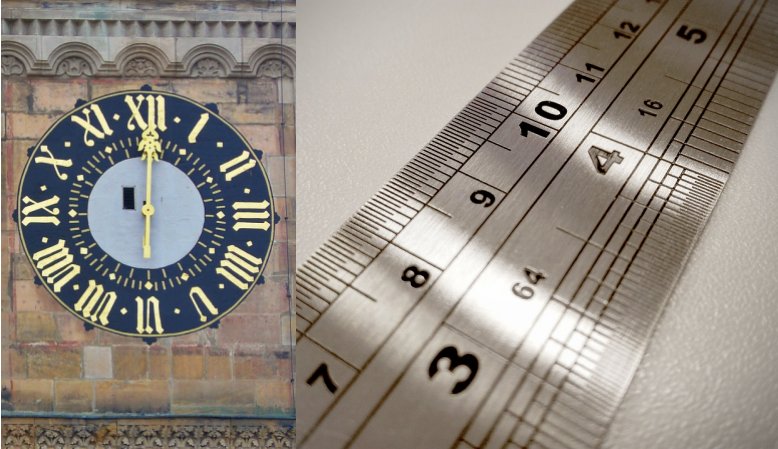
Conny Waters - AncientPages.com - It’s often said that we’ve abandoned Roman numerals, which is not entirely true. We can still find Roman numerals on clock’s, monuments, in books, personal titles and other places. We just don’t use the Roman numerals often because we switched to the Arabic numeric system.
Credit: Public Domain
Romans numerals are a numerical system composed of seven Latin letters. Ancient Romans adapted the numerical systems from Etruscan numerals.
The symbols are I, V, X, L, C, D, and M, standing respectively for 1, 5, 10, 50, 100, 500, and 1,000 in the Hindu-Arabic numeral system.
Ancient Romans and Europeans used Roman numerals for a long time, but it’s was not a practical numerical system. For example, Roman Numerals do not have a zero (0). Arabic numbers have ten digits (from 0-9) and they give us the opportunity to produce very large numbers.
See also:
Why Is The Three Golden Balls Symbol For A Pawn Shop Connected To The Medici Family?
Torquetum: Sophisticated Medieval Astronomical Instrument
Nomenclator: Ancient Living-Human Calendar And Address Book
Merkhet – An Ancient Egyptian Timekeeping Instrument
Leonardo Fibonacci (c. 1170 – c. 1250), an Italian mathematician who is considered the most talented Western mathematician of the Middle Ages introduced the Hindu–Arabic numeral system in the Western World primarily through his composition in 1202 of Liber Abaci (Book of Calculation).
While visiting North Africa, Fibonacci learned the Hindu–Arabic numeral system and he quickly understood this system was better suitable for mathematics. It should be noted that “the Arabs did not immediately adopt the Hindu zero, because it resembled their 5; they used the superscript dot as serving their purposes fairly well.” (The Hindu-Arabic numerals- David Eugene Smith and Louis Charles Karpinski)
Through his book he managed to convince many European mathematicians to abandon Roman numerals and start using the Hindu-Arabic system instead.
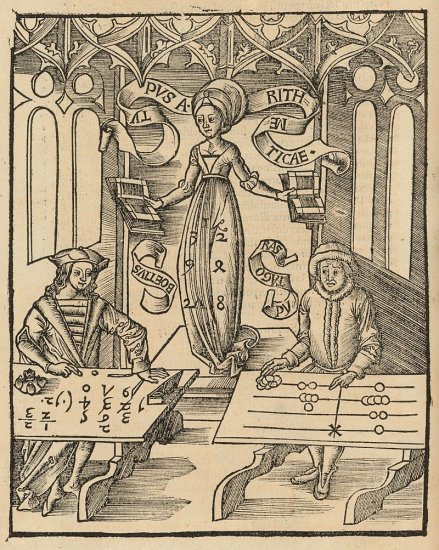
Calculating-Table by Gregor Reisch: Margarita Philosophica, 1503. The woodcut shows Arithmetica instructing an algorist and an abacist (inaccurately represented as Boethius and Pythagoras). There was keen competition between the two from the introduction of the Algebra into Europe in the 12th century until its triumph in the 16th. Credit: Public Domain
To keep track of their sales and expenses, ancient European merchants relied on counting beads and Roman numerals were only used to document the results. Even though the Hindu Arabic system offered many advantages, for some reason salesmen were rather reluctant towards it, and it took time before the new numerical system became accepted.
In The Introduction of 'Arabic' Numerals in European Accounting, John W. Durham explained that “the preference for Roman numerals continued among bookkeepers until the sixteenth century, hundreds of years after the introduction of Arabic numbers. The preferences is well-known, but the causes are not.”
In time people understood that by switching to the Hindu–Arabic numeral system it was possible to solve complicated mathematical problems and counting became much easier. The new system permitted mathematical operations to be made on arbitrarily large numbers.
Written by Conny Waters – AncientPages.com Staff Writer
Copyright © AncientPages.com All rights reserved. This material may not be published, broadcast, rewritten or redistributed in whole or part without the express written permission of AncientPages.com
Expand for referencesLouis Charles Karpinski and David Eugene Smith - The Hindu-Arabic Numerals
Durham, John W. "THE INTRODUCTION OF "ARABIC" NUMERALS IN EUROPEAN ACCOUNTING." The Accounting Historians Journal 19, no. 2 (1992): 25-55. http://www.jstor.org/stable/40698081.
More From Ancient Pages
-
 Humans Were Apex Predators For Two Million Years
-
 Troublemaker Eris: Greek Deity That Ignited Hatred Among All
-
 Ancient Codex Cospi: Intriguing Pre-Columbian Ritual Manuscript From Central Mexico
-
 War Between Romans And Persians Lasted 721 Years: One Of The World’s Longest Human Conflicts In History
-
 Ancient Petroglyphs In Toro Muerto Are Not What We Thought – Archaeologists Say
-
 Floors In Ancient Greek Luxury Villa Were Laid With Recycled Glass
-
 1500-Year-Old Mystery Of The Sandby Borg – Excavation Of Ringfort On Öland, Sweden
-
 Neanderthal Extinction May Have Been Caused By Sex, Not Fighting – New Study Suggests
-
 Stone Age Settlement Discovered Underwater In Finland
-
 On This Day In History: Great English Dramatist And Poet William Shakespeare, Was Probably Born – On Apr 23, 1564
-
 Mysterious Valkyrie Eir Remains An Enigma In Norse Mythology
-
 Danish Royal Sunken Ship Sheds Light On Psychological Warfare In The Middle Ages
-
 Mysterious Ancient Underground King And Ruler Of The World – Secret Science – Part 2
-
 Copper Artifacts Reveal New Cultural Connections In Southern Africa
-
 Ten Ancient Jugs May Reveal The Location Of The Biblical Tabernacle
-
 Mysterious Footprints In Tanzania Made By Early Humans Not Bears
-
 On This Day In History: Archbishop Thomas Becket Murdered – On Dec 29, 1170
-
 6,000-Year-Old Vast Settlement With Tools And Granite Structures Unearthed In Sotta, Corsica In France
-
 Why Is The Mysterious Menga Dolmen One Of The Greatest Neolithic Engineering Achievements?
-
 Mystery Of Monte d’Accoddi: Was It An Ancient Step Pyramid, Altar Or Astronomical Observatory?

