
Unsolved Mystery Of Gedi Ruins Protected By The ‘Old Ones’ – Why Did People Leave?
A. Sutherland - AncientPages.com - Will dense forests ever reveal the secrets of the mysterious abandoned city of Gedi, Kenya?
Wild stories had been circulating about this lost city, which was believed to be the work of Phoenicians or Egyptians stranded on the African coast.
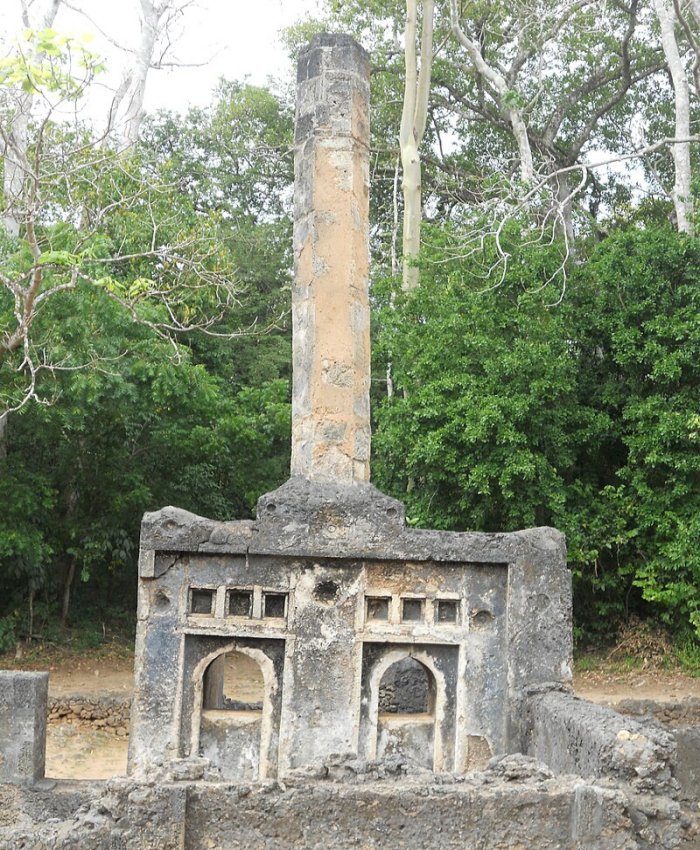
Pilar tomb at Gedi. Ruins of Gede, Kenya. Image credit: Maclemo - CC BY-SA 3.0
The circumstances and motivations behind the establishment of the Gedi settlement remain shrouded in mystery, leaving historians and archaeologists with more questions than definitive answers.
The city of Gedi, believed to be a vibrant hub for the Swahili people, flourished along the East African coast from the 13th to the 17th century. Its existence during this period suggests a lively and possibly prosperous community that engaged in trade and cultural exchanges. Interestingly, around the 16th century, this once-thriving urban center experienced an enigmatic phase of desertion, leaving it uninhabited for approximately 50 years.
This sudden abandonment raises intriguing questions about what might have driven its inhabitants away—could it have been environmental changes, economic shifts, or sociopolitical upheavals? Despite its significant historical presence, neither Portuguese colonizers nor other Europeans documented Gedi's existence; even Arabic or Swahili records make no mention of it.
This absence from historical narratives could suggest that Gedi was either overlooked by external powers or perhaps maintained a level of autonomy that kept it detached from broader geopolitical interests at the time. Yet, evidence suggests that its residents were not isolated; they most likely had interactions with overseas merchants who ventured along these coastal routes for trade purposes.
The estimated population stood at about 2, 500 people—a relatively modest number indicating a close-knit community possibly thriving on local resources and trading connections across maritime networks. How such an influential city could fade into obscurity without leaving more prominent traces in historical records and what daily life must have been like within its walls before they fell silent.
James Kirkman, the archeologist who first worked at the Gedi site, said:
'when I first started to work at Gedi I had the feeling that something or somebody was looking out from behind the walls, neither hostile nor friendly but waiting for what he knew was going to happen.'
The ancient city of Gedi (also known as Gede) is said to be 'a kind of mystery' because it was inexplicably abandoned twice - in 1500 and in 1700.
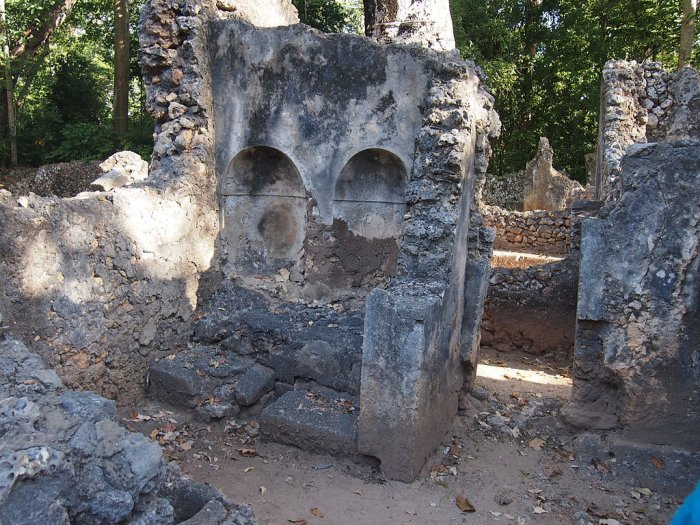
Gedi ruins, Kenya. Image credit: ordercrazy - CC0 1.0
The remaining structures include coral stone buildings, mosques, houses, and a palace. Officially, Gede buildings date back to the 15th century but it is believed that the site was inhabited as early as the 11th or 12th century.
Now in ruins, Gede (or Gedi, which means "precious") is one of the most important historical and archaeological sites in Kenya since 1984. It is located about 5 km from Watamu, a small town located approximately 105 km north of Mombasa, close to Kenya’s Indian Ocean coast.
Also, the reasons for Gedi's location remain thoroughly obscure and its absence from historical records grows more inexplicable the more you think about it.
Gedi's beautiful ruins are confusing and eerie, especially in the late afternoon. Gedi has a sinister reputation and local people - who have heard a number of ghost stories and tales of inexplicable happenings - have always been uneasy about it.

Ruins of Gedi. Image credit: LutzBruno - CC BY-SA 4.0
This large, thirteenth- to seventeenth-century Swahili town, led by a very rich Sultan was built only of stones and boulders. The place was apparently unknown to the Portuguese, despite the fact that they were present in the area only 15km away from Gedi for nearly a hundred years.
It was during a time when Gedi was believed to have been at the peak of its prosperity, to which contributed participation in maritime trade as archaeologists excavated many artifacts that included the ceramics, all the beads, and the two Chinese coins.
The city of Gedi with more than 2500 inhabitants was surrounded by two walls that separated the social middle-class (the so-called bourgeois) from the common citizens.
 The palace of Gedi. source
In the bourgeois part of Gedi, there are the ruins of three mosques, the sultan's palace, and many houses, inside which archaeologists excavated objects from different parts of the world. The most important objects found were scissors from Spain, a lamp from India, glass from Venice, and the remains of a Chinese vase.
These finds prove either direct or indirect trade with the Near East, Arabia, China, India, and Indochina. Not only Gedi but also other Swahili coastal settlements exported gold, ivory, slaves, ebony, mangrove poles, copper, copal gum, frankincense, myrrh, and crystal rock.
Despite much research, no one can say with certainty what really happened to Gedi and its inhabitants. No signs of battle or pestilence to assume such a double evacuation, have never been found.
Gedi is not mentioned in any Arab or Portuguese chronicles of that period but according to local tradition, the ruins are protected by the spirits of its priests, the 'Old Ones' who supposedly curse anyone who harms the site or removes anything.
 Ruins of the Great Mosque of Gedi. source
Excavations between 1948 and 1958 revealed that the city traces its origin in the twelfth century but was rebuilt twice with new town walls in the fifteenth and sixteenth centuries.
The city was entirely built with coral stones, lime, and sand and had drainage gutters. Its streets were laid out at right angles and high walls, with only four input ports that correspond to the four cardinal points, surrounded the city.
In the ruins of Gedi, the remains of large tanks that supported the city with water are clearly recognizable, along with the two concentric walls fences placed to protect the site, numerous apartment buildings, some of which still bear the traces of the architectural short period of Venetian rule.
Large stone houses of Gedi were complex for their time, with bathrooms with drains and overhead basins to flush toilets, which are all of the identical design, and still look superior to all others usually seen in Kenya. Once Gedi was a thriving community along the jungle coast of East Africa and its inhabitants traded with people from all over the world.
In the ancient abandoned palace of Gedi, there are mysterious tunnels, secret rooms, and the remains of several unidentified tombs.
First version of this article was written in 2015.
Updated on Nov 2, 2024
Written by – A. Sutherland AncientPages.com Staff Writer
Copyright © AncientPages.com All rights reserved. This material may not be published, broadcast, rewritten or redistributed in whole or part without the express written permission of AncientPages.com
Expand for referencesMore From Ancient Pages
-
 Royal Inscription Of Naram-Sîn Of Akkad: The First Ancient King To Use Blocks For Printing Bricks
-
 Knights Templar’s Mysterious Underground Chambers Hidden In The Caynton Caves Discovered
-
 Ancient Burial Of Woman Equipped With A Unique Gold Pectoral Ornament Discovered In Siberian ‘Valley Of The Kings’
-
 Kofun: Megalithic Keyhole-Shaped Tombs That Belonged To High Status People In Japan
-
 Mysterious Wise Pre-Flood Beings Who Gave Humans A Precious Gift – Did We Reject It?
-
 Rare Bronze Seal Matrix Of St. George Slaying The Dragon Discovered In French Castle
-
 A Rare Pre-Roman Tomb Unearthed In Pompeii
-
 Old Sword Decorated With Inscription And Related To 1173 Battle Of Fornham – Unearthed
-
 Secret Tunnel Leads To Christian Chapel In Ancient Suomela Monastery In Turkey
-
 Cursed Dwarf Fafnir Turned Into A Fearsome Norse Dragon And Guarded The Stolen Magical Ring Andvaranaut
-
 Uncovering The Lost Indigenous Settlement Of Sarabay, Florida
-
 Coral Castle Is Among Most Fascinating And Mysterious Buildings In Florida
-
 Assyrian King Ashurbanipal’s Great Library With Thousands Of Cuneiform Tablets
-
 10 Ancient Love Symbols
-
 Unknown 8,000-Year-Old Human Settlement With A Rock-Cut Temple, Altar And Inscriptions Discovered In Al-Faw, Saudi Arabia
-
 7,000-Year-Old Grains Hints At Origin Of Swiss Pile Dwellings
-
 Mysterious Sumerian Queen Puabi And Her Magnificent Underground Burial Complex – Many Followed Her To Afterlife
-
 Controversial Artifacts Linked To Cradle Of Civilization In The Americas Result In Scientific Disagreement
-
 Discovery Of Second Viking Site Point Rosee In North America Could Re-Write Ancient History
-
 Secret Dwelling Place Of Reptilian And Dragon-Like Creatures In Europe

