
Bertrand du Guesclin: ‘Eagle Of Brittany’ Brave, French Commander And His Clash With Sir Thomas Of Canterbury
A. Sutherland - AncientPages.com - Bertrand du Guesclin (c. 1320 – 1380) was the son of a poor knight from Brittany. He was known by nicknames: "The Eagle of Brittany" or "The Black Dog of Brocéliande."
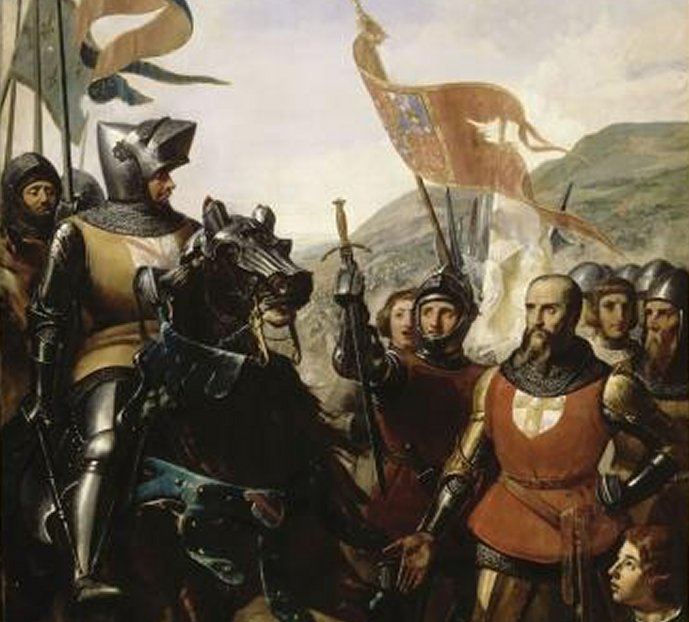
Guesclin at the Battle of Cocherel. Image credit: Charles-Philippe Larivière - CC BY-SA 3.0
Bertrand had not a happy childhood, mainly because he early learned to hate his violent father.
This man wasn't a handsome man. He was far from the kind of man we usually think of as a knight, at least in appearance. Everyone who met him seemed to agree on his unique ugliness. His body was short-grown and square-shaped, and his head was more than usually round. His arms were disproportionately long.
Bertrand And His Trusty Companions In Brocéliande Forest
In the 1340s, the Duchy of Brittany was plagued by a victorious civil war. The old duke's half-brother Charles de Blois, and his niece Jeanne de Penthiévre raved about who could take over.
Jeanne gathered a large group of fighters who would act as guerrilla warriors. Among them was also Bertrand du Guesclin. He bought enough weapons and armor for a smaller group of reliable men by selling his mother's jewels.
Bertrand and his trusty companions hid in the Brocéliande Forest, a legendary enchanted forest that, among medieval Europeans, was imagined as a place of magic and mystery. The forest was believed to be somewhere in Brittany, but its location was never established. Probably the site was only a product of human imagination.

Merlin and Viviane in Brocéliande, Gustave Doré's illustration for Idylls of the King (1868). source
The knight, Bertrand du Guesclin, reminds us of Robin Hood, a legendary heroic outlaw, and a highly skilled archer and swordsman.
Bertrand, however, was an actual historical figure. With his band of fighters, he organized quick and effective attacks, returning safely to his hiding place in the forest.
Bertrand - Military Commander
Bertrand was a Breton knight and an important military commander, who was involved in the Breton War of Succession (1341–1364), Castilian Civil War (1351 - 1369), and the Hundred Years War (1337-1453).
From 1370 to his death, he was Constable of France for King Charles V. King Charles V was particularly impressed with Bertrand's resistance to the English in the siege of Rennes and took him into royal service.
Bertrand was a good and intelligent commander, but not all his military encounters with the enemy succeeded.
He was well known for his Fabian strategy, avoiding regular field battles, harassing the English troops through what is called modern guerrilla warfare, and effectively disrupting supplies of the enemy. He made a famous military career through sheer fighting skills.
He often took part in battles, where the fighting location and time were determined earlier, and won the four in which he held command. Despite many years of military service, Bertrand was dubbed a knight at the unusually high age of 34.
Incident With Sir Thomas Of Canterbury
In 1356, Bertrand was sent to the town of Rennes, which the Duke of Lancaster besieged. The English knight, Sir Thomas of Canterbury, captured Bertrand's little brother during a truce. Such an act was against the rules of war, and Bertrand immediately rode straight into the English camp. When Bertrand entered his tent, Sir Thomas was playing chess with an English knight, Sir John de Chandos. The brave Frenchman challenged Sir Thomas to a sword duel, and the latter didn't protest.
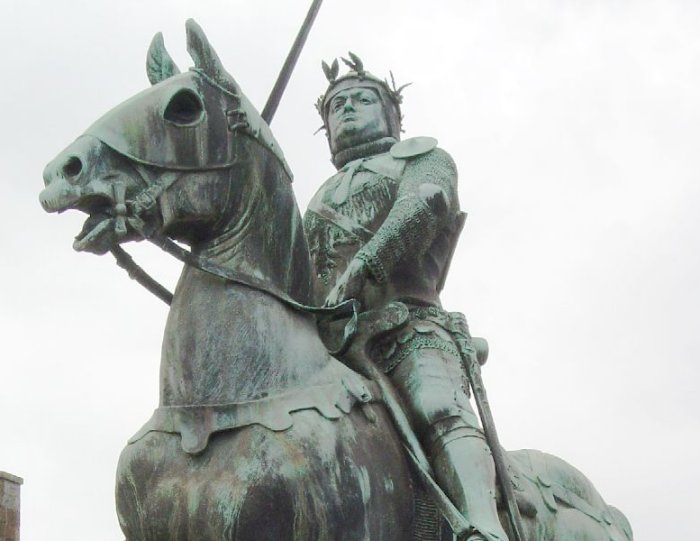
Statue of Bertrand du Guesclin in Dinan. Source
He was convinced that he would defeat this strange-looking intruder. Sir Thomas was wrong.
Bertrand did not add any other life-threatening injuries to his opponent, but he drew attention to his extraordinary sword-fighting skills. During the next half hour, however, he got into so much trouble that he could not go on for several days after this most unfortunate encounter with Bertrand, the knight.
Then he returned home with his abducted brother.
Bertrand was given many assignments, and many of them were victorious. In the Battle of Navarrete in 1367, for example, he was defeated by the Black Prince, a military genius who was a talented warrior. Often captured, then redeemed, Bertrand was known for his boldness and handled well the hostile captivity that he experienced frequently.
In 1380, however, he returned to the French king's service to fight the English but died on July 13. Bertrand du Guesclin was buried, on the command of King Charles V, in Saint-Denis, the burial ground of the French kings.
He was a highly skilled commander whose military capabilities contributed to France's successes, so he deserved an honorable royal burial.
Written by – A. Sutherland - AncientPages.com Senior Staff Writer
Updated on April 29, 2023
Copyright © AncientPages.com All rights reserved. This material may not be published, broadcast, rewritten or redistributed in whole or part without the express written permission of AncientPages.com
Expand for referencesMore From Ancient Pages
-
 Enigmatic Underground Iron Age Monument At Navan Fort And Its Connection To The Ulster Kings Investigated
-
 Hindu Monkey God Hanuman May Have Been Homo Erectus – Scientist Says
-
 Stone Water Well Dated To Sassanid Era (224-651 CE) Unearthed In Isfahan Hills, Iran
-
 Neanderthals Had Older Mothers And Younger Fathers Compared To Modern Humans
-
 Radiocarbon Dating Sheds Light On Historical Events In The Ancient City Of Gezer
-
 Unknown Saxon Village And Bronze Age Artifacts Found Near Ely, Cambridgeshire
-
 Mysterious Tiahuanaco Empire Established By The Sons Of The Sun – An Unknown Chapter Of Prehistory
-
 Ancient Secrets Of Mysterious Dead Sea Scrolls And Eastern Papyri Revealed By Handwriting Analysis
-
 Did Ancient Romans And Greeks Love As We Do? Perhaps Even More Hopelessly
-
 Legend Of Kauravas – Ancient Cloning And Test Tube Babies In India?
-
 Archaeologists Excavate Two Roman Bath Hidden In A Dark Passage Below The Streets Of Bath
-
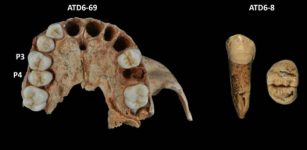 Neanderthals Are Not The Only Species Whose Dentition Is Characterized By The Possession Of Thin Enamel
-
 Undersea Scans Reveal Astonishing Ancient Submerged World Of The Adriatic Sea
-
 Golden Stool Of Ashanti People And Legend Of The Black Cloud Appearing In The Sky
-
 Large Ancient Roman Necropolis Is Buried Beneath The Gaza Strip – Can It And Other Ancient Treasures Be Saved?
-
 Chartres – Symbol Of Power And Secret Ancient Knowledge
-
 Controversial Ancient History: Did Humans Evolve From Reptilians? The Serpent Connection From Ancient Myths To Modern Science
-
 Deciphered Ancient Cuneiform Tablets Reveal Locations Of Long-Lost Cities And Shed Light On The Secrets Of Mesopotamia
-
 Mysterious Shape-Shifting Beings In Ancient Greece
-
 Ancient Superhighways: 12,000-Year-Old Massive Underground Tunnels From Scotland To Turkey

