
Feud Between The Medici And The Borgia Families – What Caused The Renaissance Clash?
Ellen Lloyd - AncientPages.com - Whether in ancient or modern times, family feuds have always occurred, and sometimes, a small incident can ignite a fight that will last for generations.
The rivalry between the Medici and Borgia, two of the most powerful families of Renaissance Italy, was an interesting chapter in European history.
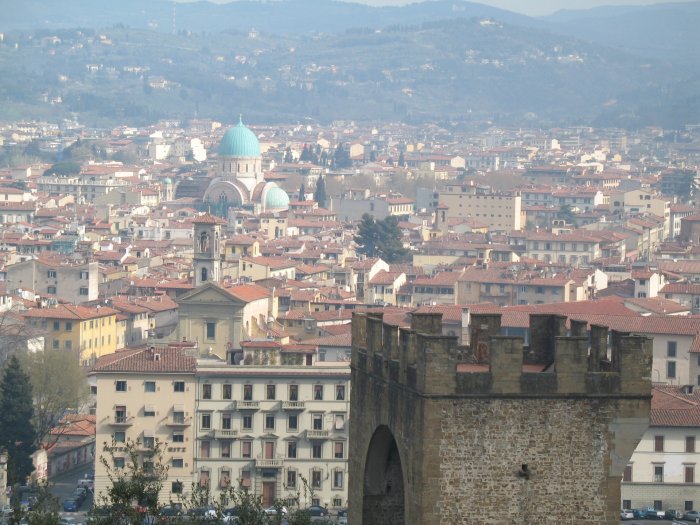
Florence, Italy. Credit: Public Domain
These two families were enemies, but what caused the feud, and why did the House of Medici and the House of Borgia hate each other? Did they really have such strong and negative feelings about one another? Could some historical events have been exaggerated?
Being described as one of history's most infamous families, the House of Borgia had a long list of enemies and constantly came into conflict with powerful people. It didn’t seem to bother them much because getting into trouble was almost a daily routine to them.
The Medici family were no saints either. They, too, had their share of enemies. The House of Medici didn’t like to be questioned, and if someone stood in their way, Medici's family members didn’t hesitate to deal with the “obstacle” in their own way.
Nevertheless, the reason for the strained relationship between the Medici and the Borgia is still discussed today.
The Medici And The Borgia – Two Similar And Yet Entirely Different Families
There were many similarities between the House of Medici and the House of Borgia. Both families were powerful and played an important role in Renaissance Italy.
What was different about the Medici and the Borgia was how they rose to power, how they acquired their wealth, and where they originally came from.
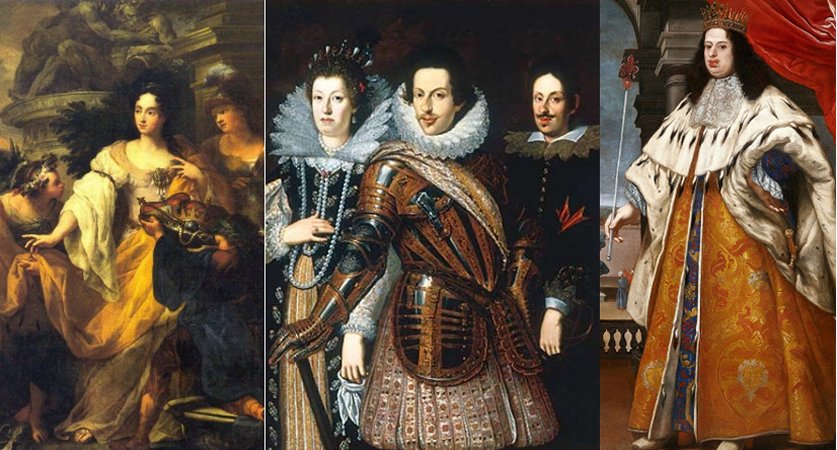
Left: Anna Maria Luisa de' Medici, the last of the Grand Ducal line, in Minerva, Merkur und Plutus huldigen der Kurfürstin Anna Maria Luisa de' Medici (English: Minerva, Mercury and Pluto pay homage to the Electress Anna Maria Luisa de' Medici) after Antonio Bellucci, 1706- Credit: Public Domain
Middle: The Grand Duchess Maria Maddalena, The Grand Duke Cosimo II, and their elder son, the future Ferdinando II. Credit: Public Domain Right: Cosimo III, the Medicean grand duke, in Grand Ducal regalia. Credit: Public Domain
The Medici family were like Renaissance Godfathers, and once their founder Cosimo de' Medici came to Florence, they quickly rose to political power.
Unlike the Borgia, who originally came from Spain, the Medici were pure Italian people. They used every opportunity to gain more wealth and influence. Being good businessmen, they knew how to divide their money into different investments. The Medici Bank was founded in 1397 and was one of Europe's most prosperous and respected institutions. For some time, the Medici was considered the wealthiest family in Europe.
The start for the Borgia family was not an easy one. They came to Florence as immigrants from Aragon, Spain, but didn’t waste much time. They pursued Papal support and authority in their new home country. Whether they were cunning or just clever is a matter of opinion, but the House of Borgia acquired a large fortune very quickly.
The Medici family were great supporters of the arts, paid their taxes, and built magnificent buildings. They followed Italian customs and spent much of their money on charitable activities. This doesn’t mean that they were not corrupt. The Medici family was exiled briefly and had to leave Florence.
“On November 17, Charles VIII entered Florence in triumph, to the wild cheers of the fickle populace, for whom the arrival of the French army had been the catalyst that had enabled the expulsion of the detested Piero de’ Medici, who had arrogantly exercised his authority in the city since the death of his father, Lorenzo il Magnifico, two years earlier,” Christopher Hibbert writes in the book The Borgias and Their Enemies: 1431-1519.
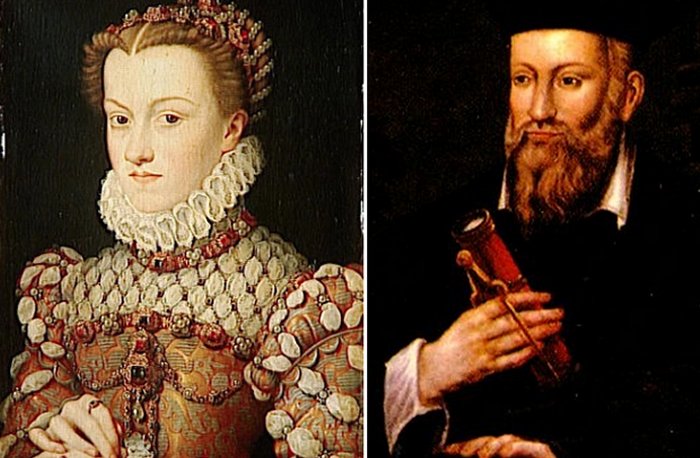
Catherine de Medici (left) believed in prophecies and supported Nostradamus (right). Both images credit: Public Domain - Read more
The Borgia family were also patrons of arts and contributed to the Renaissance, but they were not especially eager to share their wealth. In fact, much of their fortune was acquired at the expense of the Italian people. This made them very unpopular among Italians.
Both families had an interest in the Church, and the Medici produced four Popes Pope Leo X (1513–1521), Pope Clement VII (1523–1534), Pope Pius IV (1559–1565), and Pope Leo XI (1605). In addition to this, the Medici family could also boast of having two queens, Catherine de Medici (1547–1559) and Marie de Medici (1600–1610)
The Borgia family managed to get two of its members elected as Pope –Pope Callixtus III 1455–1458 and Pope Alexander VI (1492-1503).
The Feud Between The House Of Medici And The House Of Borgia
Feuds are usually battled over money, power, social position, prestige, and royal placement.
Of course, all these factors contributed to the clash between the Medici and the Borgia, who were grasping for power.
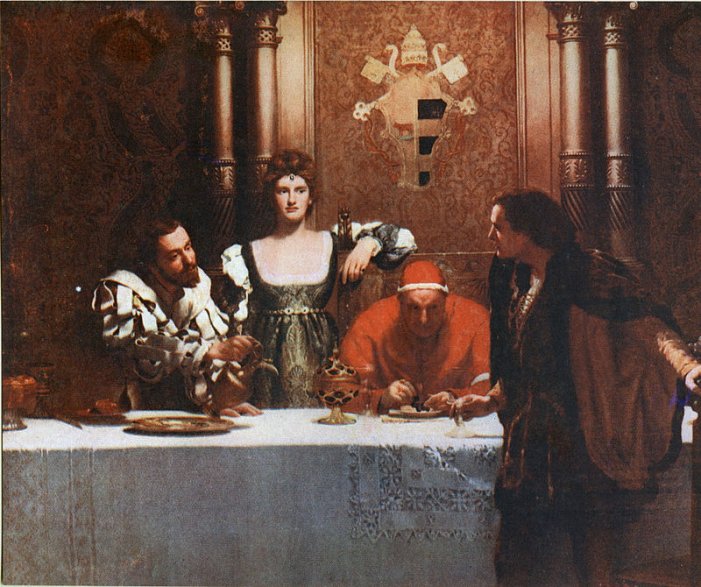
Painting by John Collier, "A glass of wine with Caesar Borgia", from left: Cesare Borgia, Lucrezia, Pope Alexander, and a young man holding an empty glass. The painting represents the popular view of the treacherous nature of the Borgias - the implication being that the young man cannot be sure that the wine is not poisoned. Credit: Public Domain
When Borgia’s Alexander VI was elected as a Pope, Cardinals who knew him were unhappy that he would lead the Roman Catholic people. It was especially during the reign of Pope Alexander VI that the House of Borgia was suspected of many crimes, including adultery, incest, theft, bribery, and murder.
Giuliano della Rovere was among the few Cardinals Pope Alexander VI couldn’t bribe. In the book The Borgias: Three Faces of Evil, author Andrew Alexander writes that Giuliano della Rovere “would become Alexander’s chief adversary and a thorn in Alexander’s side for his entire pontificate.
Additionally, Cardinal Giovanni di Lorenzo de Medici, later Pope Leo X, also had concerns. He was reported as pronouncing: "Now we are in the power of a wolf, the most rapacious perhaps that this world has ever seen. And if we do not flee, he will inevitably devour us all."
Money was one of the main reasons the Medici and the Borgia became enemies. During one period, the Medici Bank experienced difficulties maintaining a high reserve balance. The House of Medici had problems getting Italian people to repay their debt. When Pope Alexander VI needed money, the Medici Bank could not offer him the requested amount he wished. Another reason for the tension between these two families was the fact that the Borgia originated from Spain and the Medici were Italians.
Eager to gain more power, the House of Borgia also made enemies of the Sforza and the Dominican friar Savonarola, among others.
The House of Borgia was not meant to last. In the early 16th century, the Borgia family lost power and influence in Italy. The House of the Medici continued to prosper and survived for centuries.
In the middle of this Renaissance feud between two money-hungry families, ordinary people tried to figure out whether they should listen to the Church, the philosophers or form an opinion of their own.
Florence flourished, and today, it’s easy to understand why this beautiful city was so interesting in those years. There was something special about the Renaissance, a time that marked Europe for many years to come.
Updated on November 30, 2023
Written by Ellen Lloyd – AncientPages.com
Copyright © AncientPages.com All rights reserved. This material may not be published, broadcast, rewritten or redistributed in whole or part without the express written permission of AncientPages.com
Expand for referencesMore From Ancient Pages
-
 Ancient Maya Used An Unknown And Ingenious Method To Prevent Tooth Decay And Infections – Scientists Say
-
 Huehueteotl: Old Aztec God Of Fire, Time And Aging – Ceremony Of The New Fire
-
 Identity Of Anti-Christ And Number 666 Revealed By Ancient History Professor
-
 Stunning Reconstruction Of Caterthun Iron Age Forts In The Grampian Mountains, Scotland
-
 Tower Of Babel Story As Told By The Choctaw Indians And The Cherokee
-
 First Leaf Fossils Study Reveals An Ancient 4 Million-Year-Old Forest In Borneo
-
 Five Witchcraft Myths Debunked By An Expert
-
 On This Day In History: Mount Fuji Erupted – On Dec 16, 1707
-
 Graffiti Reveals Crusaders’ Beautiful Altar In The Church Of The Holy Sepulchre
-
 Vikings’ Long Distance Trade Reached The Arctic – Deer Antler Combs Reveal
-
 2,500-Year-Old Tibetan Medical Text Describes A Coronavirus-Like Outbreak In Surprisingly Accurate Details
-
 Mysterious Jade Cong – Perplexing Ancient Chinese Artifact
-
 4500-Year-Old Fingerprints Reveal Children Created Pottery Vessels In Ebla Kingdom
-
 Unusual Carved Stone Pillar With ‘Special Powers’ Discovered In Canada Confirmed Authentic Indigenous Artifact
-
 Unexpected Discovery Reveals People Arrived In North America 20,000 Years Earlier Than Previously Thought
-
 Has The Mystery Of The 11,000-Year-Old Amazonian Rock Art Been Solved?
-
 Hollow Bones That Let Dinosaurs Become Giants Evolved At Least Three Times Independently
-
 Amazing New Frescoes With Mythological Individuals Discovered At Pompeii
-
 2,000-Year-Old Huge Terracotta Jar Discovered In Turkey
-
 A Well-Preserved Lararium Shrine Discovered At Pompeii

