
Shishak (Sheshonq I): Egyptian King Who Invaded Judah And United Egypt
A. Sutherland - AncientPages.com - Shishak (Shishaq), later identified with the pharaoh Shoshenq I, was an Egyptian pharaoh who sacked Jerusalem in the 10th century BC, according to the Hebrew Bible.
Who Was Shishak – Sheshonq I?
Shishak (it was his Biblical name) was an official of a Semitic family and a Libyan chieftain. His family was long settled in Egypt, and had particular associations with the town of Bubastis, which became their residence. Shishak’s grandfather (he had the same name) obtained his higher position through the intermarriage leading directly to the royal house.
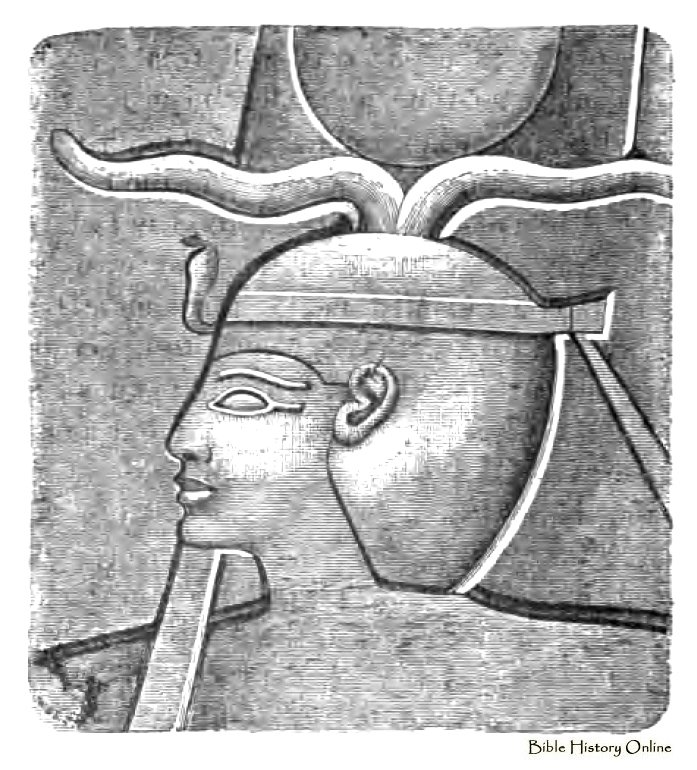
The head of Shishak. Image credit: Bible History Online
"His father Namrut, had held a high military office, being commander of the Libyan mercenaries, who at this timeformed the most important part of the standing army. Sheshonk himself, thus descended, was naturally in the front rank of Egyptian court-officials.
When we first hear of him he is called “ His Highness,” and given the title of “ Prince of the princes,” which is thought to imply that he enjoyed the first rank among all the chiefs of mercenaries, of whom there were many..." we read in George Rawlinson's book "Ancient Egypt".
During the rule of Shishak/Sheshonq I, Egypt was united and he understood that he must act effectively and quickly to become a legitimate pharaoh. Besides, he married an Egyptian princess, Maatkare, a daughter of Psusennes II, the last pharaoh in the 21st dynasty and thus, he forged another important marriage tie. It obviously helped his son to hold the title of high priest of Amun.
With a strong ruler, Shisak/Sheshonq I, began the sequence of Libyan chiefs who were to rule Egypt for the next two centuries. He brought the divided faction Tanis and Thebes together into a once again united Egypt.
He made also possible for his sons to get prominent high offices and thus, he stabilized Egypt’s political situation.
Shishak's Campaign Against Kingdom Of Judah And His Sack Of Jerusalem
According to the Hebrew Bible, Shishak had provided refuge to Jeroboam, the first king of the northern Kingdom of Israel who ruled c. 943–922 BC) during the later years of Solomon's reign.
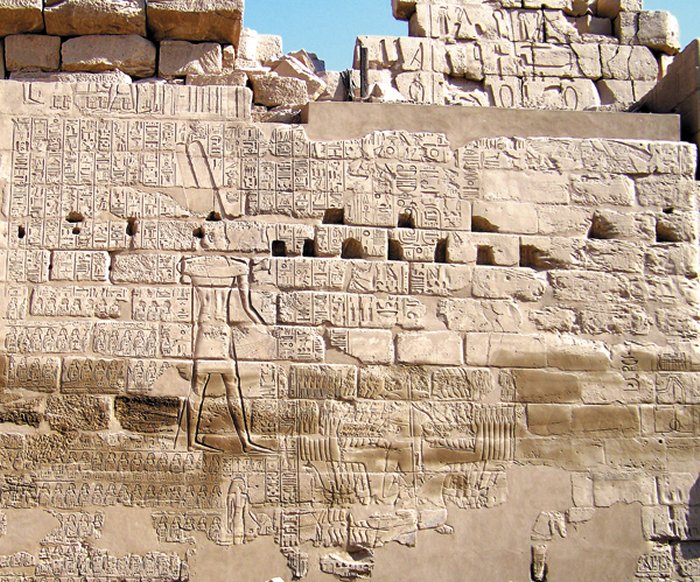
The Bubastite Portal includes a large weathered relief in which the pharaoh lists more than 150 towns and peoples he conquered during his military campaign into Israel and Judah in c. 925 B.C.E. Photo: © Regents of the University of California/Courtesy the Digital Karnak Project. Image via Biblical Archaeology.org
Following the death of Solomon in 930 BC, the kingdoms of Judah and Israel under Rehoboam (Solomon's son) and Jeroboam I, respectively, were not able to offer much resistance to Shishak’s approaching army.
Shishak, king of Egypt, attacked the Kingdom of Judah with a huge and powerful army of 60,000 horsemen and 1,200 chariots, in support of his ally Jeroboam, the king of Israel. According to 2 Chronicles 12:3, he was supported by the Lubim (Libyans), the Kushites, and the Sukkiim, an ancient African nation.
These important events took place in the 5th year of the reign of Rehoboam, a son of and the successor to Solomon, and a grandson of David. Rehoboam managed to build fifteen fortified cities, which means that the attack of the Egyptian ruler was not totally unexpected.
Shishak's campaign against the Kingdom of Judah (which is documented with a stele discovered at Tel Megiddo) and his sack of Jerusalem is mentioned in the Hebrew Bible (2 Chronicles 12:1-12 and 1 Kings 14:25:
“In the fifth year of King Rehoboam, Shishak king of Egypt attacked Jerusalem. He carried off the treasures of the temple of the Lord and the treasures of the royal palace. He took everything, including all the gold shields Solomon had made…”
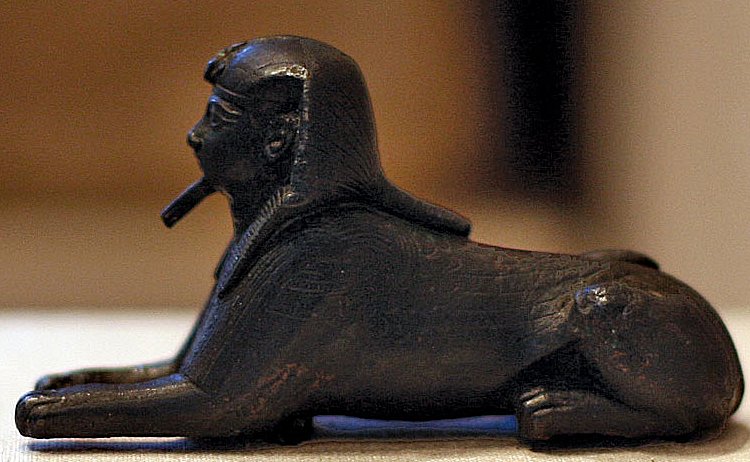
Sphinx of king Shoshenq I, Brooklyn Museum, New York City. Image credit: CC BY-SA 2.0
Rehoboam had to replace them with the brass ones.
According to "Antiquities of the Jews" written by Flavius Josephus (37 – c. 100), a first-century Romano-Jewish scholar, historian, and hagiographer, who was born in Jerusalem—then part of Roman Judea, the invading army met with no resistance throughout the campaign, taking Rehoboam's most fortified cities "without fighting."
Many believe that Shishak did not destroy Jerusalem but was bought off from entering it by being given all the treasures. Thus Jerusalem was spared destruction because Rehoboam paid tribute to Shishak.
2 Chronicles 12:8 confirm that the city does not appear to have been sacked: nor was there any destruction. Rehoboam was maintained in his kingdom, but he had to become pharaoh’s servant.
Except for biblical records, there is also a monument declaring Shishak’s victory and naming those 50 cities the Pharaoh captured. This monument can be found at the temple of Amun in Karnak. The exact number of cities captured by Shishak is still debated and so is the Bubastite Portal, a relief discovered at the temple of Amun in Karnak, in Upper Egypt.
It shows the cartouches of Shishak/Sheshonq I and his historical military campaign. In fact, the relief makes no mention of Jerusalem being sacked, nor of the king Rehoboam or Jeroboam.
He was succeeded by his son Osorkon I after a reign of 21 years. No trace has yet been found of his tomb. The sole funerary object related to Shoshenq I is a canopic chest of unknown provenance that was donated to the Egyptian Museum of Berlin by Julius Isaac in 1891.
Does it mean that his tomb was looted in antiquity? There are speculations regarding the tomb's location. Is he buried in Tanis or perhaps in Bubastis?
Written by – A. Sutherland - AncientPages.com Senior Staff Writer
Copyright © AncientPages.com All rights reserved. This material may not be published, broadcast, rewritten or redistributed in whole or part without the express written permission of AncientPages.com
Expand for referencesMore From Ancient Pages
-
 DNA From 10,000-Year-Old Scandinavian Chewing Gum Reveals Stone Age Diet
-
 “The Starving Of Saqqara Statue” And Its Undeciphered Inscription Could Pre-Date The Pyramids Of Egypt
-
 Famous Ancient Hittite Figures And Symbols Engraved In Stone By A Local Artist From Çorum Province, Anatolia
-
 Deciphered Ancient Cuneiform Tablets Reveal Locations Of Long-Lost Cities And Shed Light On The Secrets Of Mesopotamia
-
 3,800-Year-Old Wall Relief Created By Ancient Caral People Unearthed In Peru
-
 Largest Ever Recorded Ancient Petroglyphs Found In Venezuela – Mapped
-
 Mysterious Steles Of Mongolia – ‘Deer Stones’ In The Tsatsyn Ereg Necropolis
-
 A 4.4 Million-Year-Old Hand Of ‘Ardi’ Has Some Clues On Humans’ Upright Walking
-
 1,000 Bog Bodies From Across Scandinavia Reveal More Ancient Secrets – Here’s What Scientists Found
-
 Khufu Boat And Unique Boat-Building Technique Of Ancient Egyptians
-
 Teens Make Incredible Discovery In An Ancient Florida Cave
-
 Meskiaggasher: Legendary Founder Of The First Dynasty Of Uruk Who ‘Entered The Sea And Disappeared’
-
 2,000-years-old tomb found in S. China
-
 ‘Curious’ Creature With No Anus Is Not Earliest Human Ancestor – Relieved Scientists Discover
-
 Hulagu Khan Destroyed Thousands Of Priceless Ancient Books Kept In The House Of Wisdom In Baghdad
-
 Beowulf Is Much Older Than Previously Thought And Not An English Poem – Professor Says
-
 On This Day In History: The Battle of Blore Heath – Sep 23, 1459
-
 Easter Island’s Society Was Sophisticated And Its People Shared Information And Collaborated
-
 3,500-Year-Old Tomb Discovered In Luxor – Who Is The Royal Buried Inside?
-
 Huge, Cylindrical Pre-Incan Chullpas Of Sillustani, Peru Were Used As Graves For Colla Nobles

