
Ancient Basilica Cistern: Intriguing Hidden Subterranean World With Medusa Heads
A. Sutherland - AncientPages.com - The astonishing Basilica Cistern, or the "Sunken Palace," is located underneath the streets and houses of Istanbul, Turkey. It is a marvelous hidden subterranean world decorated with two Medusa heads.
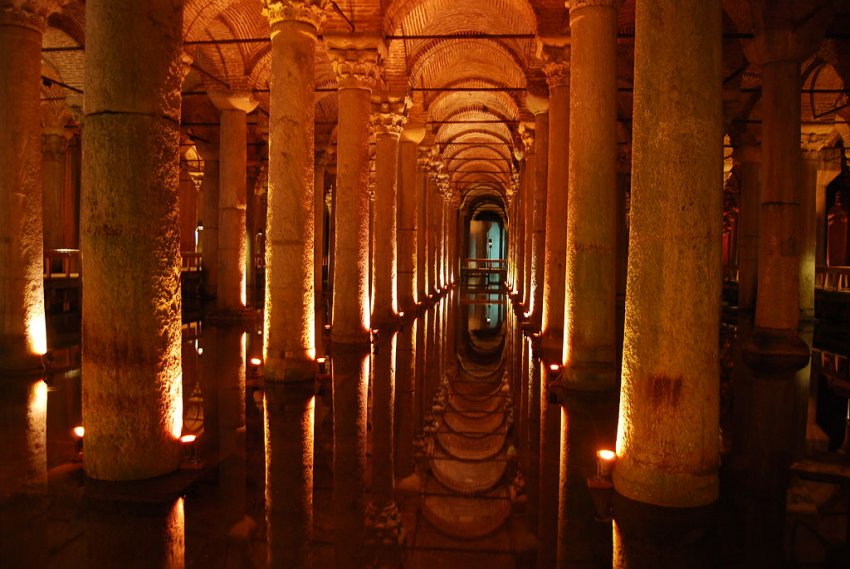 Image credit: Wikipedia - Dpnuevo
In 1545, Peter Gyllius, a Frenchman visiting Constantinople, heard remarkable stories of locals drawing up fresh water and fishing from holes in their cellars. He became so intrigued by these fascinating stories and the legends of great underground temples that he decided to explore and find this mysterious place.
Upon further investigation, he rediscovered a subterranean marvel, the largest of the long-forgotten palatial cisterns of the Byzantine Empire.
Fish swam in an artificial freshwater lake the size of two football fields, and the vaulted brick ceilings were held up by 336 thirty-foot pillars taken from nearby Roman ruins.
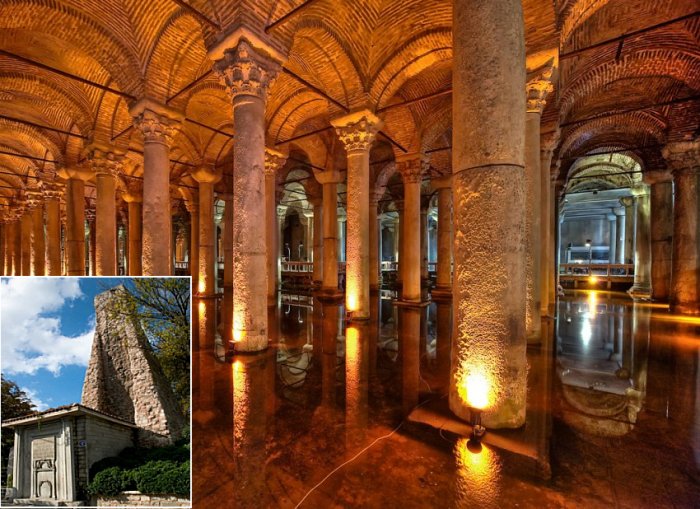 Left: The entrance to the Basilica Cistern. Image credit: Wikipedia - David Bjorgen; Right: Basilica Cistern, also known as the "Sunken Palace"
The Basilica Cistern was founded in the 6th century during the reign of Justinian I of the Byzantine Empire (527-565). The cistern, built on an early Roman basilica site, was nicknamed the "Sinking Palace" by locals.
The Roman columns rising from the pools of water in the Basilica Cistern certainly give the impression of a once magnificent residence slowly succumbing to a watery grave.
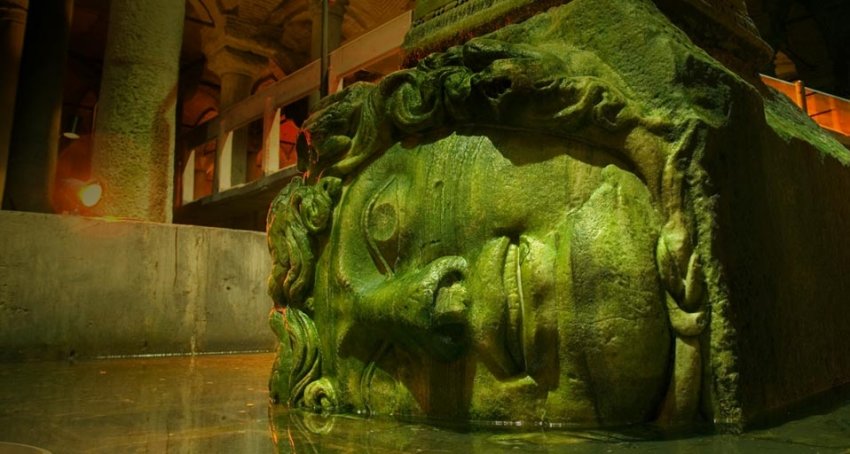 One of the Gorgon heads, but this one is tilted to the side. Image credit: David Sutherland/Corbis
The cistern is located 500 feet (150 m) southwest of the Hagia Sophia on the peninsula of Sarayburnu. The first settlement dates back to this ancient place's Neolithic, c. 6600 BC.
The cistern lies underground, just below the tram lines and busy streets of Istanbul's Old Town. The largest of several hundred cisterns below the surface of Istanbul has 336 massive columns of granite and marble that support a space large enough to hold 27 million gallons of water (carried in from 12 miles away via clay pipes and aqueducts).
Palace once held an emergency water supply for Constantinople, but today has been drained, save a foot or two of rainwater teeming with goldfish.
Inside, two giant Gorgon-head pillar bases pose a mystery. It is suspected that they may have been pulled out of an older pagan temple, where motifs of the famous Gorgon Medusa were used as a protective emblem.
The early Christians practiced putting pagan statues upside-down to boldly state their faith.
Both heads are casually used as column bases; one is positioned upside down, the other tilted to the side.
It is suspected that they may have been pulled out of an older pagan temple, where motifs of the famous Gorgon Medusa were used as a protective emblem.
 Upside down Gorgoneion in the Basilica Cistern. Image credit: DIMSFIKAS - CC BY-SA 3.0
The placement of these two faces - upside down and sideways, at the base of pillars - may have been a deliberate display of the power of the new Christian Empire.
This particular location of the Medusa heads in the cistern has long been a question of scientific discussion.
We have many guesses today, and the best is that ancient people believed that if the sculptures were placed in two different positions (upside down and sideways), they would ward off evil spirits.
Medusa, a sea nymph, was the most beautiful of the three gorgon sisters. Poseidon courted her and made love to him in the temple of Athena.
The Goddess Athena was furious and transformed Medusa into a monstrous chthonic beast with snakes instead of hair, whose frightening face could turn onlookers to stone. She was beheaded during her sleep by the hero Perseus, who then used her head as a weapon until giving it to the goddess Athena to place on her shield.
In classical antiquity and today, the image of the head of Medusa finds expression in the evil-averting device. Having coupled with Poseidon previously, two beings sprang from her body when she was beheaded. One was a winged horse, Pegasus, that Bellerophon later tamed to help him kill the chimera. The other, Chrysaor of the Golden Sword, remains relatively unknown today.
The mystery of the Medusa heads trapped under the cistern's columns may never be fully understood.
The cistern was cleaned and renovated in 1985 by the Istanbul Metropolitan Municipality and opened to the public in 1987.
Written by – A. Sutherland - AncientPages.com Senior Staff Writer
Updated on January 3, 2024
Copyright © AncientPages.com All rights reserved. This material may not be published, broadcast, rewritten or redistributed in whole or part without the express written permission of AncientPages.com
Expand for referencesMore From Ancient Pages
-
 Watlington Viking Hoard May Re-Write History Of England
-
 Castro People: Intriguing Life Of The Female-Dominated Society In Ancient Iberia
-
 Our 7-Day Week Can Be Traced To Babylonians Who Started Using It 4,000 Years Ago
-
 Massive Roman-Era Column Base Of Limestone Unearthed In The Foothills Of Mount Hermon, Golan Heights
-
 Evidence Of Legendary Ancient Great Flood In China May Re-Write History
-
 Fenja And Menja: Two Giant Sisters, Magical Grotte Mill And Why The Sea Is Salt
-
 On This Day In History: Battle Of Naulochus Was Fought Off The Coast Of Sicily – On Sep 3, 36 BC
-
 Ancient People Possessed Far Greater Knowledge Of Astronomy Than Previously Believed – Researchers Say
-
 Kindred Spirits: Why Did The Irish Build A Monument In Honor Of Native Americans?
-
 Vikings Feared Climate Change 1,200 Years Ago – Famous Rök Stone Reveals
-
 Unique 1,600-Year-Old Gold Bead Found By Teenager In Jerusalem’s City Of David
-
 How Did Canada’s Oldest Coin Make Its Way To Newfoundland’s South Coast?
-
 Stunning 3,400-Year-Old Palace Of the Kingdom Of Mitanni Discovered Thanks To Drought
-
 Archaeologists Discover Ancient Mayan Board Game – Here’s What It Can Teach Modern Educators
-
 Incredible CT scans show Pompeii victims ‘in good health’
-
 Mystery In The Stones: Rujm El-Hiri (Wheel Of Ghosts) Was Not An Ancient Observatory – So Why Was It Built? – New Study
-
 Legend Of The Candle Dragon That Could Lighten The Darkest Gate Of Heaven
-
 Hel – Loki’s Terrible Daughter And Goddess Of The Land Of Dead
-
 Inventory Stela And Its Message: Controversy About This Artifact Still Remains
-
 On This Day In History: Viking Forces Laid Siege To Paris – On Nov 25, 885

