
Fenrir Killed At Ragnarok By Vidar Who Avenged His Father Odin’s Death
A. Sutherland - AncientPages.com - In Norse mythology, Vidar (in Old Norse: Vidarr – “wide ruler”) was famous for his silence.
He was one of the respected gods among the Aesir and one of the two gods associated with vengeance (the other was Vali, his half-brother). Vidar was also a very brave and fierce warrior who did not like to speak much and boast.
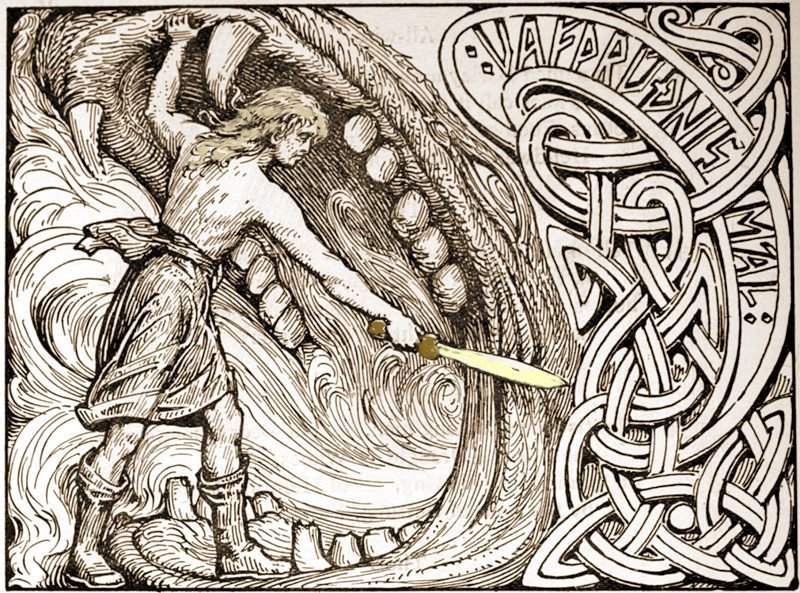
The god Víðarr stands in the jaws of Fenrir and swings his sword. The list of illustrations in the book's front matter gives this one the title Vidar (motive from the Gosforth Cross). Credit: W.G. Collingwood (1854 - 1932) – Public Domain
He possessed an enormous strength, which was only surpassed by Thor, and the Aesir gods often depended on him in times of trouble.
Vidar – “the silent god,” is foretold to avenge his father's death by killing the wolf Fenrir at Ragnarok. This god is attested in several sources, like Snorri Sturluson "Edda" and his "Prose Edda" books Gylfaginning and Skáldskaparmál. He is also mentioned in the Poetic Edda, the Icelandic medieval manuscript known as the Codex Regius. The Codex Regius is considered the most important source of Norse mythology and Germanic heroic legends.
In our earlier article, we were acquainted with the evil Fenrir (“bog dweller”), who had to feed on the bodies of the dead. Born in the Iron Forest (Járnviðr , Järnwidur), located on the border of Utgard and Midgard, Fenrir (or Fenris) was one of three terrible monster children of the trickster god Loki. He was born in the likeness of a gigantic wolf whose eyes and nostrils spewed out a fire.
His mother was the giantess and witch, Angrboda, who had two other terrible children, Hel, ruler of Niflheim, the land of the dead, and the Midgard Serpent, Jormungand, a hideous, venom-spewing serpent
These two – not exactly friendly creatures - were siblings of Fenrir.
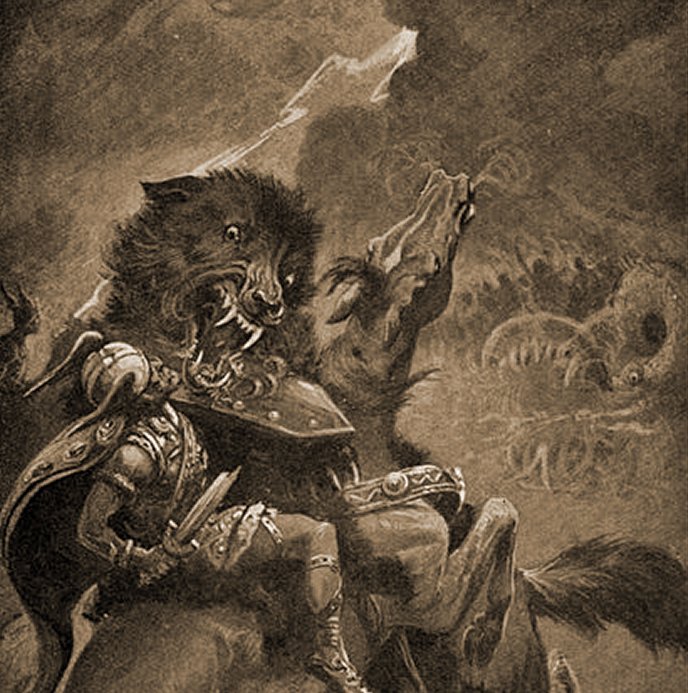
Fenrir, the monster-wolf, and the god Odin in a fight. Image credit: Dorothy Hardy (fl. 1891 - 1925) via Wikipedia
Vidar’s father was the great god Odin, and his mother, the friendly giantess Grid. His home was called Vidi (Vide or Landvidi), a peaceful and silent place full of tall grasses, growing saplings, and wildflowers, where he rides and exercises his spear.
In the saga Grímnismál, Odin describes the halls of many gods, including that of his son Vidar:
“…Brushwood grows and high grass
widely in Vidar's land
and there the son proclaims on his horse's back
that he's keen to avenge his father..”.
Hero Vidar Depicted On Stone Cross
God Vidar was so admired that in the 9th century, he was depicted on a stone cross in the English city of Gosforth in Cumbria, England. On the cross, he fights against Fenrir, the wolf, immediately after he devoured his father Odin.
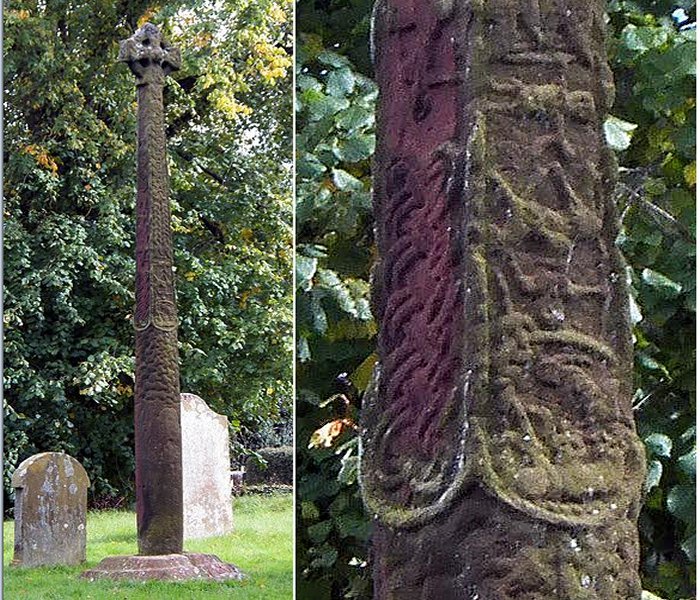
Gosforth cross; the tallest Viking cross in England. In the graveyard of the parish church of Gosforth, Cumbria. Image credit; Doug Sim/Wikipedia
The Gosforth Cross has intricate carvings depicting characters and scenes from Norse mythology. These include the god Heimdallr holding his horn; the god Vidar tearing the jaws of the wolf Fenrir; Thor's failed attempt to catch Jormungand, the Midgard Serpent, and Loki, the trickster god.
Deadly Encounter With Fenrir
One day in the future, the god Vidar must leave his quiet and peaceful land to fight at Ragnarok, “the darkness of the gods”, the coming destruction of the world, whose inevitability is impossible to fight with.
He had to face the evil monster, Fenrir, and defeat him, so it happened.
That day, Vidar leaped from his horse and attacked Fenrir to avenge his father, Odin. He stepped down with one foot on the lower jaw of Fenrir, grabbing his upper jaw in one hand and tearing his mouth apart. Finally, Fenrir was dead.
Tradition has it that Vidar wore a special shoe or boot that had been made from leather pieces he saved throughout all time.
Another version of the myth says that it was Vidar's mother, Grid made the shoe for Vidar.
Vidar, “the silent god,” was one of the few gods who survived Ragnarok and became one of the rulers of the new world.
Updated on March 1, 2023
Written by – A. Sutherland - AncientPages.com Senior Staff Writer
Copyright © AncientPages.com All rights reserved. This material may not be published, broadcast, rewritten or redistributed in whole or part without the express written permission of AncientPages.com
More From Ancient Pages
-
 Has The Mysterious Ancient Underground Labyrinth Of Mitla Finally Been Found?
-
 Archaeological Finds Shed New Light On The Paleo Diet Habits Of Ancient Hunter-Gatherers
-
 1.3-Million-Year-Old Stone Age Axe Discovered In Morocco Pushes Back The Start Sate Of Acheulian Technology In North Africa
-
 Why Is A ‘Piggy Bank’ Shaped Like A Pig?
-
 Spectacular Vespasianus Titus Tunnel – An Ancient Roman Engineering Marvel
-
 The 426-Km-Long Roman Aqueduct Provided Water For Constantinople – New Study
-
 ‘Cradle Of The Scythians’ Studied By Russian-Polish Archaeologists
-
 Enigma Of The Unusual Forest In Disguise
-
 Mystery Of The Proto-Elamite Tablets – Cracking The World’s Oldest Undeciphered Writing
-
 Bad King John’s Lost Treasure May Be Hidden Near The Walpole Marsh In The Fenlands – Archaeologists Say
-
 Why Napoleon’s Invasion Of Russia Was A Fiasco
-
 On This Day In History: Battle Of Cibalae Was Fought Between Two Roman Emperors – On Oct 8, 314
-
 Ji Gong: Legendary Ancient Monk Who Defended People Against Injustice
-
 The Late Antique Little Ice Age Weakened The Roman Empire – Study Reveals
-
 Why Some Stories About Ancient Roman Emperor Nero Are Wrong
-
 Giant Geoglyphs Near The Golden City Jaisalmer In India’s Thar Desert May Be World’s Largest Drawings – Who Made Them And Why?
-
 On This Day In History: Spanish Conquistadors Led By Hernan Cortés Entered The Aztecs Capital Tenochtitlán – On Nov 8, 1519
-
 Violent Steppe Invasion In Iberia Peninsula Theory Challenged By Archaeologists
-
 Medieval Mystic Nicholas Of Cusa’s Fascinating Ideas On Extraterrestrials Inspired New Ways Of Thinking About Our Place In The Cosmos
-
 10 Most Bizarre Forms Of Ancient Taxes: Surprising And Funny

