
Yuezhi Civilization: Ancient Nomadic People Who Once Ruled Bactria
Ellen Lloyd - AncientPages.com - The first mention of the Yuezhi civilization can be found in ancient Chinese sources from the 2nd century B.C.
They are describes as nomadic people living in the western part of Gansu province, northwestern China. Known by a Chinese name (“Meat Eaters,” a Chinese appellation), the Yuezhi was one of the numerous Iranian or Aryan nomadic tribes.

The Chinese mission of Zhang Qian to the Yuezhi in 126 BCE, Mogao Caves, 618–712 CE mural painting
The Yuezhi - first mentioned in ancient Chinese sources at the beginning of the 2nd century B.C are generally believed to have spoken a language related to Tocharian, of the Indo- European family, and to have been ethnically Caucasoid.
Before being driven out by the Xiongnu, a powerful people of North China, the Yuezhi dominated the northern steppes, still searching for new territories. Finally they moved westward into Sogdiana and Bactria, where they put an end to Greek rule in both regions.
Ancient Bactria was located between the Hindu Kush mountain range and the Amu Darya river, covering the flat region that we today recognize as modern-day Afghanistan and Tajikistan. Bactria was the birthplace of Zoroastrianism, and later also hosted Buddhism before becoming Muslim.
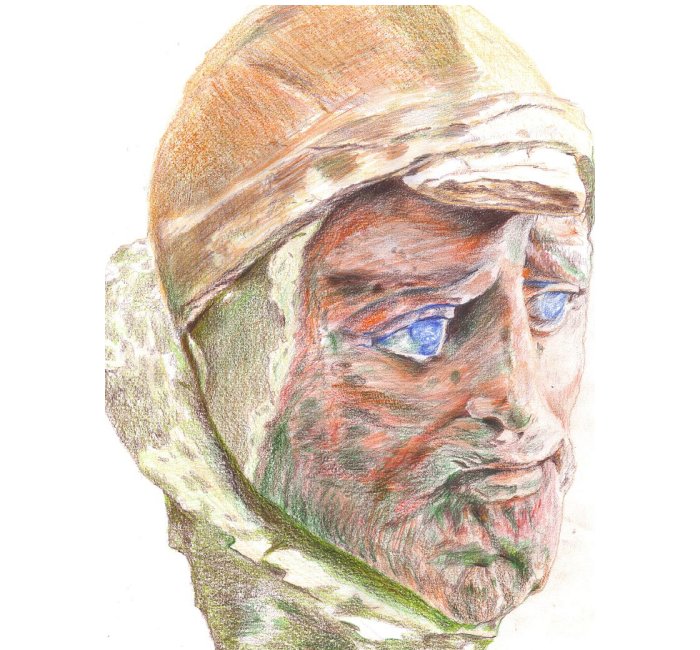
Bust of a man, found at from Khalchayan, a major site of the Yuezhi (later Kushan) people, in Bactria (modern Surxondaryo Province, Uzbekistan). Painted clay.Image credit Wikipedia
The Yuezhi were involved in many conflicts. They fought the Tocharians, Scythians, and even the Han Empire in Central Asia.
When the Yuezhi entered Bactria, they defeated the Greco-Bactrian kingdom, forcing them to regroup in India. They also displaced a people called the Saka, who responded by overrunning portions of the Parthian Empire.

Possible Yuezhi king and attendants, Gandhara stone palette, 1st century CE.
Tribes of Scythians and Saka eventually established themselves all over Afghanistan.
See also:
Lost Ancient Greco-Bactrian Kingdom Of 1,000 Cities
Mysterious Disappearance Of Scythians Remains Unsolved
Ancient Great City Of Napata In The Kingdom Of Kush
In time, the Yuezhi consolidated and established an agricultural economy. A new dynasty, known as the Kushan, was subsequently founded by one of the five chieftains among whom Bactria was divided. The Kushan kingdom was powerful and extended its power and their territories southward, eastward into India, and northward into Central Asia.
The Kushans managed to survive for three centuries, until forces from Persia, Pakistan, and India all re-conquered their old territories. In consequence, the Kushan Kingdom's power declined.
Missionaries from the Great Yuezhi played an important part in spreading and promoting of Buddhism in China. The spread of Indian culture into the territories of Central Asia reaching the borders of China probably resulted from Kushan influence.
Written by - Ellen Lloyd – AncientPages.com
Copyright © AncientPages.com All rights reserved. This material may not be published, broadcast, rewritten or redistributed in whole or part without the express written permission of AncientPages.com
More From Ancient Pages
-
 Etruscan Urn With Skillfully Adorned Medusa Relief Discovered In The Palazzone Necropolis, Perugia, Italy
-
 Diet And Social Changes In Central Europe Around 1500 BC
-
 On This Day In History: Battle Of Rudau Was Fought – On Feb 17, 1370
-
 Australia’s Submerged Indigenous Sites – New Discoveries And Study
-
 Jelling Stone And Legendary Harald ‘Bluetooth’ King Of Denmark – ‘Who Made The Danes Christian’
-
 New Tool-Making Timeline For East Asian Hominins – Study
-
 Ancient City Of Sogmatar And Recent Discovery Of 5,000-Year-Old Children’s Toy
-
 Magnificent Ancient Egyptian Gold And Soapstone Jewelry Discovered At Tell El-Amarna Necropolis
-
 Mystery Of Vangchhia Ancient Site: Water Pavilion And Ingenious Idea Of Water Harvesting
-
 Bragi – Norse God Of Poetry, Eloquence, Music And Singing And Husband To Idun Who Protected Golden Apples
-
 Ancient City Of Tyana And A 1600-Year-Old Rare Octagonal Church Unearthed In Central Anatolia Turkey
-
 Neanderthals Used Amlash Caves In Iran’s Gilan Province As Shelters
-
 Cassandra: Greek Goddess Who Foretold Cursed Prophecies
-
 What Are The Monumental Uratrian-Era Structures Unearthed At Garibin Tepe In Van?
-
 Scythians Were Not Always Nomadic Warriors Of The Pontic Steppe In Black Sea Region
-
 Cup Of Jamshid – Holy Grail Of Ancient Persia Offered Immortality And Visions Of The Future
-
 Trentren And Caicai: The Battling Serpents Of Chilote Mythology
-
 Mystery Of The Brave Viking Chief Buried On The Gokstad Ship
-
 5,000-Year-Old Russian Skull Offers Evidence Of Brain Surgery Made With Stone Scalpel
-
 The Oseberg Tapestry And Other Artifacts Show Intense Colors Were A Viking Symbol Of Status And Wealth

