
Everyday Life Of A Samurai: Armor, Appearance And Belongingness
Rafael - AncientPages.com - In the Hagakure, it states that a samurai is required to wake up, take a bath, arrange his hair everyday starting four in the morning. He eats when the sun comes up and rests when it is dark. Yamamoto Tsunetomo, the author of Hagakure, stated that a samurai must live a life up to the age of 40 and to settle down at the age of 50.
The daily life of a samurai happens in the 2 poles of the daimyo's castle and the samurai's own estates. The measure of the samurai's wealth was according to the yield of his rice fields.

Japanese traditional full armor. Credit: Public Domain
Usually, the food eaten by samurai warriors were simple. These foods are rice, soybean variety, fish, vegetables, seaweed, and fruits. Primarily, their protein supply came from eating seafood and shellfish. In terms of dining inside the daimyo’s yashiki there is always a ceremony.
At times of peace, samurai warriors enjoyed hunting duck, wild boar or deer. Not only do they spend their time using armors but also in loving the arts, particularly calligraphy, poetry and even flower arranging. They also love playing games like shogi or go.
Samurai Warriors Training
In terms of training, samurai warriors were trained for certain sword techniques or kenjutsu. In the Age of Warring States, schools for swordsmanship were developed. They are taught by experts who were called sensei or teacher.
A sensei on the 17th century have stated that a samurai should be diligent in practicing sword techniques everyday using a wooden sword. A samurai must develop haragei or mental concentration and must focus on ki, the life energy.
To control his energy, he must perform repetitive actions that are called kata. At first, he does it slowly then gradually speeding up to be able to increase the lethal power. The actions are founded on attack, counterattack and defense strategies. Kata is a performance of a set of moves in a prescribed and accurate manner and a student can practice it with a partner.
Meanwhile, the suburi is a sword-drilling process whereby the sword is swung back and forth against an imaginary opponent. This kind of training technique is useful to develop the samurai's good balance and muscle endurance.
In yarijutsu or spear technique training, samurais can use tampo yari. Tampo yari is a dummy spear with a round padded end. They also use a dummy sword called bokuto. Bokuto is a wooden sword which is similar to a real sword. Another type of dummy sword is a habiki or edgeless sword. In the 16th century, shinai was used for training. It is made of bamboo that has been tied together.
Another training session is called tsumeru wherein the fight is stopped an inch before the samurai hits his opponent.
A Samurai Child
When a child is born into a family of samurai warriors, the baby’s father or a priest is present during birth. A drawstring is then pulled to cast out evil spirits. After the process, the baby is given a small sword which is required for him to wear it at all times.
At the age of three, he begins practicing the fundamentals of fencing using wooden swords. And at five years old, he receives his first haircut and is given a real sword, called mamorigatana, for his self-defense. Between 13 to 16 years old, the young samurai goes through genpuku, a rite of passage ceremony. In this rite, he receives his first haircut as an adult, given a wakizashi and an armor. At this time, he is already allowed to wear a katana but only with a scabbard to prevent fatalities or injuries.
On the other hand, samurai girls were required to take care of their husband’s estates while at war. They also received martial arts training primarily on handling naginata and yari. The amount of training the samurai received is dependent on their family’s wealth.
Samurai Appearance
The samurai is expected to be a role model to the lower classes by their appearance.
A samurai when not clothe in his armor, must wear fine traditional clothes and must be according to the situation.
Formal duties require him to wear the kamishimo. It is a combination of formal jacket or a haori and a hakama (trousers). The 2 parts have similar design and color which include the daimyo's mon on the back and on the breast. When it comes to informal attire, kobakama or breeches are used.

A senior samurai underneath his armor wears an embroidered yoroi-hitare or an armor robe. Other samurai wears an underwear made of badger skin.
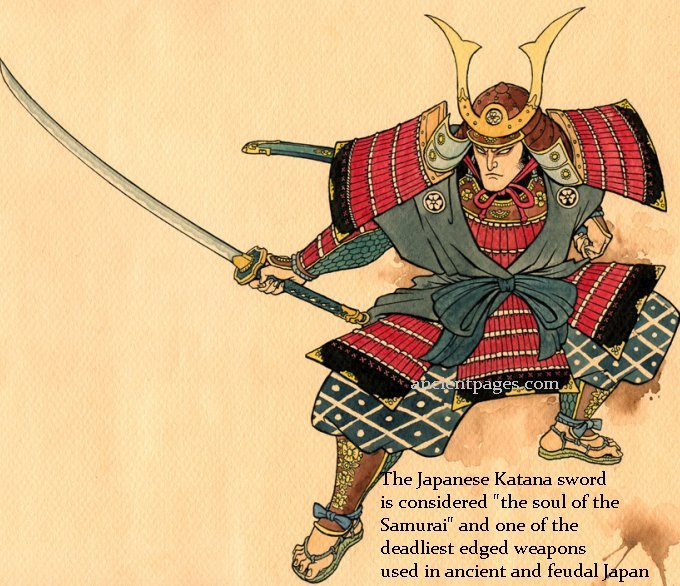
Samurai armor is made of lamellar construction or small metal plates fastened together and was lacquered to prevent rust. The plates are then interconnected using rawhide in creating horizontal sections. And on the vertical sections, silk suspensory cords were used.
The body armor is called the do, which has a row of kusazari or tassets to create an armored skirt. A kote or a sleeve armor, sode or shouler plate and nodowa throat protector was worn.
Katana ‘Soul Of The Samurai’ – Most Famous Japanese Sword With Long Tradition - Read More
Underneath the do is the thighguards called haidate and shinguards or suneate to protect the legs.
The menpo or facemask is decorated with horsehair with provision for the kabuto to be attached. A shikoro or lamellar neckguard is hung around the helmet's rim. The crown is enhanced by decorations such as buffalo horns, sword blades, antlers, feathers and conch shells that were made through paper mache.
The samurai's loyalty was identified by wearing a sashimono on his back. In the Hagakure, it states that if soldiers would test their armor, they should only test the front part. Ornamentation on the armor isn't required but the helmet's appearance is vital.
The samurai primarily weapons are the Katana and Wakizashi. They use to carry it around their waist. In the battlefield, they carry yumi (bow) made of bamboo wood and spears called yari.
Belongingness Of The Samurai Warriors
The Samurai class organization have completely changed during the time of Japan's 'super daimyo'.
Oda Nobunaga and Toyotomi Hideyoshi were Japan's first unifiers. Nobunaga's rivals were the peasant and low class samurai armies of the Ikko-ikki. Hence, he advocated a rule in disarming the rural population of the Ikko-ikki. This policy prevailed further in separating the samurai class and the farming class during the year 1588.

A portrait of Oda Nobunaga, by Jesuit painter Giovanni Niccolò, 1583–1590. Credit: Public Domain
Toyotomi realized that the primary reason why the rural population of the Ikko-ikki challenge the samurai rule is due to the readily available supply of armory. It resulted to the Sword Hunt of 1587, which opposes Hideyoshi's governance. Toyotomi Hideyoshi's military entered the villages, temples and shrines to confiscate all weaponry. The kinds of weapon relieved were spears, guns and swords.
A Separation Edict was then emulated in the year 1591 prioritizing professionalism of armies, wherein an untrained farmers handling a weapon are far more dangerous and considered a hindrance to the community. The edict particularly distinguishes a military function and an agricultural function.
The last unifier of Japan named Tokugawa Ieyasu, finished the process of classification in Japan's population, samurai, farmers, merchants and priests.
Written by – Rafael - AncientPages.com Contributor
Copyright © AncientPages.com All rights reserved. This material may not be published, broadcast, rewritten or redistributed in whole or part without the express written permission of AncientPages.com
Expand for referencesWarriors of Medieval Japan, Stephen Turnbull
Samurai Sourcebook, Stephen Turnbull
Samurai: The Code of the Warrior, Thomas Louis Thomas Ito
Hagakure, Yamamoto Tsunetomo
More From Ancient Pages
-
 First-Ever Discovery Of Roman Road Network Spanning The South West UK Made By LIDAR
-
 Rare Viking Treasure Made By A Highly Skilled Goldsmith Found On The Isle of Man
-
 Magnificent Skellig Michael And A 1,400-Year Old Christian Monastery
-
 America’s First Civilization Was Made Up Of ‘Sophisticated’ Engineers – New Evidence
-
 Reasons Behind Abandonment Of Extensive Farming System In Mesopotamia Are Still Unclear
-
 Enigmatic Ale’s Stones – Sweden’s Megalithic Ship-Like Formation
-
 Ancient Secrets Of Mistletoe – Sacred Celtic Plant With Magical Powers
-
 Little-Known Mummy Fragments Analyzed By Scientists
-
 Lost Laodicea Temple And Seleucid Relics – Archaeological Search Continues
-
 Cosmic Message Of The Zapotec Glyphs In The Valley Of Oaxaca – Deciphered!
-
 Ancient City Of Isaura And Zengibar Castle Used By The Hittites, Persians, And Romans
-
 Harem Conspiracy – Plot To Murder Ramesses III, The Last Great Warrior Pharaoh
-
 Artifacts From Shakhi Kora Reveal The Rejection Of Early Centralized Governance In Ancient Mesopotamia
-
 Earliest Evidence Of Forest Management Discovered At The La Draga Neolithic Site
-
 Etzanoa: Long-Lost Native American City Discovered In Kansas After 400 Years
-
 Dinosaurs Were On The Up Before Asteroid Downfall – Study Finds
-
 Powerful Winds In Ancient Beliefs
-
 First Record Of Ancient Music Of Babylon
-
 Mysterious Unknown Beings Who Walked The Earth With Humans
-
 Was Napoleon Bonaparte Defeated At Waterloo Because Of Volcanic Eruption?

