
London’s Underground Rivers Were Deliberately Hidden
Ellen Lloyd - AncientPages.com - When you think of London, many things come to mind, but not the fact that many hidden underground rivers flow beneath the significant capital of the UK.

Traces of London's lost rivers are visible throughout the city, if you know what to look for Photo: SF Said
Below the ground is a vast network of tunnels and chambers, put in place by Victorian engineers, the final step in a process which took centuries.
London once needed all the rivers it could get: for drinking water, for harbors and wharves, for mills, for tanneries, and for sluicing away waste. The rivers were London's sewage system long before any system was built. Still, even tiny medieval London was too much for any stream to cope with, and many inner London waterways remained deliberately hidden.
The Fleet is probably one of the better-known rivers located beneath Londoners' feet.
Vestiges of it can be traced above ground by following a modest stream that flows from Hampstead and Highgate Ponds in north London.
 The Victorian brickwork from Joseph Bazalgette's sewer system remains in a preserved state. Image credit: Emma Lynch BBC
Today it is swiftly submerged, becoming a sewer that flows to Blackfriars Bridge on the River Thames.
During Medieval times the waters of the Fleet were renowned for being clean.
As London city grew, mills, tanneries, and meat markets appeared along its banks. Water was vital to keep these industries functioning and growing.
Gradually, however, the river was polluted with blood, sewage, and other waste, so it became a waste tip, an easily accessible repository to discard anything unwanted, including the carcasses of dead livestock.
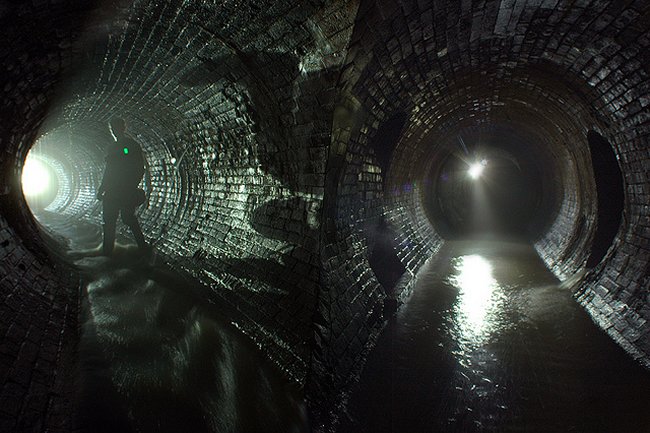
Image Credit Flickr User sub-urban.com
London's origins are deep in the Walbrook, the river around which the Romans founded the city. The debris dug from the river – hoes and plow shares, chisels and saws, scalpels and spatulas, the heads of forgotten gods, and a collection of 48 human skulls tell the earliest London tales.
As a result, over the years, the river became shallower and the water much slower than in previous generations, only exacerbating the burgeoning problem of the health hazard it now presented. It would silt up in the summer, and although the spas and wells upstream remained open and functioning, the Fleet in London became an open sewer with a mix of slums and prisons on its banks. Something had to be done.
 The Walbrook's name derives from the fact the brook passed by the Roman city's wall. Image credit: Alan Sorrell/Museum of London
A solution was urgently needed. The architect Sir Christopher Wren was afforded the chance of transforming the lower Fleet. The Great Fire of London in 1666 provided that opportunity.
The river was channeled underground in the 1730s from Holborn to Fleet Street, which still bears its name. Decades later, it was filled in and arched over from Fleet Street down to the river Thames and is covered by what is now New Bridge Street.
Perhaps, the rivers are hidden, but they are far from gone. It is tough to stop a river from flowing, so they have merely been diverted into the sewer system.
Written by - Ellen Lloyd – AncientPages.com
Copyright © AncientPages.com All rights reserved. This material may not be published, broadcast, rewritten or redistributed in whole or part without the express written permission of AncientPages.com
Expand for referencesMore From Ancient Pages
-
 ‘Blue Highways’ Helped Middle Stone Age Humans Who Survived The Toba Supereruption 74,000 Years Ago
-
 Eclipse Was A Bad Omen, A Sign Of Gloom And Doom In Ancient Peoples’ Beliefs
-
 Earliest Evidence Of Rice Harvesting Provided By China’s Ancient Stone Tools
-
 Mystery Of The Demon Wall In Sauherad Church Finally Solved
-
 Strange Community Rules Of Essenes Preserved In The Dead Sea Scrolls
-
 Mystery Of Mexico’s Bizarre Mummy May Never Be Solved
-
 Mycenae Kingdom: Home To King Agamemnon And Tholos Tomb ‘Treasure of Atreus’
-
 Ancient Dragons And Dragon Kings In Myths And Legends
-
 Native Americans’ Unexplained Encounter With A Strange Underground Humanoid 500 Years Ago – Who Was This Being?
-
 Evidence Of Extensive Human Fire Use 50,000 Years Ago
-
 Codex Washingtonianus Contains A Passage Not Seen In Any Other Biblical Manuscript
-
 Ancient Site Tres Zapotes Offers Evidence The Olmecs Practiced Shared Governance
-
 Genuine Bronze Warrior Statuette Unearthed At Technologically Advanced Celtic Settlement Oppidum Of Manching
-
 Pre-Columbian Americans Mastered Electricity – Ancient Inscription And Document Reveal Proof Of Advanced Ancient Technology
-
 Mystery Of The Large Ancient Boulders In Ireland And Britain – Possible Connection To The City Of Troy?
-
 On This Day In History: Vatican Began 7-Year-Long Trial Against Giordano Bruno – On Jan 27, 1593
-
 Tile Tomb Dated To The Late Hellenistic Era – Discovered In Surroundings Of Istanbul, Turkey
-
 Bryggen Inscriptions Reveal Viking Runes Were Used As Modern SMS – Short Message Service In The Norse World Was Popular
-
 Ancient Mystery Of The Before – Time People – Traces Of An Unknown Lost Race – Part 1
-
 Divine Shulgi Of Ur: Influential, Long-Ruling King, Conqueror And Native Akkadian Speaker In Five Languages

