
Amazing Thirteen Ming Tombs: Gigantic Stone Animals And Human Figures Were Symbols Of Royal Power
A. Sutherland - AncientPages.com - The Ming Tombs ("Ming Thirteen Mausoleums") is a collection of imperial tombs of the Ming Dynasty scattered over forty square kilometers in Changping District northwest of Beijing.

They were built by the emperors of the Ming dynasty of China, all members of one family.
Of the sixteen emperors of China's Ming Dynasty (AD 1368-1644), only three were not buried with the rest (two were buried elsewhere, while the other still needs to be accounted for).
The remaining thirteen were built according to 'feng shui' (closely related to Taoism), a Chinese philosophical system of harmonizing everyone with the surrounding environment.
The first Ming emperor's tomb was built in 1409, and the last one in 1644, and it took more than two hundred years to build this necropolis.
 Top image: Watercolor overview of the Ming Tombs. Credits: United States Library of Congress's Geography & Map Division
It seems that the tombs were arranged randomly, but each emperor's grave has a location meticulously chosen with precision and strategy; all this was done within 120 kilometers of the fascinating landscape.
All halls in the Ming tombs were built with nanmu, a special kind of wood (the so-called imperial timber) used frequently in China. In the Ming Dynasty, special groups were sent to dangerous, uninhabited regions of south China to collect nanmu.
Another unique building material was bricks; each with the imprinted word "longevity" weighed about 25 kilograms. One million bricks were required each year, each of good quality, solid and smooth, and emitting a clear tone when struck. The names of brick manufacturers and officials put in charge were printed on every brick for later check.

The entire impressive graveyard is located at the foot of the Tianshou Mountains, of which earlier, simple name was Huangtu (yellow earth).
Yongle died in 1424 and was the first emperor buried in this graveyard. Three tombs have been excavated and restored: Chang Ling, the largest; Ding Ling, whose underground palace is open to the public; and Shao Ling. Yongle was important in Chinese history; he moved the capital from Nanjing to Beijing after its reconstruction. Yongle's tomb gave inspiration to the building of other graves. As was the Chinese tradition, the Emperor and Empress were buried under a large mound in underground vaults. Imperial tombs were tightly sealed because emperors feared grave robbers.
One of the more impressive sights at the Ming Tombs is the Sacred Way (or Road), about seven kilometers long and flanked on both sides by carvings of human and animal figures. Twelve large stone human figures and twenty-four animals were carved from a single granite block in 1435.
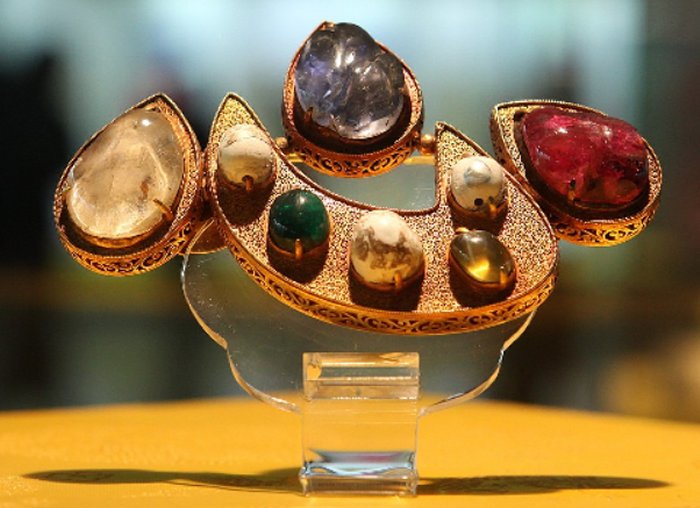
This piece of jewelry was one of the most beautiful antiques excavated from the Dingling, Welcome one of the w:Ming Dynasty Tombs. It was made during the w:Ming Dynasty (1368–1644) in China, by using gold, ruby, pearl and other gemstones, and is about the size of an adult human's palm. It is of the shape of a Chinese character '?' (read Xin), which literally means heart. This photo was taken at the Dingling Museum. Image uploader: - CC BY-SA 3.0
Interestingly, placing stone animals and human figures in front of imperial tombs can be traced back at least to the Qin Dynasty (221-206 BC.), some two thousand years ago, as each dynasty has followed this custom. However, both numbers of figures and animals varied depending on the dynasty.
In the Qing Dynasty, such stone animals as qilin, pixie (exotic animal with horns), elephants, and horses were placed in front of the tombs. In the Tang Dynasty (618-907 CE), lions, horses, oxen, blackbirds, and stone figures of civil officials and warriors were favored. In the Northern Song Dynasty (960–1279), stone animals –such as elephants, horses, sheep, tigers, lions, blackbirds, and stone figures of civil and military officials- were lined in front of imperial tombs.
Presently, the Ming Tombs are designated as one of the components of the World Heritage Site, the Imperial Tombs of the Ming and Qing Dynasties.
Written by – A. Sutherland - AncientPages.com Senior Staff Writer
Updated on Oct 20, 2023
Copyright © AncientPages.com All rights reserved. This material may not be published, broadcast, rewritten or redistributed in whole or part without the express written permission of AncientPages.com
Expand for referencesMore From Ancient Pages
-
 Ancestors Of The Irish And Scots Came From Biblical Lands And Ancient Egypt – Myths, History And DNA
-
 Mysterious Ichthys – Ancient Secret Christian Symbol With A Deep Meaning
-
 York’s Thriving Medieval Jewish Community – New Study
-
 Rare 2,000-Year-Old Intact Sundial With Inscription Discovered In Italy
-
 Looted ‘Pietas Domini’ Gothic Altar Dated To 1435 AD Returns From Germany To Poland
-
 Jörmungandr – Hideous Poison-Spewing Midgard Serpent Was One Of Loki’s Children
-
 Legendary Saraswati River Is Not A Legend – It Existed 4,000 Years Ago
-
 Mysterious Disappearance Of King Aegeus Of Athens After His Wedding
-
 What Really Happened To Library Of Alexandria Remains A Mystery
-
 Glastonbury Tor – One Of The Most Mysterious Sacred Places In England
-
 First Scandinavian farmers were far more advanced than previously thought
-
 Danger Lurking In The Woods – Unknown Force And Mysterious Lights – Part 1
-
 Varahamihira: Indian Sage And One Of The Greatest Minds Of All Time
-
 ‘The Battle Of The Tooth Worm’ – Strange Ivory Carving
-
 Genetic Changes In Bronze Age Southern Iberia
-
 God’s Personal Flying Vehicle Described In ‘The Book of Ezekiel’
-
 Medicine in Antiquity: From Ancient Temples To Roman Logistics
-
 Gold Spiral In Early Bronze Age Grave – Unearthed
-
 600-Year-Old Axe Heads Used In The Battle Of Grunwald Found in Poland
-
 Sacred Regalia Of Japanese Emperor: Sword, Mirror And Jewel In Ancient Japanese Tradition

