
Askeladden – Little Trickster That Succeeds Where All Others Fail
A. Sutherland - AncientPages.com - Askeladden (in English: 'Ash Lad') is a charming, the youngest of all brothers, and the least resourceful figure from ancient mythological beliefs.
When we hear that someone is 'least resourceful,' we immediately think of an unbelievably stupid person.
But it is not the case with Askeladden because this little boy can finally handle most difficult situations and surprisingly wins when everyone else fails.
Askeladden is mentioned in many folk tales that describe his fascinating adventures. There is one story that especially presents the boy's character perfectly.
One day, a poor farmer with three sons sent them to cut wood in a forest he owned to pay off debts. Askeladden was the youngest, most probably the dumbest in the family.
The eldest son went first but returned with nothing, for he came across an evil troll who threatened him with death if he cut down any tree. The next day, the same fate met the average brother.

Askeladden and the Troll by Theodor Severin Kittelsen. Credit: Public Domain
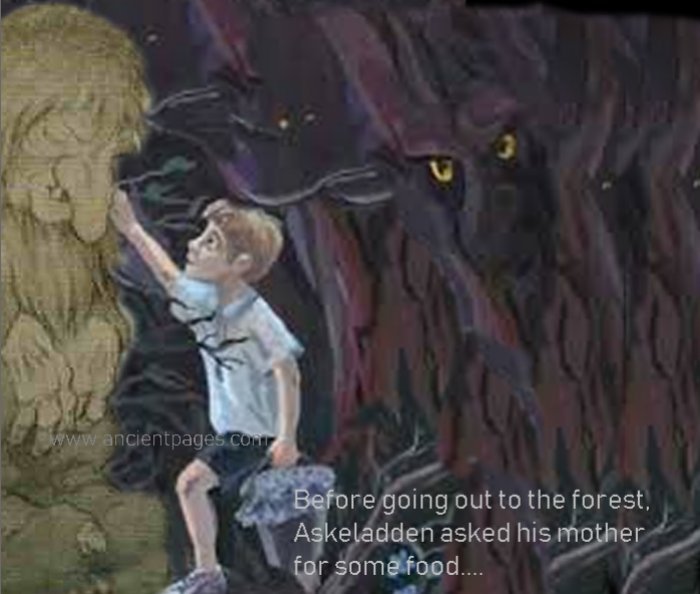
Then it was Askeladden's turn to go and try, but before going out to the forest, he asked his mother for food. He began to cut wood in the forest, and the troll suddenly appeared.
Askeladden pulled out some cheese, squeezed it so that water flowed, and convinced the troll that it was a stone. He also threatened that if he disturbed him at work, he would do the same with him as with the alleged 'stone.'
The troll – not a very intelligent creature - did not disturb Askeladden and even offered to help him with the wood-cutting. When the job was done, the troll invited the boy to his house for supper and asked him to bring water in one of the boilers, which was so huge that Askeladden could not even move it.
But remember, Askeladden was very resourceful, so he came up with a brilliant idea and said:
"It is not worth bringing along these thimbles; I think I'll rather go for the entire well."
"No, dear," said the troll, "I cannot lose my well. Make the fire, and then I will get the water."
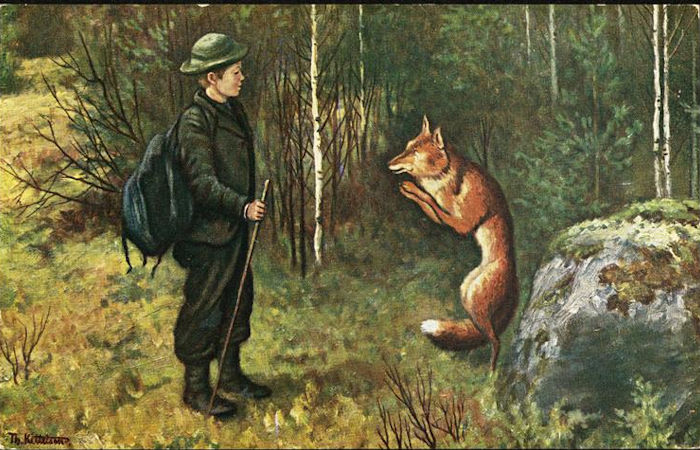
Askeladdens adventure by Theodor Severin Kittelsen (1990). Credit: Public Domain
The troll brought the water himself, prepared a meal, and proposed an eating competition. The boy knew he had no chance of winning this eating match.
The boy managed to sneak it into his bag and tie it to his belly. Then he put much more porridge into his bag than he ate himself. When the bag was complete, he took up his knife and cut a hole in it.
They had eaten for quite a while, but finally, the troll put down his spoon. "I give up; I can eat no more," he said.
"But you must!" said the boy; "I'm barely half full yet. Do as I did and cut a hole in your stomach; then, you can eat as much as you want."
The troll did so and died, and the boy took all the silver and gold he could find in the mountain and brought it home to his father. Now, they were very well able to pay off some of the debt.
So Askeladden is a clever and cunning boy; he is also very resourceful. He uses a few tricks to deceive the troll, and he does not think about the consequences and what kind of damage he will cause. He stays calm in a difficult situation but is ruthless and evil in pursuing his goal.
His damage cannot be repaired because he kills the creature.
Written by – A. Sutherland AncientPages.com Staff Writer
Updated on January 5, 2024
Copyright © AncientPages.com All rights reserved. This material may not be published, broadcast, rewritten or redistributed in whole or part without the express written permission of AncientPages.com
More From Ancient Pages
-
 Two Discoveries Reported From Komombo Temple And Elephantine Island, Aswan
-
 8,000-Year-Old Petroglyphs Discovered In Oldest Impact Crater In South Africa
-
 2,000-years-old tomb found in S. China
-
 Tombstone With Ancient Greek Inscription Unearthed Near Nitzana In The Negev, Israel
-
 Ancient City Of Tenea Built By Trojan Prisoners Reveals More Archaeological Secrets
-
 ‘Dates Add Nothing To Our Culture’: Everywhen Explores Indigenous Deep History, Challenging Linear, Colonial Narratives
-
 Kava – Astonishing Ancient Plant That Improves Emotional Intelligence Is Gaining Popularity In The Western World
-
 ‘Liber Linteus’ – Unique History Of Ancient ‘Linen Book’ Written In Etruscan That Still Remains Poorly Understood
-
 Unexplained Behavior In People Found After Being Lost In National Parks – Strange Encounters With Dangerous Humanoids And The Little People
-
 Edfu Texts Reveal Secrets Of Predynastic Egypt And Zep Tepi
-
 The Parthenon Marbles Evoke Particularly Fierce Repatriation Debates – An Archaeologist Explains Why
-
 Home Of The Gods – Arrival Of Golden Ships – Part 1
-
 Does The Shigir Idol Depict Demons And Evil Spirits?
-
 Mystery Of The Headless Skeletons From Vráble
-
 Deciphered Ancient Cuneiform Tablets Reveal Locations Of Long-Lost Cities And Shed Light On The Secrets Of Mesopotamia
-
 Wolstenholme Towne: Lost Virginia Settlement – Destroyed, Abandoned And Forgotten
-
 DNA Reveals Neanderthals’ Own Blood May Have Led to Their Demise, Scientists Say
-
 5 Different Types Of Priests In Ancient Rome – Their Role And Responsibility Explained
-
 New DNA Evidence Rewrites Ancient History Of Pompeii
-
 New Entrances To Ancient Underground City In Kayseri, Turkey – Found Accidentally

