
Invasion Of Mysterious Sea People – Enigmatic 3,200-Year-Old Luwian Hieroglyphic Inscription Sheds New Light On Ancient Puzzle
AncientPages.com - In 1878, archaeologists discovered a stone slab covered with ancient symbols in modern Turkey. The 29-meter-long bears the longest known hieroglyphic inscription from the Bronze Age. It is a Luwian hieroglyphic inscription and only a handful of scholars have been able to decipher it.
This enigmatic stone describes the events at the end of the Bronze Age in the Eastern Mediterranean and sheds new light on one of the greatest puzzles of Mediterranean archaeology.
Although many theories have been presented there is little solid information about the mysterious Sea People.
Their nationality remains a mystery as the only records we have of their activities are mainly Egyptian sources who only describe them in terms of battle (such as the record from the Stele at Tanis which reads, in part, “They came from the sea in their war ships and none could stand against them”).
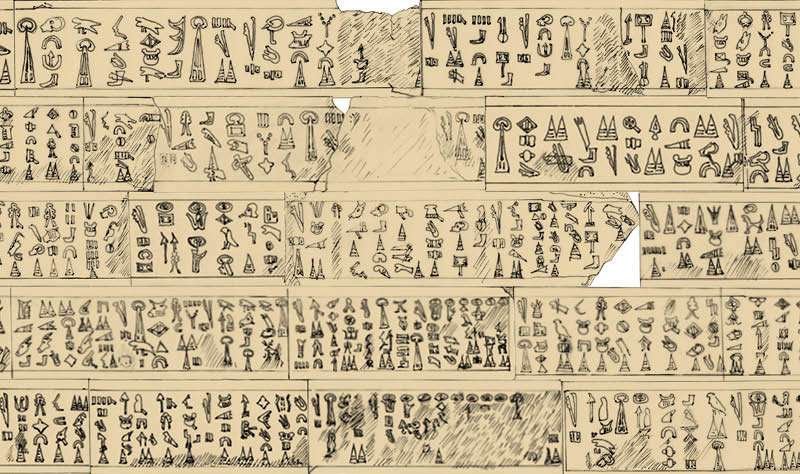
Luwian Hieroglyphic inscription by the Great King of Mira, Kupanta-Kurunta, composed at about 1180 BC. Credit: Luwian Studies
The term ‘Sea Peoples’ refer to nine groups of people, but the historical inscriptions give indications only to three of them, namely, the Sherden, Shekelesh, and Eqwesh.
The first translation of the Luwian hieroglyphic inscription has offered an explanation for the collapse of the Bronze Age's powerful and advanced civilizations.
The inscription and a summary of its contents also appear in a book by Eberhard Zangger that is being published in Germany today: Die Luwier und der Trojanische Krieg – Eine Forschungsgeschichte.
See also:
Life Of Galilean Sages Described On 1,800-Year-Old Hebrew Inscriptions Can Confirm Ancient Legends
The script tells how a united fleet of kingdoms from western Asia Minor raided coastal cities on the eastern Mediterranean.
It suggests they were part of a marauding seafaring confederation, which historians believe played a part in the collapse of those nascent Bronze Age civilizations.
Researchers believe the inscriptions were commissioned in 1190 BC by Kupanta-Kurunta, the king of a late Bronze Age state known as Mira.
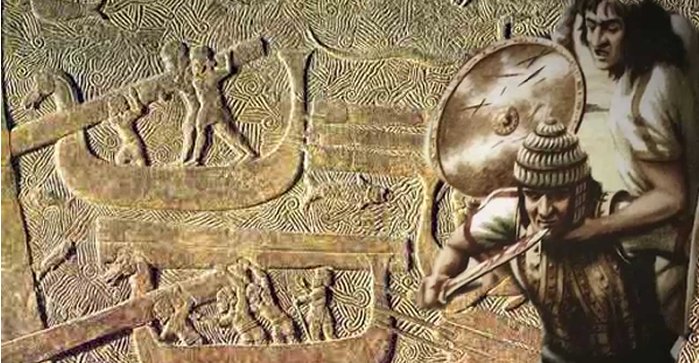
Ancient Sea People – The Philistines
The text suggests the kingdom and other Anatolian states invaded ancient Egypt and other regions of the east Mediterranean before and during the fall of the Bronze Age. When Kupanta-Kurunta had reinforced his realm, just before 1190 BC, he ordered his armies to storm toward the east against the vassal states of the Hittites.
After successful conquests on land, the united forces of western Asia Minor also formed a fleet and invaded a number of coastal cities (whose names are given) in the south and southeast of Asia Minor, as well as in Syria and Palestine. Four great princes commanded the naval forces, among them Muksus from the Troad, the region of ancient Troy. The Luwians from western Asia Minor advanced all the way to the borders of Egypt, and even built a fortress at Ashkelon in southern Palestine.
According to this inscription, the Luwians from western Asia Minor contributed decisively to the so-called Sea Peoples' invasions – and thus to the end of the Bronze Age in the eastern Mediterranean.
Copyright © AncientPages.com All rights reserved. This material may not be published, broadcast, rewritten or redistributed in whole or part without the express written permission of AncientPages.com
More From Ancient Pages
-
 Ancient Symbol Fleur-de-lis: It’s Meaning And History Explained
-
 Evil God-Bird Anzu Who Stole The Tablet Of Destiny To Control Universe And Fates Of All
-
 On This Day In History: Henry VIII Ascended The Throne Of England – On Apr 22, 1509
-
 Fascinating Accounts Of Incredible Vehicles, Cosmic Cities In Vedic Literature
-
 On This Day In History: Amelia Earhart’s First Solo Ocean Flight – On Jan 11, 1935
-
 New DNA Study Links Early Europeans’ Cultural And Genetic Development Over Several Thousand Years
-
 Why The Discovery Of Cleopatra’s Tomb Would Rewrite History
-
 Image Of The Day: ‘The Standard of Ur – War And Peace’
-
 Boreas – Mighty North Wind God In Greek Mythology
-
 Rare Kakatiya Dynasty Sculptures Discovered Near A Temple In Telangana, India
-
 Anatolia’s Seyitömer Mound Was Inhabited In Bronze Age, Achaemenid, Hellenistic, And Roman Times
-
 Unknown Ancient History Of Antarctica And It’s Lost Civilization – Secrets Beneath The Ice
-
 Mystery Of Giant Ancient Statues And A Vanished Civilization With Unusual Physical Characteristics – Strange American Connection – Part 2
-
 10 Magnificent Ancient Libraries
-
 Why Didn’t Pythagoras And His Followers Eat Beans?
-
 Artificial Intelligence And Clay Tablets: Not Yet A Perfect Match
-
 ‘Collata Quipu’ May Explain Messages Hidden In Mysterious Writing Of Inca
-
 1,700-Year-Old Depiction Of A Hydraulic Water Wheel On A Roman Mosaic – Analyzed
-
 Exceptional Precision And Technical Mastery Of Iberian Archery From 7,000 Years Ago
-
 Stunning Discovery Of 1,000-Year-Old Knight’s Sword From Reign Of Poland’s First King Bolesław The Brave

