
Curtana – Sword Of Mercy Once Belonged To The Anglo-Saxon King Edward The Confessor And Perhaps Even The Arthurian Hero Tristan
Ellen Lloyd – AncientPages.com - Curtana, the Sword of Mercy, is an 11th-century sword that is a truly historical object and one Crown Jewels of the United Kingdom. It is one of only five swords used during the coronation of British kings and queens.
The other four British coronation swords are the Jeweled Sword of State, the Sword of State, the Sword of Temporal Justice, and the Sword of Spiritual Justice. The British Crown Jewel's swords are some of the most valuable swords in the world.
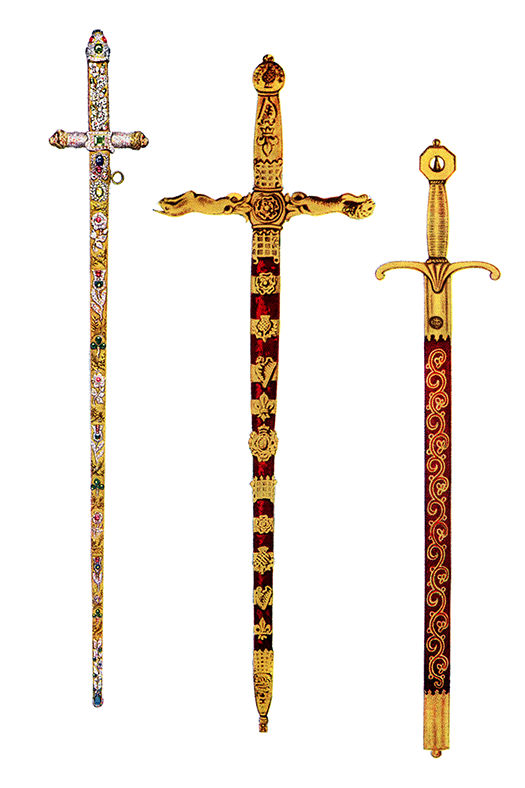
From left to right: The jeweled Sword of Offering, the Sword of State, and the Sword of Mercy (Curtana).
G. Younghusband; C. Davenport (1919). The Crown Jewels of England. London: Cassell & Co. p. 54. (published in the US by Funk & Wagnalls, NY). Cyril Davenport (1848 – 1941)
This famous weapon once belonged to Edward the Confessor (1003-1066), one of the last Anglo-Saxon kings of England before the Norman Conquest of 1066. He was known as 'the Confessor' because of his deep piety.
Edward the Confessor ruled from 1042 to 1066, and his reign was characterized by the crumbling disorganization of royal power in England. Shortly after Edward the Confessor's death, the Normans began to expand into England, led by William the Conqueror, a ruthless and powerful ruler who changed Britain forever.
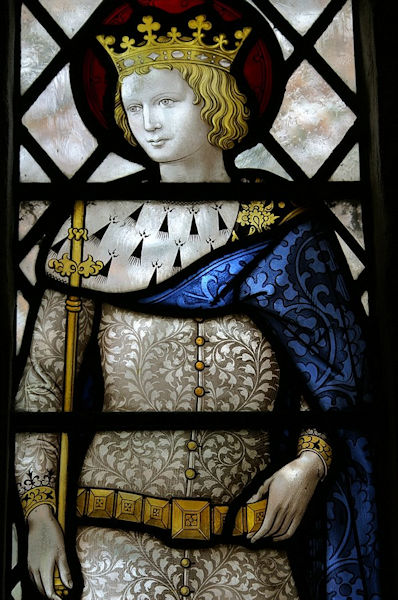
Church of England parish church of St Nicholas, Ickford, Buckinghamshire: stained glass window depicting Saint Edward the Confessor. Ickford, Buckinghamshire. Credit: Vitrearum - CC BY-SA 2.0
The name Curtana comes from the Latin Curtus, meaning short. Interestingly the sword is also linked to some ancient legends.
According to one legend, the Curtana was the sword of Ogier the Dane, an 8th-century warrior. The sword bore the inscription, "My name is Cortana, of the same steel and temper as Joyeuse and Durendal." It is said that Ogier drew the Sword of Mercy against Emperor Charlemagne's son in revenge for the murder of his son but stopped with a voice from Heaven called upon him to show mercy.
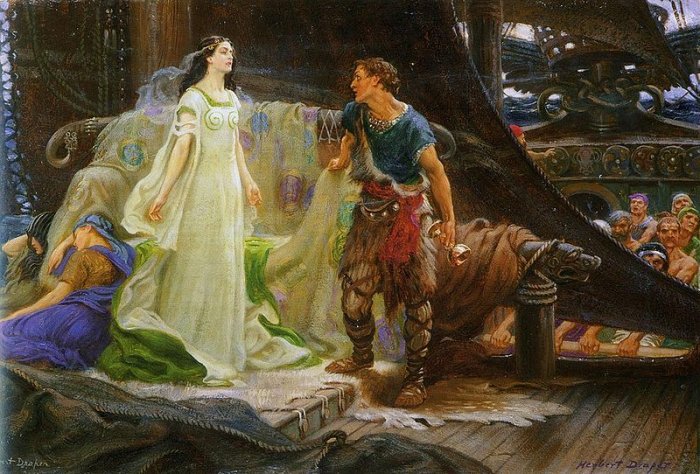
Tristan and Iseult as depicted by Herbert James Draper (1864–1920). Public Domain
Another legend links the Sword to Mercy to Tristan, the hero of the Arthurian Tristan and Iseult story. He was a Cornish knight of the Round Table.
The 13th-century Prose Tristan states that Ogier had inherited Tristan's sword, shortening it and naming it Cortaine.
These ancient legends may be true but have not been confirmed. What is undoubtedly very possible is that the Sword of Mercy once belonged to Edward the Confessor.
It has a steel blade inlaid with copper and a wire-bound grip. The scabbard is covered with velvet and embroidered with gold thread. The blade started as a normal pointed sword that had been cut off about from its original point. Why the sword is broken is an ancient mystery. Perhaps Edward, the Confessor, broke the blade himself or had it forged that way precisely for the current symbolic resonance. It's also been said that an angel broke off the blade to show that a sovereign must show mercy.
Today, the Sword of Mercy is displayed with the other Crown Jewels in the Jewel House at the Tower of London.
Updated on March 9, 2024
Written by - Ellen Lloyd – AncientPages.com
Copyright © AncientPages.com All rights reserved. This material may not be published, broadcast, rewritten or redistributed in whole or part without the express written permission of AncientPages.com
More From Ancient Pages
-
 Rare Eleventh-Century Astrolabe Unearthed Recently Sheds Light On Islamic-Jewish Scientific Exchange
-
 Ouroboros: Ancient Infinity Symbol Used By Different Ancient Civilizations
-
 Two Well-Preserved Shipwrecks Found By Swedish Maritime Divers In Baltic Sea
-
 120,000-Year-Old Bone Etchings – Evidence Of The Earliest-Known Use Of Symbols
-
 On This Day In History: Henry VIII Ascended The Throne Of England – On Apr 22, 1509
-
 Nemesis: Winged Goddess Of Justice And Revenge
-
 On This Day In History: Captain James Cook Spotted The East Coast Of Australia – On Apr 19, 1770
-
 Manannán Mac Lir – Irish God Of Sea, Healing, Weather And Master Of Shapeshifting
-
 World’s Oldest Toy Car – Could This 7500-Year-Old Discovery Be The Earliest Evidence Of The Wheel?
-
 Odd Ancient Dwellings Of The Snake People – Clues From Biblical Lands – Part 2
-
 Earliest Evidence Of Humans Using Fire To Shape The Landscape Of Tasmania
-
 Mysterious Shasu – Bandit Canaanites Or Israelites?
-
 Massive Bronze-Age Settlement Discovered Underwater in Greece
-
 Polish Excavations At Tell el-Murra And Long History Of Egyptian Coffins
-
 Unkulunkulu: ‘Great Oldest One’ Progenitor Of Mankind, Creator Of All Things And Origin Of Death In Beliefs Of Zulu People
-
 Edward Of Woodstock “Black Prince” – Idol Of The English People And Terror Of The French
-
 Mysterious Medes: Was It An Ancient City Of Ecbatana?
-
 3D Facial Landmarks Reveal Columbus’ Cannibal Claims Were No Myths But True Accounts
-
 Palace From The Time Of The Kings Of Judah – Unearthed In Jerusalem
-
 Outstanding Unfinished Ancient Marble Carving Of A Lion’s Head Found Near Selinunte, Sicily

