
Beautiful Ancient City Of Pisac In The Sacred Valley, Peru – Incredible Inca Ruins
Ellen Lloyd - AncientPages.com - Ancient city of Pisac in the Sacred Valley, Peru is not as famous as Machu Picchu, but it’s a remarkable place that is not only beautiful but also rich in history and legend.

Structures in the urban sector of the Inca complex at Pisac. Image credit: Leon Petrosyan - CC BY-SA 3.0
Known for its Incan ruins, the city of Pisac, located about 19 miles northeast of Cusco lies atop a hill at the entrance to the valley. The view is fantastic, and it seems that no matter where you stand, you can admire remarkable agriculture terraces that are still in use today.
It is said that in ancient times, the city was guarded at night by pumas.
Why Did Inca Build The City Of Pisac?
Why Pisac was built is not entirely clear. According to the scholar Kim MacQuarrie, Pachacuti erected a number of royal estates to memorialize victories over other ethnic groups. Among these royal estates are Písac (victory over the Cuyos), Ollantaytambo (victory over the Tambos), and Machu Picchu (conquest of the Vilcabamba Valley).
However, there are also historians who suggest Písac was established to protect Cusco from possible attacks from the outside.
The ruins are separated along the ridge into four groups known as P'isaqa, Inti Watana, Qalla Q'asa, and Kinchiraqay. In Quechua, Pisac means “partridge”. Inca tradition dictated building cities in the shape of birds and animals, and as such, Pisac is partridge shaped.
Partridge-shaped structures are related to the spirituality and values that the Incas believed that each human being should develop.
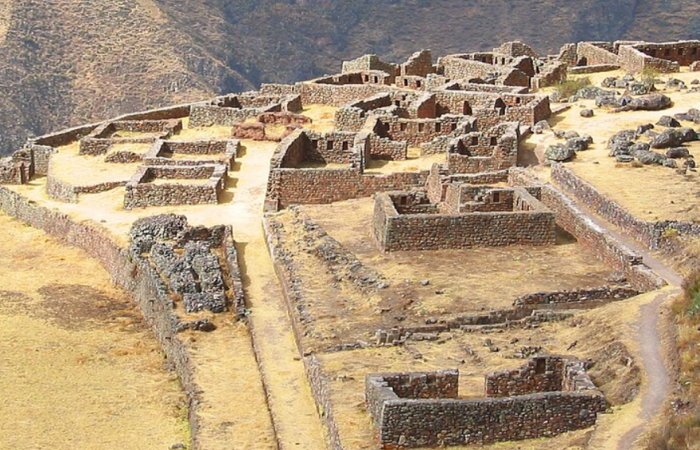
The Pisaq'a residential area in the Inca complex. Image credit: Bcasterline - Public Domain
There are twenty lookout towers of different sizes placed strategically throughout the ruins. Some are massive watchtowers that are placed so that messages could be shouted from one to the other, and there are other towers that were used to store water for the elaborate irrigation system.
The ruins in Pisac contain a group of thirty independent but uniform enclosures, which were probably used as apartments.
Legend Of Princess Inquill (Inkill) Chumpi And The Stone Figure
There are several ancient legends about this beautiful place in the Andean Mountains. One legend tells that a princess called Inkill Chumpi (princess of the Florida belt) owned the entire city. She would marry someone who could build a bridge over the Wilkamayu River (Vilcanota) in a single day.
After learning about this, many young men tried to accomplish what seemed like an impossible task. Asto Rimac, who was a secret lover of the princess owned the lands to the east. When Asto Rimac was started building the bridge, Princess Inkill Chumpi went to invoke the Apus (mountain spirits) to help him.
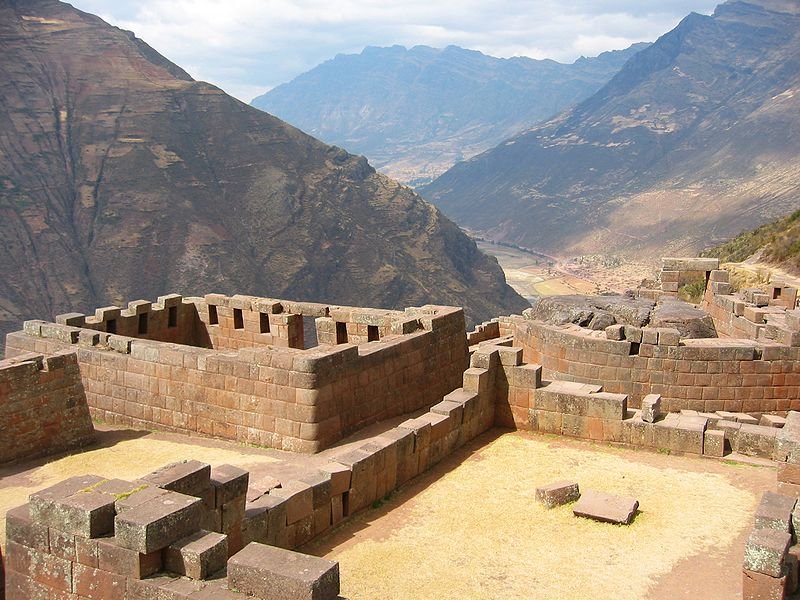 View of the Sacred Valley, Peru, from the Sun Temple (foreground) at Písac. Image credit: Bcasterline - Public Domain
The spirits agreed to help him, but only if she didn’t look at the bridge until it was ready. Just before the bridge was finished, the princess began to hear loud thunders and gave in to the temptation to see what happened and turn to observe; At that moment, the Urubamba river swallowed Asto Rimac, and she was turned to stone, standing, looking towards the valley of Pisac. In the place until today can be seen as the figure of stone.
It is unknown when Inca Písac was built. There are no traces suggesting that Písac was inhabited by any pre-Inca civilization, so it was most likely built no earlier than 1440.
Francisco Pizarro and the Spanish conquerors destroyed Inca Písac in the early 1530s. The modern town of Písac was built in the valley by Viceroy Toledo during the 1570s.
Written by Ellen Lloyd – AncientPages.com
Updated on Oct 14, 2024
Copyright © AncientPages.com All rights reserved. This material may not be published, broadcast, rewritten or redistributed in whole or part without the express written permission of AncientPages.com
Expand for referencesMore From Ancient Pages
-
 1,500-Year-Old “Church of the Glorious Martyr” With Beautiful Mosaic Unearthed Near Jerusalem
-
 A Hoard Of Silver Coins Found Accidentally Under An Uprooted Tree Near Pieštany, Slovakia
-
 Secrets Of Ancient Underwater City Pavlopetri Revealed – Travel Back In Time And See What The City Looked Like!
-
 First Time A Meteorite Killed A Person In Known History Revealed In Old Documents
-
 On This Day In History: Declaration Of Arbroath – The Scots Reaffirm Their Independence – On Apr 6, 1320
-
 Skull From Broken Hill, Zambia Is Relatively Young – New Analysis Shows
-
 Extremely Brutal Conflicts Among Maya Broke Out Before Civilization’s Decline
-
 Massive Head Of Hercules Pulled From The Antikythera Shipwreck
-
 Ancient Intriguing Sao People: “Men From Another Time” – One Of The Oldest Civilizations Of Central Africa
-
 Unravelling The Mystery Of The Yellow Emperor And His Connection To Regulus
-
 January 2016: Lost Library Of John Dee Revealed In A Special Exhibition
-
 41,500-Year-Old Ivory Pendant Is The Oldest Evidence Of Humans Decorating Jewelery In Eurasia
-
 Unique Glimpse Into The Secrets Of Mysterious Ancient Egyptian Manuscripts And Sacred Tablets Deliberately Hidden From The Outside World
-
 Discovery Of Ancient Sarcophagus And 14 Stone Pillars Covered With Inscriptions In Eastern Mongolia
-
 Chilling Tale Of The Tailor And Odin’s Wild Hunt – Why The Norse God Warns Against Going Out On Christmas Eve
-
 Extraordinary Biblical Frescos Uncovered In Domitilla Catacombs
-
 Unique Miniature Roman Gold Lock Smaller Than A One-Euro Coin Discovered In Germany
-
 Cousin-Marriages Were Uncommon In The Ancient World
-
 Surprising Discovery – Replica In The Field Museum Is A 3,000-Year-Old Sword
-
 15 Prehistoric Rock Paintings Discovered Near Ancient Armenian City Of Ani

