
Mead Of Poetry: Odin Gave This Magical Potion To Gods, Valkyries And Humans
A. Sutherland - AncientPages.com - Odin is a god of war, death, poetry, and wisdom in Norse mythology. He often spoke in beautiful poems.
But before he became the god of poetry, he had to steal and consume the Mead of Poetry; a magical potion even called "the stirrer of inspiration," was a source of unlimited knowledge, inspiration, and eloquence.
A giant Suttung and his daughter protected the magical and priceless drink. Odin had to call on all his powers of deception and cunning to steal it.
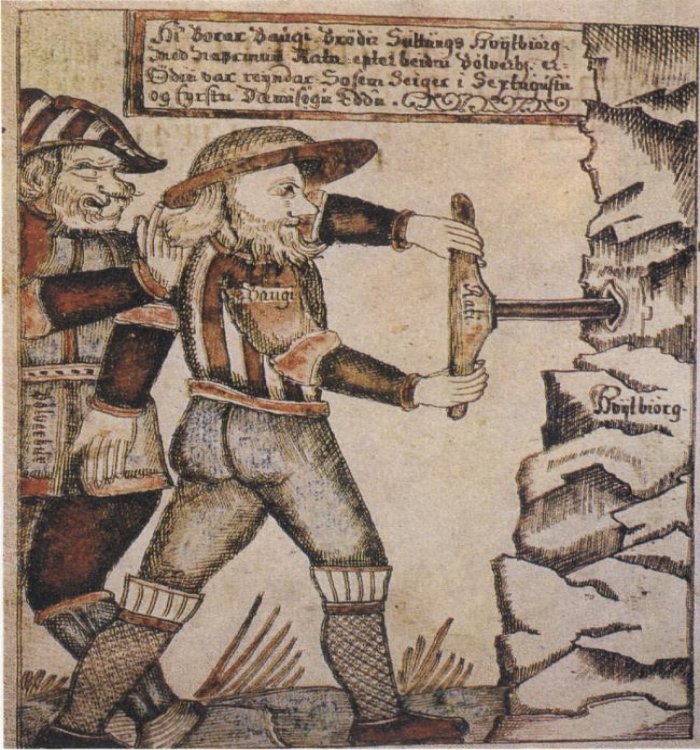
At the top of the drawing is written: "Here drills Baugi, Suttung brother, Hnitberg with drill Rati following command from the Bolverk, which by the way was Odin, as it is told in the sixty-first example of Edda.
As we know, Odin was always seeking wisdom, even at a high personal cost. He was already a great master of supernatural powers, but he wanted to go to a further extreme to master even more.
Eventually, he became known as the God of Poetry, speaking in beautiful poems and gladly giving poetic talent to gods, humans, and others he considered worthy of this supernatural gift.
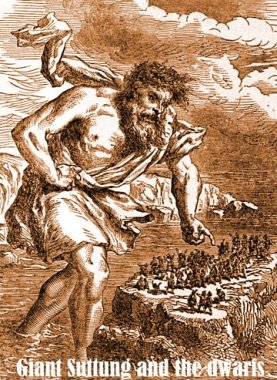
But before that happened, Odin had to figure out how to access the mountain, which was giant Suttung's home.
Disguised as a mortal and calling himself, Bolverk ('Evil-Doer'), Odin set forth to obtain the mead.
He took up lodgings with Suttung's brother, a giant Baugi, the owner of nine slaves. Odin murdered them and offered to do their work for a price of one drink of Suttung's mead of poetry.
When winter came, Odin/Bolverk completed his work and came to Baugi demanding his reward. Baugi was not authorized to accept such a request, but he agreed. Both men set off for Suttung's mountain dwelling.
When they arrived, giant Suttung refused to participate in Bolverk and Baugi's agreement.
Then, Bolverk decided to use en auger (an instrument for boring) and ordered Baugi to bore a hole in Hnitberg (Hnitbjörg) mountain, which he believed contained the mead.
Soon, a tunnel was created, and Bolverk could transform into a snake and crawl into an inner chamber, where he changed his appearance again into a young, beautiful man to meet Suttung's daughter, Gunnlöd (whose name means "invitation to the battle").
She guarded the precious liquid, so Odin had to spend three nights with her, and after this time together, Gunnlöd, who fell in love with him. Thus, he could have three draughts of mead.
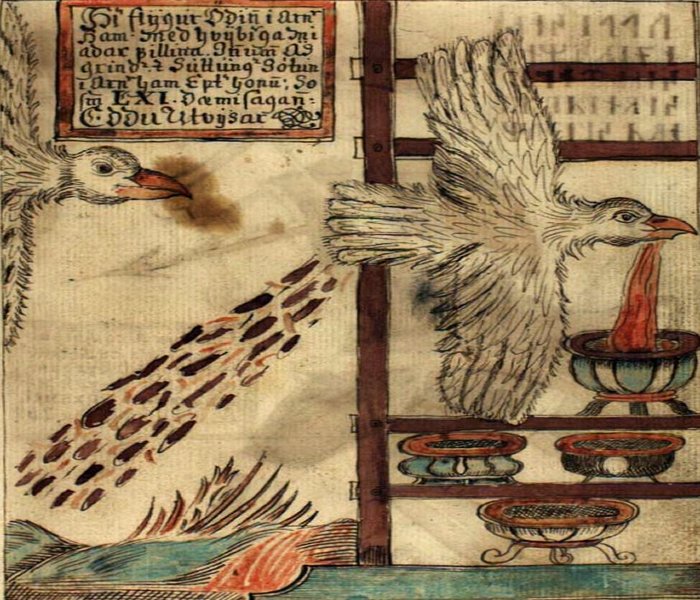
An Icelandic 17th century drawing depicting Odin taking mead to Valhalla. Eddahandskrift. Ny kgl. Saml. 1867 4, Det Kongelige Bibliotek, Köpenhamn
But each emptied a container. Then, Odin turned himself into an eagle and flew to Asgard, the kingdom of the Norse gods.
When the Aesir gods saw Odin flying towards them, they were ready to help him by placing special containers in the courtyard. Thus, Odin, who flew overhead, could release the mead into them, and so he did.
He also gave the mead to the Valkyries for reviving dead heroes upon their arrival in Valhalla and all mortals on earth.
Did Odin really want to give mortals some of the magical potion?
In another version of this beautiful myth, we learn that furious Suttung, also transformed into an eagle following Odin in pursuit. Being very close behind, Suttung caused Odin to spill some of the magical drink outside the walls of Asgard, and since that time, any mortal can benefit from it - if he/she so wishes.
Updated on January 21, 2022
Written by – A. Sutherland AncientPages.com Staff Writer
Copyright © AncientPages.com All rights reserved. This material may not be published, broadcast, rewritten or redistributed in whole or part without the express written permission of AncientPages.com
Expand for referencesReferences:
Lindow, Norse Mythology
More From Ancient Pages
-
 Egyptian Blue: World’s Oldest Artificial Pigment
-
 Immortal Mimi Spirits In Beliefs Of Aborigines Of Arnhem Land
-
 Decorative Relief Of El Cerrón Helps To Uncover Unique Identity Of Central Iberian Elite Of Carpetania
-
 Unexplained Accounts Of Mysterious Fires – ‘Burning’ Questions Remain Unanswered – Part 1
-
 Luxor – Ever-Lasting Legacy Of The Ancient Egyptian Civilization And The Pharaohs
-
 Controversial Story And Secret Knowledge Of Li Ching-Yuen Who Lived For 256 Years
-
 Mystery Of The Avars Who Conquered The Roman Empire Solved By Scientists
-
 Dispute Between Russia And Poland Over Discovery Of Czarist Officer’s Corpse In Turkey
-
 Igaluk – Powerful Eskimo Moon God That Directs Natural Phenomena
-
 Socrates: Great Philosopher And Brave Man Who Still Inspires Many People
-
 Ensisheim Meteorite Is The Oldest Meteorite With A Precise Date Of Impact
-
 Story Behind The Two Keys On Vatican’s Flag
-
 Mysterious Leaden Sarcophagus Found Under Notre Dame Will Be Opened
-
 Early Christian Crypt Unearthed In Zaldapa Fortress, Bulgaria
-
 Bees – Embodiment Of Human Soul, Divine Messengers Symbolizing Invisible Bridge Connecting Life And Death
-
 Did Richard The Lionheart Order Assassins To Kill Conrad Of Montferrat, King Of Jerusalem?
-
 Curious 6,000-Year-Old Skull May Confirm Mythical Ancient Tribe Of Small Dark-Skinned People Did Exist!
-
 Anglo-Saxons Practically Eradicated Native Britons: The Question Is: Was It Ethnic Cleansing?
-
 Something Never-Before-Seen Is Hidden Beneath 15 Giant Viking Burial Mounds Spotted By Radar In Norway
-
 Acta Diurna: World’s First Newspaper Appeared In 131 B.C

