
Siege Of Alesia: Last Decisive Battle That Ended Gallic Independence In France And Belgium
A. Sutherland - AncientPages.com - The Battle of Alesia took place in September 52 BC. It was the culmination of Caesar's successful campaigns to bring Gaul (modern France) into the Roman Empire.
For many years, Caesar had marched his soldiers across the country humiliating and slaughtering all Celtic tribes that resisted Roman rule. It took time but he finally ended Gallic independence in France and Belgium.

About one million Gauls had been sold as slaves and an equal number had been massacred; the remaining five million people had no choice – they accepted Roman rule.
Despite the victory at Gergovia, the Arverni king, Vercingetorix, was reluctant to fight in the open field against the Roman forces and still led guerrilla raids and used scorched-earth tactics.
He knew his enemy, who was engaged in the Gallic Wars (58-50 BC); he knew that Caesar conquered the Gallic peoples one by one and these successes brought him political prestige in Rome and great wealth through the spoils of wars and the sale of war captives as slaves.

The walls stretched for approximately 25 miles, connecting with more than 50 miles of trenches, 23 forts, turrets, palisades and other obstacles disturbing the approaching Gallic warriors.
Now, Caesar had to confront Gallic rebellions, which threatened his control over Gaul. The next his success came when Vercingetorix’ forces attacked him north-west of Dijon, in eastern Gaul; the Gallic attack was resisted by Roman legions supported by the Germanic cavalry.
The confidence of the rebels was shaken and Vercingetorix withdrew to Alesia, and closed its fortifications. Caesar used to pass up such an opportunity, stopped the march south and chased the fleeing Gauls.

Vercingetorix before Caesar
Commanding fewer than 50,000 legionnaires, Caesar began a siege. Caesar’s made his decision to continue the siege of Alesia and forcing the Gallic surrender by starvation. Approximately 80,000 men were stationed in Alesia, together with the local civilian population, so it was obvious that the city’s food supply could not last long.
See also:
Vercingetorix: Greatest Of All Gallic Leaders And Hero Of The French People
Gallic Leader Vercingetorix In Victorious Battle Of Gergovia, 52 BC
Wilhelm Tell: Famous Legendary Crossbowman And Swiss Patriot – Symbol Of Freedom And Dignity
Vercingetorix dispatched his cavalry to rally reinforcements from across Gaul, and in turn the Romans decided to construct a double wall of fortifications around Alesia. The strengthening was facing towards and away from the city.
The walls stretched for approximately 25 miles, connecting with more than 50 miles of trenches, 23 forts, turrets, palisades and other obstacles disturbing the approaching Gallic warriors.
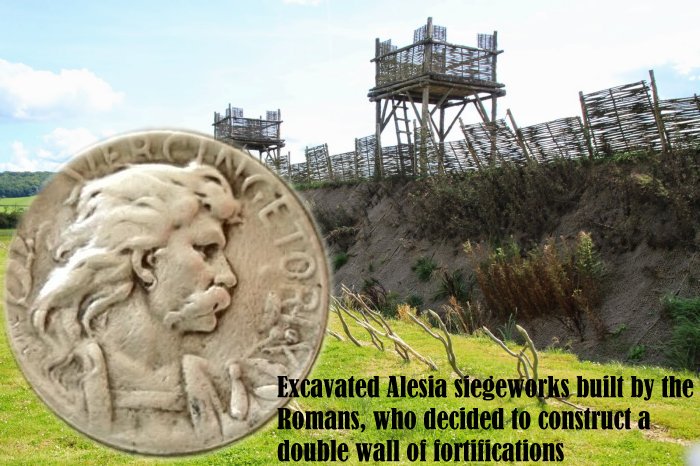
Excavated Alesia siegeworks
When Gallic support force arrived, the Romans had to face 80,000 men in Alesia and about 250,000 foot soldiers along with 8,000 cavalry attacking from outside the city.
After two days of heavy fighting, Caesar’s army was in trouble and on the third day, the Gauls captured the Roman camp, playing an important role in the Roman defense. To Caesar’s help came his German cavalry, which outflanked the Gallic forces and attacked them from behind and thus, the battle eventually turned to the Roman advantage.
The great Gallic leader, Vercingetorix, decided to surrender the next day. The three-day battle of Alesia was over; the Romans had won a decisive victory, destroying the powerful and very brave Gallic tribes.
The nation of Gaul was turned into a province of the Roman Empire. About one million Gauls had been sold as slaves and an equal number had been massacred; the remaining five million people had no choice – they accepted Roman rule.
After his surrender, Vercingetorix the Gaul, was taken to Rome where he was kept prisoner until he was executed in Julius Caesar's triumph of 46 B.C.
Written by – A. Sutherland AncientPages.com Staff Writer
Copyright © AncientPages.com All rights reserved. This material may not be published, broadcast, rewritten or redistributed in whole or part without the express written permission of AncientPages.com
Expand for referencesReferences:
S. Sandler, Ground Warfare
M. L. Lanning, Battle 100: The Stories Behind History's Most Influential Battles
More From Ancient Pages
-
 Ancient Egyptian Toys And Games In Focus
-
 Indus Civilization And Complex Patterns Of Urbanity – New Study
-
 Ancient Mexicans’ Precise Solar Observations Fed Millions – Remarkable Farming Calendar Invented
-
 New Historical Finds Near Khoja Ahmed Yassawi Mausoleum In Turkestan – Uncovered
-
 Maya Settlement In City Of Itzan Is Much Older Than Previously Thought – New Study
-
 Two 19th Dynasty Royal Statues Unearthed At Ancient Site Of Heliopolis, Cairo, Egypt
-
 On This Day In History: Julian ‘The Apostate’ Died During The Retreat From The Sassanian Empire – On June 26, 363
-
 Rare Ancient Human Footprints Found On Gower Peninsula, Wales Are 7,000 Years Old
-
 New Denisovan Fossil: Extinct Humans Inhabited Tibetan Plateau For 160, 000 Years – Study
-
 Male-Female Roles 7,000 Years Ago Were Less Traditional Than Previously Thought – New Study Reveals
-
 Reconstructing The Lost Ancient World Of The Marquesas Islands With Unique Plants And Animals
-
 Legend Of The Four Dragons That Disobeyed The Jade Emperor And Gave China Water
-
 Huge Ancient Sarayini Underground City Is Twice As Large As Previously Thought
-
 Ouroboros: Ancient Infinity Symbol Used By Different Ancient Civilizations
-
 New Light On Prehistoric Chalk Plaques From Stonehenge Using Innovative Technology
-
 Unique Temple Of The Condor In Machu Picchu: 3D Spectacular Inca Stonemasonry
-
 New Huge Viking Ship Discovered By Radar In Øye, Norway – What Is Hidden Beneath The Ground?
-
 Well-Preserved Bronze Statues Discovered In Thermal Baths In Tuscany
-
 Fossilized Trilobite Amulet Found At The Roman Site In Spain Was Believed To Have Magical Or Protective Properties
-
 Daily Life Of Télpochcalli Students Of The Aztec Empire Was A Challenge

