
Siege Of Alesia: Last Decisive Battle That Ended Gallic Independence In France And Belgium
A. Sutherland - AncientPages.com - The Battle of Alesia took place in September 52 BC. It was the culmination of Caesar's successful campaigns to bring Gaul (modern France) into the Roman Empire.
For many years, Caesar had marched his soldiers across the country humiliating and slaughtering all Celtic tribes that resisted Roman rule. It took time but he finally ended Gallic independence in France and Belgium.

About one million Gauls had been sold as slaves and an equal number had been massacred; the remaining five million people had no choice – they accepted Roman rule.
Despite the victory at Gergovia, the Arverni king, Vercingetorix, was reluctant to fight in the open field against the Roman forces and still led guerrilla raids and used scorched-earth tactics.
He knew his enemy, who was engaged in the Gallic Wars (58-50 BC); he knew that Caesar conquered the Gallic peoples one by one and these successes brought him political prestige in Rome and great wealth through the spoils of wars and the sale of war captives as slaves.

The walls stretched for approximately 25 miles, connecting with more than 50 miles of trenches, 23 forts, turrets, palisades and other obstacles disturbing the approaching Gallic warriors.
Now, Caesar had to confront Gallic rebellions, which threatened his control over Gaul. The next his success came when Vercingetorix’ forces attacked him north-west of Dijon, in eastern Gaul; the Gallic attack was resisted by Roman legions supported by the Germanic cavalry.
The confidence of the rebels was shaken and Vercingetorix withdrew to Alesia, and closed its fortifications. Caesar used to pass up such an opportunity, stopped the march south and chased the fleeing Gauls.

Vercingetorix before Caesar
Commanding fewer than 50,000 legionnaires, Caesar began a siege. Caesar’s made his decision to continue the siege of Alesia and forcing the Gallic surrender by starvation. Approximately 80,000 men were stationed in Alesia, together with the local civilian population, so it was obvious that the city’s food supply could not last long.
See also:
Vercingetorix: Greatest Of All Gallic Leaders And Hero Of The French People
Gallic Leader Vercingetorix In Victorious Battle Of Gergovia, 52 BC
Wilhelm Tell: Famous Legendary Crossbowman And Swiss Patriot – Symbol Of Freedom And Dignity
Vercingetorix dispatched his cavalry to rally reinforcements from across Gaul, and in turn the Romans decided to construct a double wall of fortifications around Alesia. The strengthening was facing towards and away from the city.
The walls stretched for approximately 25 miles, connecting with more than 50 miles of trenches, 23 forts, turrets, palisades and other obstacles disturbing the approaching Gallic warriors.
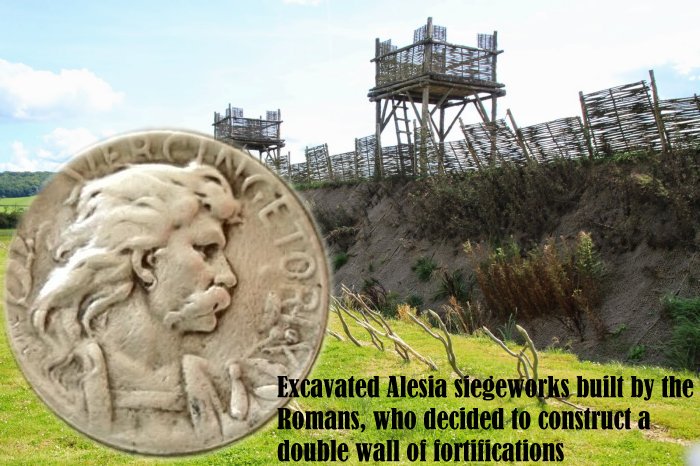
Excavated Alesia siegeworks
When Gallic support force arrived, the Romans had to face 80,000 men in Alesia and about 250,000 foot soldiers along with 8,000 cavalry attacking from outside the city.
After two days of heavy fighting, Caesar’s army was in trouble and on the third day, the Gauls captured the Roman camp, playing an important role in the Roman defense. To Caesar’s help came his German cavalry, which outflanked the Gallic forces and attacked them from behind and thus, the battle eventually turned to the Roman advantage.
The great Gallic leader, Vercingetorix, decided to surrender the next day. The three-day battle of Alesia was over; the Romans had won a decisive victory, destroying the powerful and very brave Gallic tribes.
The nation of Gaul was turned into a province of the Roman Empire. About one million Gauls had been sold as slaves and an equal number had been massacred; the remaining five million people had no choice – they accepted Roman rule.
After his surrender, Vercingetorix the Gaul, was taken to Rome where he was kept prisoner until he was executed in Julius Caesar's triumph of 46 B.C.
Written by – A. Sutherland AncientPages.com Staff Writer
Copyright © AncientPages.com All rights reserved. This material may not be published, broadcast, rewritten or redistributed in whole or part without the express written permission of AncientPages.com
Expand for referencesReferences:
S. Sandler, Ground Warfare
M. L. Lanning, Battle 100: The Stories Behind History's Most Influential Battles
More From Ancient Pages
-
 Extremely Rare 2,700-Year-Old Black Stone Seal Depicting A Winged Genie Discovered In Jerusalem
-
 Spread Of Early Farming Across Atlantic Coast Of Europe – In New Light
-
 When Giants Ruled North America – Encounters With Mysterious Races Of Giants – Part 1
-
 Unexpected Substance Found In Ancient Maya City May Have Arrived Through Distant Trade
-
 Rare Statue With A Ka Symbol And A Dwarf Sphinx Discovered In Egypt
-
 Modern Pesticide Accelerates Corrosion Of Ancient Roman Bowl
-
 Ishtar Gate, The Eighth Gate Of The Inner City Of Babylon
-
 Mysterious Ancient Red Princess Of The Silk Road With Cinnabar Dyed Teeth
-
 Mystery Of The Ancient Forgotten Mizoram Civilization And Lost City Of Vangchhia
-
 Ruins Of Post-Medieval Brunell Township Discovered In Glen Brittle Forest On The Isle of Skye
-
 The Mystery Of Serpent Worship
-
 Enigmatic Newport Tower – Built By The Vikings, Knights Templar, Freemasons Or Someone Else?
-
 The Faery Grail Of Hospitality And Accord – Secrets Of The Elucidation – Part 2
-
 Nine 1,400-Year-Old Coins Belonging To Christian Pilgrims Found On The Highway To Jerusalem
-
 On This Day In History: Famous Inventor Thomas Edison Died – On Oct 18, 1931
-
 Well-Preserved 1,000-Year-Old Ulfberht Sword Found In The Wisla River, Poland
-
 Two 1,800-Year-Old Sarcophagi Of Wealthy People Accidentally Found At Ramat Gan Safari Park
-
 Jelling Stone And Legendary Harald ‘Bluetooth’ King Of Denmark – ‘Who Made The Danes Christian’
-
 Maya Storm God Huracán Taught That When We Damage Nature, We Damage Ourselves
-
 Mystery Of Egyptian Queen Hetepheres I’s Bracelets Solved!

