
Votive Plaque Dedicated To Dudu High Priest Of God Ningirsu
A.Sutherland - AncientPages.com - Votive plaques were characteristic and widespread pieces of art in the Second and Third Early Dynastic Periods (2800-2340 BC) of Sumer.
With round perforations in the center, they were decorated with diverse incised or carved scenes.
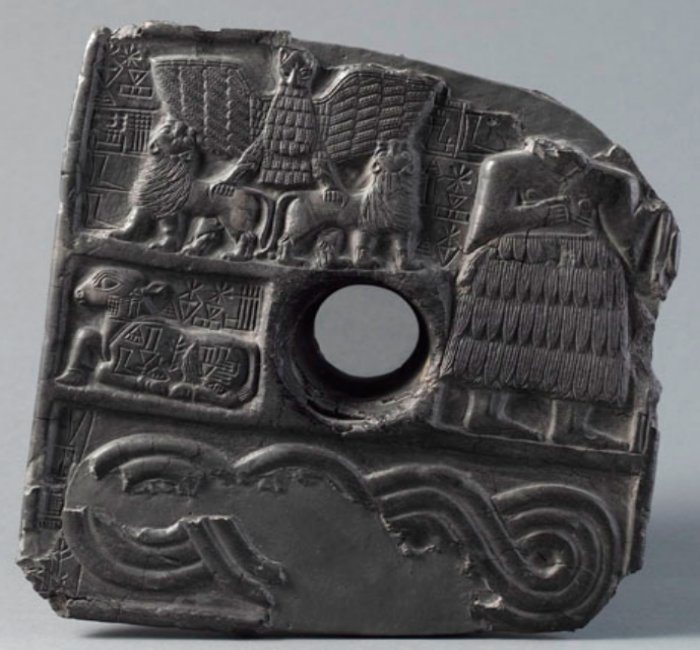
Perforated plaque of Dudu, the high priest of Ningirsu in the reign of Entemena, prince of Lagash (c.2450 BC). Credits: Louvre
This relief, with its central round perforation, is divided into four, horizontal parts (registers) and according to a Sumerian inscription, it depicts Dudu, the high priest of the god Ningirsu during the reign of Entemena - the king of Lagash, who reigned about 2418-2391 BC
Dudu’s figure occupies the height of two registers on the plaque and faces right; the figure is dressed in the kaunakes, (originally traced to the Sumerian civilization, which existed even before 4,000 BC), a skirt in sheep's wool or other tufted material.
Incised to his left is the lion-headed eagle, called Imdugud, a symbol of the god Ningirsu and emblem of Lagash, as found in other similar plaques from Telloh (Tello). The eagle is depicted with wings outspread, two lions gripped in his talons. In the middle, a calf is shown lying down, while the lower register is filled by a motif of running water, probably symbolizing the subterranean water reserves for crops or source of fertility.
The dedicatory inscription, confined to the area left free by the image in the upper part, runs over the body of the calf: "For Ningirsu of the Eninnu, Dudu, priest of Ningirsu ... brought [this material] and fashioned it as a mace stand."
See also:
Millennia-Old Sumerian Tripod Vase Dedicated To God Ningirsu, The Son Of Enlil
Ur-Nammu - Popular And Accomplished Ruler Of Sumer
Codes Of Ur Nammu: World’s Oldest Known Law Code
King Ur-Nammu – King Of Ur, King Of Sumer And Akkad – The One Who Built The Temple Of Enlil
Made of gypsum or limestone, the Sumerian perforated plaques are decorated with scenes from Sumerian life and have been excavated at many sites in Mesopotamia. About 120 of them are known to exist now and about fifty plaques were found in religious buildings.
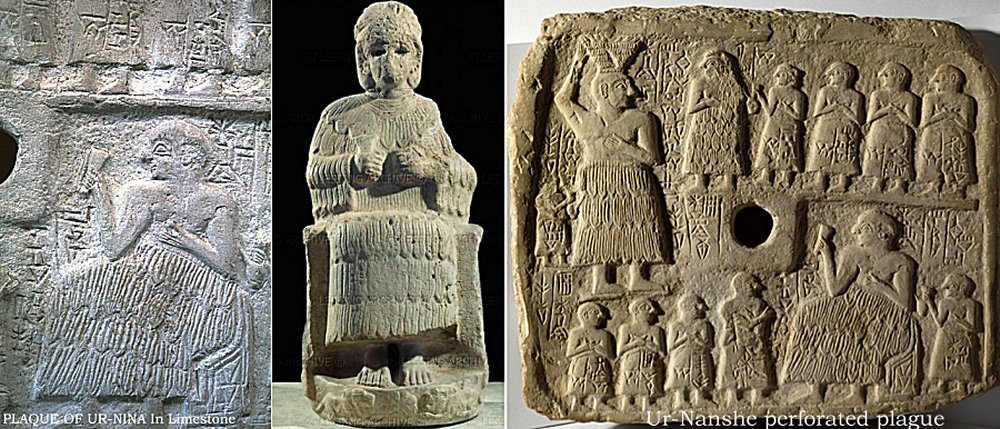
They are usually rectangular in form and decorated with scenes incised or carved in relief.
The exact function of this kind of plaques is unknown, and so is the purpose of the central perforation. The inscription here at first led scholars to consider them as mace stands, but it seems unlikely.
Some have suggested they were to be hung on a wall, the hole in the center taking a large nail or peg, they could even part of a door-closing mechanism.
Perforated plaques such as this one were usually organized in horizontal registers, depicting various ceremonies, banquets, the construction of buildings (as in the perforated plaque of Ur-Nanshe), and other royal events.
Written by – A. Sutherland - AncientPages.com Senior Staff Writer
Copyright © AncientPages.com All rights reserved. This material may not be published, broadcast, rewritten or redistributed in whole or part without the express written permission of AncientPages.com
Expand for referencesReferences:
- Dickin, Pagan Trinity
More From Ancient Pages
-
 Evolution Of Plague Over Hundreds Of Years In Scandinavia Documented By Scientists
-
 First Carbon-Based Paleolithic Paintings Found In Font-De-Gaume Cave, France Could Be 19,000 Years Old
-
 Advanced Ancient Irrigation Network Discovered In Mesopotamia
-
 ‘Sea Monsters’ Were Real Millions Of Years Ago: New Fossils Tell About Their Rise And Fall
-
 Face Of Queen Lady Cao Reconstructed – Unique Look At The First Known Female Ruler In Peru
-
 Jambu Tree In Great Cosmogonic Forest Of Sacred Land Of Jambudvipa In Buddhist Mythology
-
 Sculptures-Menhirs Dated To The Copper Age Unearthed In Los Millares (Almería) Spain
-
 Ancient History Of Body Modification In Mesoamerica Practiced By The Aztecs, Maya And Olmecs
-
 Ancient Artifacts With Carved Geometric Patterns Demonstrate Advanced Cognitive And Symbolic Behavior Among Early Humans
-
 Why Were Ba And Ka Powerful Elements Of Soul In Ancient Egyptian Beliefs?
-
 World’s Largest Complex Of Borobudur – Spectacular Buddhist Masterpiece
-
 Amazing ‘Guennol Lioness’ – One Of The Greatest Ancient Works Of Art Of All Time
-
 Pazzi Conspiracy – Failed Murder Attempt On Lorenzo de’ Medici Made Him Even More Powerful And Threw Renaissance Florence Into Chaos
-
 Empusa – Shape-Shifting Evil Female Demon In Greek Myth And Folklore
-
 What Was Life For Ancient Viking Children?
-
 When And Why Was Yakuza, The Japanese Mafia Founded?
-
 Mystery Of The Gold From Troy, Poliochni And Ur Solved!
-
 Mysterious Ancient Shapeshifters Who Guided Humans And The Battle Of The Gods Described In Sacred Texts And Myths
-
 Pre-Hispanic Carved Stone Monuments Discovered On A Mountaintop In Puebla, Mexico
-
 British Museum Is World’s Largest Receiver Of Stolen Goods – Says QC

