
Bezvodovka: Little Known Ancient Solar Observatory In Ukraine Reveals Its Secrets
Ellen Lloyd - AncientPages.com - Our ancestors were fascinated with the night sky. They watched the movements of celestial bodies, observed solar and moon eclipses and created calendars based on their astronomical observations. All around the world, we come across traces that reveal people who lived thousands of years ago were, in fact, skilled ancient astronomers.
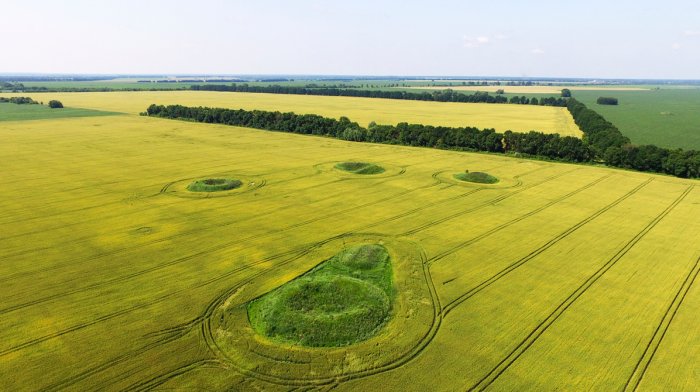
In a small now long-forgotten ancient village of Bezvodovka in Chernihiv region, nearby the city of Ichnia, Ukraine there are several intriguing ancient mounds.
The mounds occupy an area of 20 square kilometers and are believed to have been built by nomadic tribes who lived in the region during the first and second millennium B.C.
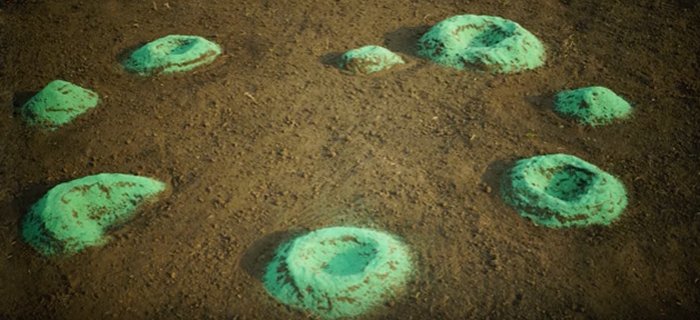
Bezvodovka is an ancient solar observatory in Ukraine. Image credit: Bezvodovka
The Bezvodovka mounds are of great archaeological interest and scientists are now considering they were used for astronomical observations.
On one of the maps created by Fedor Schubert in 1861, there are 6 mounds depicted in a circular position. Four of them have an elongated shape. Unfortunately, only four of the mounds and one satellite mound have survived until the present.
While investigating the mounds scientists found intriguing evidence the mounds served as part of an ancient solar observatory.
Six sights mark the astronomic events of the rise and set of the sun in days of winter and summer solstice, and the autumn and spring equinox. It has not been confirmed, but it’s possible ancient people also used the site for observations of the Moon.
The Bezcodovka solar observatory is believed to have been constructed about 3,000 to 5,000 years ago when the famous solar observatories of Arkaim and Stonehenge were built.
According to Oleksandr Klykavka, an agrochemist and soil scientist from the National Agricultural University in Kyiv, Ukraine, the ancient astronomers sent us a message that is hard to conceive.
Bezvodovka observatory is located at Latitude 50º51", which is almost equal to the angle of inclination of the Great Pyramid. However, why does the pyramid indicate this very latitude?
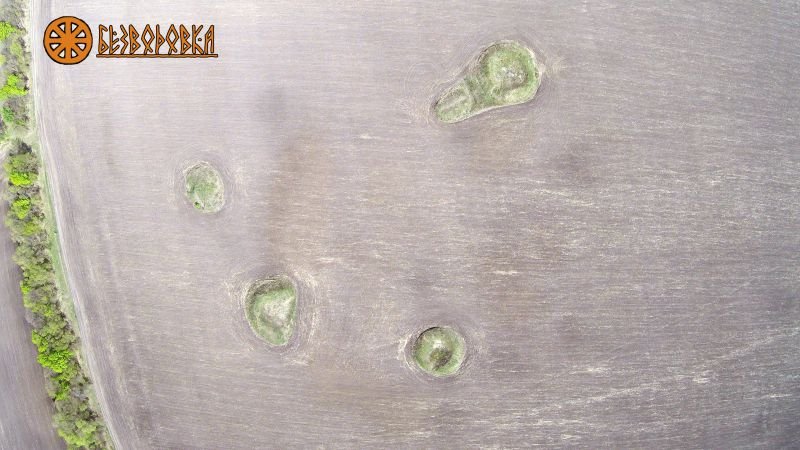
Bezvodovka mounds seen from high altitude. Image credit: Bezvodovka
The length of the circumference of our planet at Latitude 50º51” is equal to 24768 km. The relation of the length of the equator to the circumference of the planet, which is indicated by the Great Pyramid, is 40075 km / 24768 km = 1.618.
This is a golden proportion underlying the architecture of the Pyramid of Cheops and Bezvodovka. At this very latitude, there are five known horizon observatories.”
These five ancient solar observatories are Avebury, Stonehenge, Goseck, Bezvodovka and Arkhaim.
The level of knowledge available to the ancient civilization, along with the information they obtained at horizon observatories, challenge us to revise our history,“ Oleksandr Klykavka said.
The ancient solar observatory at Bezvodovka is truly intriguing and requires much more scientific studies. Places like Bezvodovka are often neglected by scientists, and yet these ancient sites offer so much we could learn about our ancestors.
Written by Ellen Lloyd – AncientPages.com
Copyright © AncientPages.com All rights reserved. This material may not be published, broadcast, rewritten or redistributed in whole or part without the express written permission of AncientPages.com
Expand for referencesMore From Ancient Pages
-
 Parthians: Their Great Empire And Skilled Horse Archers
-
 Who Was The Mysterious Spitalfields Roman Noblewoman Dressed In Silk Found In A Sarcophagus In London?
-
 Brutus Of Troy: First King Of Britain Or Just A Myth?
-
 Ancient Stone Ram Figurine – Symbol Of Abundance And Great Courage – Unearthed In Old Cemetery
-
 Life Of Galilean Sages Described On 1,800-Year-Old Hebrew Inscriptions Can Confirm Ancient Legends
-
 Ancient Liangzhu Culture Collapsed Due To Climate Change – New Study Says
-
 Englishmen Jailed For Stealing Rare Viking Hoard Worth Millions
-
 Myth Of The Pale Sun Followed By A Catastrophe Confirmed By Archaeologists
-
 Qilin – One Of Four Noble Animals In Chinese Myths And Legends
-
 Oldest Evidence To Date: 80,000-Year-Old Stone Blades Of Homo Sapiens Found In Jebel Faya, Arabia
-
 Face Of Norwegian Boy Who Lived 8,000 Years Ago Reconstructed
-
 Mysterious Unknown Caves And Tunnels Discovered Beneath The Olsztyn Castle
-
 Encounter With Time Window At The Upper Current River And Curious Glimpses From The Past
-
 Early Harappan Burial Site With 26 Graves Unearthed In Kutch, Western India
-
 The Maya Produced Rubber 3,000 Years Before Goodyear
-
 Ife Head: Significance Of The Head ‘Ori’ In Yoruba Ancient And Present Beliefs
-
 Submerged Roman Villa Discovered On The Coast Of Cerveteri, Italy
-
 Does A Renaissance Painting Offer Proof Of Unknown Advanced Technology?
-
 Concept Of Fate In The Eyes Of Slavic People
-
 Hybrid Camels Revealed In Ancient Arab Temple Art At Hatra, Northern Iraq

