
Neanderthals Buried Their Dead And Developed Spirituals Beliefs – Did Neanderthals Practice Religion?
Conny Waters - AncientPages.com - There are still many things we don’t know about Neanderthals. Still, new discoveries provide us with knowledge about our closest extinct human relatives who walked the Earth as recently as 37,000 years ago.
The Neanderthals were fully bipedal and had a slightly larger average brain capacity than a typical modern human, though it's thought the brain structure was organized differently. They contributed to the genes of modern Eurasians, and scientists have determined that Neanderthals were closely related to modern humans, sharing 99.7% of DNA.
 Neanderthal DNA influences many physical traits in people of Eurasian heritage. Credit: Michael Smeltzer, Vanderbilt University
Neanderthals were skilled hunters, produced and used several sophisticated tools, controlled fire, lived in shelters, and made and wore clothing.
There is evidence that Neanderthals made symbolic or ornamental objects and deliberately buried their dead. Sometimes they also marked their graves with offerings, such as flowers. No other primates or earlier human species had ever practiced this sophisticated and symbolic behavior.
But were the Neanderthals religious too?
Evidence from the late Middle Paleolithic period (around 50,000 years ago) shows an early form of religious or spiritual belief amongst Neanderthals. The evidence is based on their deliberate burials with grave goods. To ritualistically bury the dead is a very ancient tradition that goes back at least tens of thousands of years. There are signs of offerings in graves going back 120,000 years, and deliberate burials were ascribed to the Neanderthals.
According to Sharon R Steadman, author of the book Archaeology of Religion: Cultures and Their Beliefs in Worldwide Context, evidence indicates that the boast of the first religion belongs to the Neanderthals and possibly to even earlier ancestors. Specialized treatment of the dead and the deposit of goods such as tools suggest Neanderthals conceived something “beyond” death. Perhaps they believed in some form of afterlife.
It has also been suggested that Neanderthals practiced animal-based belief systems and had Shamans in their societies.
From 1917 to 1921, Emil Bächer excavated a Drachenloch Cave in the Swiss Alps. Inside the cave, he discovered tools that offered evidence Neanderthals had once inhabited the cave. Bächer also found cave-bear bones. These fossils were not scarred around. Examination showed the skulls contained stone-lined cists.

There are still many things we don't know about the Neanderthals. Reconstruction of the child's burial by Neandertals at La Ferrassie. © Emmanuel Roudier
Based on his findings, Bächer put forward the theory that Neanderthals believed in animal cults. Similar results were later reported in other European countries, and researchers took Bächer’s view more seriously.
Some Neanderthals did bury their dead with purpose and care. The site at La Chapelle-aux-Saints, France, has long been a debated topic. In 1908, a 50,000-year-old Neanderthal skeleton was discovered in the cave, suggesting that the remains were intentionally buried.
However, those who discovered the skeleton were Catholic priests, and many thought they had misinterpreted the Neanderthal burial. In 1999, researchers re-examined the site, and the depression where the skeleton was found was at least partially modified to create a grave. Moreover, unlike reindeer and bison bones in the cave, the Neanderthal remains contained few cracks and showed no signs of weathering-related smoothing or animal disturbance.
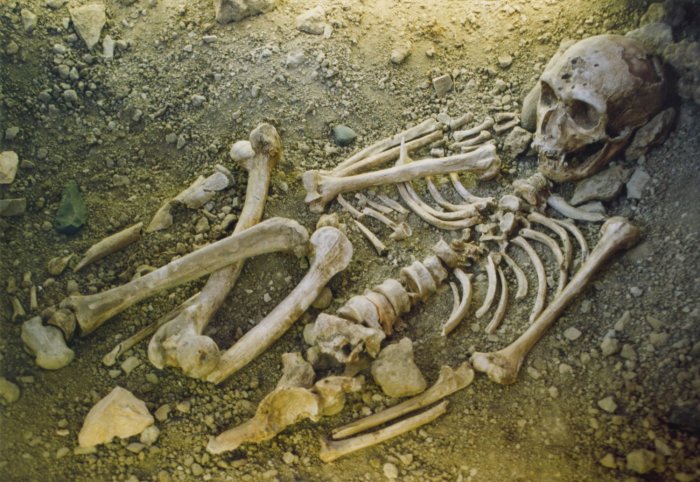 It was in La Chapelle aux Saints, in the department of Correze in the South West of France, that three brothers named Bouyssonie discovered on the 3rd of August in 1908 the first entire skeleton of a Neanderthal man and one of the first burial sites ever found. Image credit: Ice Age Europe
"All these elements attest that the two sets of bones have two different histories. The animal bones were exposed to the open air for a long time. At the same time, the Neanderthal remains were rapidly protected after their deposit from any kind of disturbance or alteration," said Rendu, a researcher at the Center for International Research in the Humanities and Social Sciences (CIRHUS) in New York City.
The scientists also found bone fragments belonging to other Neanderthals—two children and one adult—but it's unclear whether they were also buried.
Paul Pettitt, an archeologist at Durham University in the U.K. who also did not participate in the research, said the report "not only demonstrates that Neanderthal burial was a reality at La Chapelle-aux-Saints but in my opinion, also raises the possibility that the evolution of human burial began with the simple modification of natural pits for funerary use."
We will probably never know the truth about Neanderthals’ beliefs and rituals. All scientists can do is offer evidence-based speculations.
We can clearly see that modern humans were not the first to contemplate a world beyond life on the physical plane.
Neanderthals did believe in something. Whether it was the concept of an afterlife, spirits, god, or anything else – remains unknown.
Updated on July 17, 2022
Written by Conny Waters - AncientPages.com Staff Writer
Copyright © AncientPages.com All rights reserved. This material may not be published, broadcast, rewritten or redistributed in whole or part without the express written permission of AncientPages.com
Expand for referencesMore From Ancient Pages
-
 Clay Tablets Of Assyrian ‘King Of The World’ Esarhaddon Found Beneath Biblical Tomb Of Jonah
-
 The Unicorn In The Bible Was An Oryx – Ancient Translation Mistake
-
 Did Two Daughters Of Akhenaten Rule Together Under One Name Before Tutankhamun?
-
 Rare Bronze Hand Found At Roman Vindolanda
-
 Buried Ancient Roman Glass Has Formed Photonic Crystals – Extraordinary Discovery – Scientists Say
-
 Mummification In Europe May Be Older Than Previously Known – 8,000-Year-Old Evidence Presented
-
 Manasota People: Will 1,300-year-Old Village Tell Us About Their Lives?
-
 How Greenland Got The ‘Wrong’ Name Thanks To Viking Erik The Red
-
 Beautiful Legend Of Giant Olentzero Who Brings Christmas Presents To Basque Children
-
 Ancient Artifacts With Carved Geometric Patterns Demonstrate Advanced Cognitive And Symbolic Behavior Among Early Humans
-
 Major Puzzle In Mammal Skull Shape Evolution Solved
-
 Is The Mystery Of Controversial Phaistos Disk Solved?
-
 Ireland’s Population Was In Decline When Vikings Arrived To Settle
-
 5,000-Year-Old Underground Partly Submerged City Discovered In Turkey’s Cappadocia
-
 Toltecs’ Intriguing And Forgotten Ancient Wisdom Of Dreaming Can Change How We Perceive Ourselves And Everything Around Us
-
 Krakatoa Prophecy – Samson’s Mysterious Dream
-
 Vikings Filed Their Teeth For Unknown Reasons
-
 Celts: Facts And History About The Powerful And Intriguing People Of Central And Northern Europe
-
 Ancient Tools Used In Religious Rituals In Honor Of Goddess Hathor Discovered In Egypt
-
 Dismantled Ancient Stone Circle In West Wales Was Used To Rebuilt As Stonehenge

