
Ancient Complex Of Elephanta Caves In India
A. Sutherland - AncientPages.com - The Elephanta Caves, believed to be dated to about the 7th century, represent a complex of ancient cave temples on Elephanta Island, located 10 km from the Gateway of India at Mumbai. These structures represent some of the most striking collections of rock-art in India.
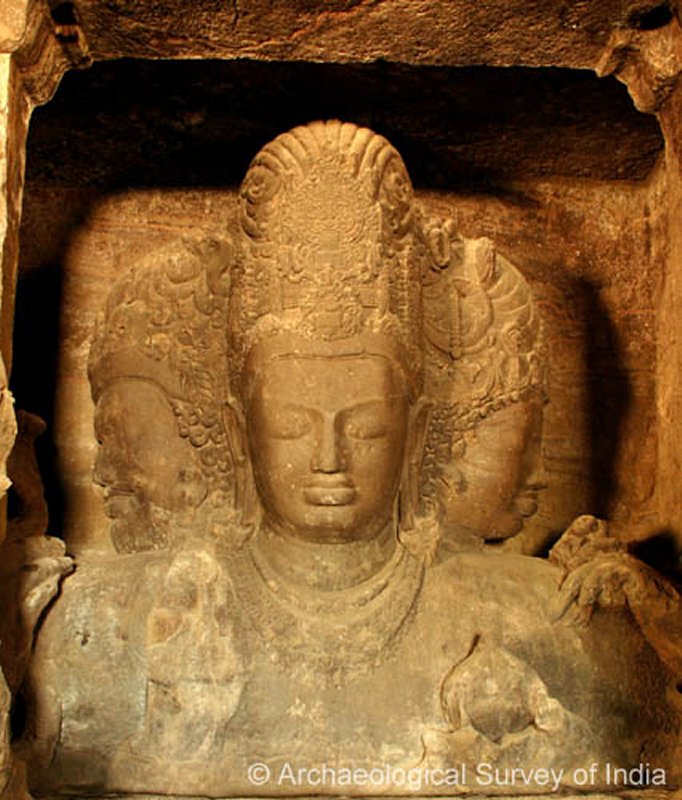
Trimurti Sculpture - Elephanta Caves, India - The sculpture is 20 ft (6.1 m) high.; it is a colossal bust of the three forms of Shiva. Photo credits: ASI
The complex consists of two groups of caves—the first is a large group of five Hindu caves with rock-cut stone sculptures. The main cave is famous for its carvings depiciting the glorious Shiva, who is displayed in various forms and act ions. The cave consists of a square plan mandapa whose sides measure about 27 m.
The second (to the east) is a smaller group of two Buddhist caves with one of which is unfinished, and several cisterns.
The place - still worshipped by the locals - is dedicated to Lord Shiva.
The island, which covers an area of approximately 7 km, was initially called Gharapuri (literally "the city of caves"); later, the Portuguese renamed the island after they found a colossal stone elephant near their landing place.
Elephanta Island came under the dominion of at least half a dozen different powers that ruled this region from 400 BC to modern times.
Before the Hindu caves were excavated, the island was a Buddhist center. The remains of the Buddhist stupas in Elephanta probably date to the early phase of Buddhism (about the 2nd century BC.)
 Elephanta Caves, India - The island of Elephanta, the glorious abode of Lord Shiva and an epitome of Hindu cave culture, consists of seven caves on an island in the Sea of Oman close to Mumbai which, with their decorated temples and the images from Hindu mythology, bear a unique testimony to a civilization that has disappeared. Here, Indian art has found one of its most perfect expressions, particularly in the huge high reliefs in the main cave. Image source - Ministry of Culturen - Government of India
The Buddhists, the first to carve temples from mountains, were followed by the Hindus. Every Hindu temple primarily worships one Hindu god, and the Elephanta Caves were for worshipping Shiva.
The statues carved on the walls of the Elephanta Caves are giant (about 20 feet high). They were elaborate, centering on a scene in Shiva's life featuring Shiva, his wife, and other influential personalities.
The date of the famous Elephanta Caves is still very much debated and varies from the 6th century to the 8th century according to the experts. There are many theories regarding the beginnings of the Elephanta Caves. Most of them propose that they were built from 450 to 750 AD.
Interestingly, this period also marks the decline of Buddhism in India and the revival of the Brahmanical traditions (ancient Indian religious traditions that have their beginnings in the early Vedic religion) in the country.
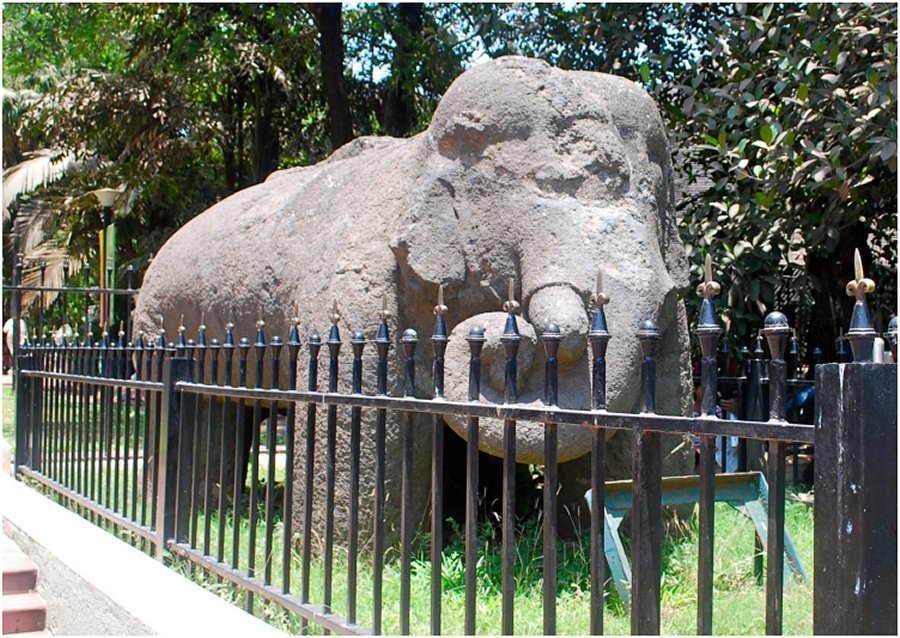
The Elephant statute from which Elephanta Island gets its name is now displayed in the Bhau Daji Lad Museum in Mumbai.
The most impressive of all the caves is Cave 1, which represents the evolved Brahmanical rock-cut architecture and displays several unique and lively sculptures.
The cave has a main entrance on the north with two other openings on the east and west, respectively, and a central hall with six rows (with six in each row) of pillared columns, six in each row except on the western corner, where a shrine contains a collection of rock art related to Shiva.
The temple dedicated to Lord Shiva is declared a UNESCO World Heritage Site.
Written by – A. Sutherland - AncientPages.com Senior Staff Writer
Updated on Oct 16, 2023
Copyright © AncientPages.com All rights reserved. This material may not be published, broadcast, rewritten or redistributed in whole or part without the express written permission of AncientPages.com
Expand for referencesMore From Ancient Pages
-
 Biblical Event Verified By Study Of Earth’s Magnetic Field?
-
 Ancient Bone Reveals Syphilis May Have Originated In The Americas – Columbus Theory Questioned By Scientists
-
 Bjorn Ironside: Famous Viking Who Captured Luna By Mistake Instead Of Ancient Rome As Planned
-
 Are The Mysterious ‘Ubeidiya Limestone Spheroids Of Early Hominins Evidence Of Intentional Symmetric Geometry?
-
 2,000-Years-Old Warrior Graves With Iron Swords, Mysterious Square Structures, Unearthed In Bejsce, Poland
-
 Code Of Nesilim: Ancient Laws Of The Hittites
-
 Drinking Milk Increased Ancient Human Body Size – New Study
-
 Ice Age Cycles Played A Key Role In Early Human Interbreeding
-
 Genghis Khan Has 16 Million Relatives – You Could Be One Of Them
-
 Surprising Discovery Of 88 Ice Age Human Footprints In Utah Desert
-
 207-Year-Old Whaling Shipwreck Discovered In Gulf Of Mexico
-
 Unique Ancient Map Depicting The Earth As Seen From Space Restored Digitally
-
 Ancient Seal Offers First Biblical Evidence Of The Prophet Isaiah?
-
 Meskhenet: Egyptian Goddess Of Household And Childbirth Who Governed Over Fate And Destiny
-
 Mystery In Abydos: Carved Rock Chambers Discovered Inside Sacred Mountain
-
 ‘Exceptional’ Ancient Roman Bath Complex Discovered In Mérida, Spain
-
 Mystery Of The Cave Where People Vanish Or Become Disoriented
-
 Two Pieces Of A Six-Foot-Tall Lion Statue Accidentally Found In Phnom Penh, Cambodia
-
 Unexplained Teleportation Cases Of People – Dangerous Fog – Part 2
-
 Unraveling The Mystery Behind The Perplexing Story Of Pied Piper Of Hamelin

