
Mysterious 2000-Year-Old Carved Vishap Stone Monuments Of Armenia
A. Sutherland - AncientPages.com - Vishap stones represent one of the more interesting mysteries of Armenian archaeology.
Vishaps are menhirs (large carved stones) that date back to 2000 BC. These formations, which had once religious significance, are believed to be related to water.

Vishap means for the Armenians - 'dragon' and such stone has a dragon or serpent-shaped 'head' carved at the top.
Usually, the Armenian vishaps have cylindrical or cigar-shaped forms and are grey in color. Their true ancient name is vishapakahr, derived from the Armenian word “vishap” meaning “serpent/dragon,” and “kahr” meaning “stone.” They can be from 10 to 20 feet tall.
In Armenia's pre-historic period, there was the worship of “Vishaps” (dragons), associated with the marine origins of life. Their likenesses in the form of large stone-fish figures were placed near water springs and canals.
The ancient Armenians believed that their land - "Land of the Armenians" - was protected by
Vahagn, who was worshiped as the God of War, Thunder, and Lightning. He fought the Vishaps,
killing them with his powerful lightning strikes.
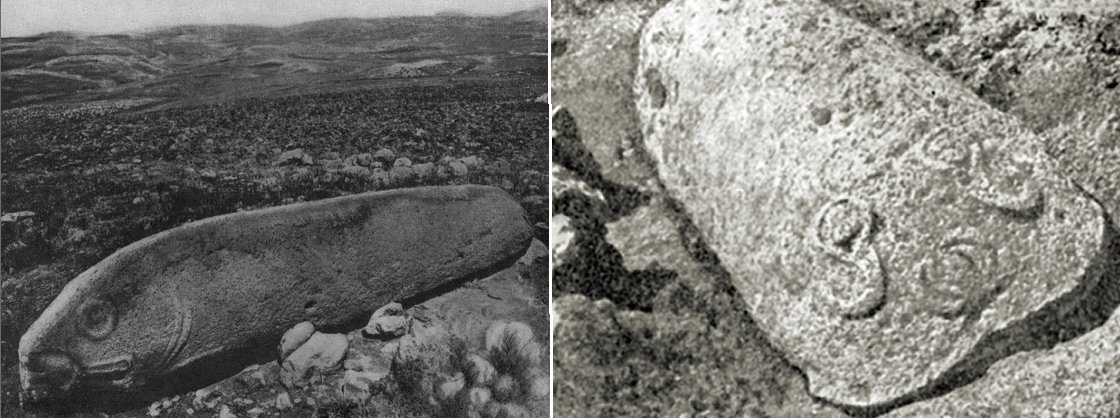
Sometimes, the most ancient vishaps are so weathered or altered by weather and time that inscriptions on them are difficult to decipher.
One of the vishaps can be found at Garni, an ancient village, which was once a settlement inhabited almost continuously since 3000 BC. This vishap-formation is covered with a cuneiform inscription dated to the 6th century. Later, crosses were added to some of the vishaps to make them more like Christian monuments.

Tracing distant past of the vishaps, scholars determined that they could have been the forerunners of stelae - tetragonal (with four sides) columns standing on a cube-shaped base and functioning as gravestones or memorial stones.
They often had carvings depicting religious subjects in form of saints, biblical scenes or angels.
People do not know where they originate from and how they ended up in Armenia. According to Armenian mythology vishaps are dragons, which live in the mountains, especially on Mount Ararat.
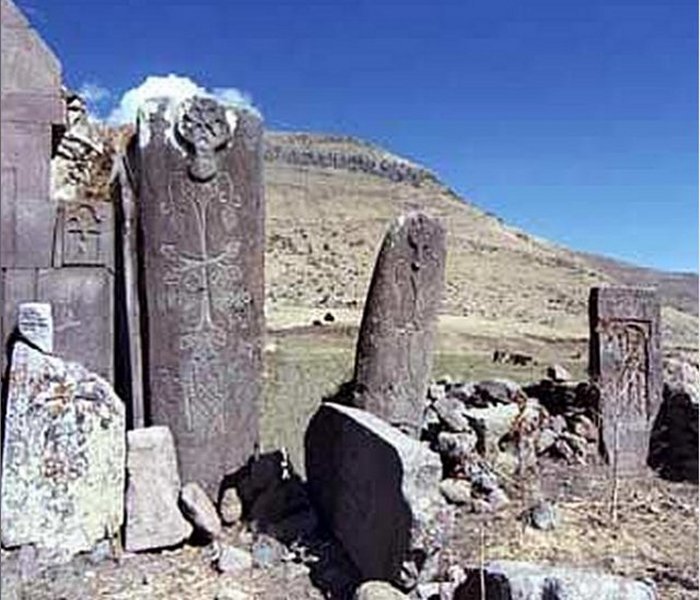
They have been found on the north-eastern shore of Lake Sevan (the largest body of water in Armenia and the Caucasus region) and are often in association with water engineering and construction of big and small artificial lakes and a complex system of canals joining them.
Today, almost all Vishap (Dragon) stones are devastated; they were intentionally knocked down.
The exact dating of these megaliths presents certain difficulties. In the vicinity of these enigmatic ancient figures, there are no remnants of ancient settlements, fires, or other fossils, to which the radiocarbon analysis could be applied.
Written by – A. Sutherland AncientPages.com Staff Writer
Copyright © AncientPages.com All rights reserved. This material may not be published, broadcast, rewritten or redistributed in whole or part without the express written permission of AncientPages.com
Expand for referencesReferences:
D. Holding, Armenia
More From Ancient Pages
-
 Neanderthal Cave Engravings Identified As Oldest Known, More Than 57,000 Years Old
-
 On This Day In History: Charlemagne Became The King Of The Franks – On Dec 5, 771
-
 7,000-Year-Old Grains Hints At Origin Of Swiss Pile Dwellings
-
 Secrets Of The Freemasons – Masonic Symbols Reveal Worship Of Ancient Mother Goddesses
-
 Fragarach: Supernatural Sword That Controlled Winds, Cut Through Wood, Metal And Bricks In Irish Myths And Legends
-
 Intriguing El Tajin – Pre-Hispanic Ceremonial Site Dedicated To Totonac Rain God
-
 9,600-Year-Old Permament Settlement And Daily Tools Discovered In Turkey
-
 Rare Lost Pictish Stone With Strange Mythical Beasts Goes On Display For The First Time
-
 On This Day In History: Canute Lavard Was Murdered By His Cousin, Magnus I Of Sweden – On Jan 7, 1131
-
 Hellenistic Decorated Tombs And Tombstone Probably Used As A False Door Unearthed In Egypt
-
 Unique Ancient Map Depicting The Earth As Seen From Space Restored Digitally
-
 London’s Underground Rivers Were Deliberately Hidden
-
 On This Day In History: Sunspot Observed By Chinese Astronomers During The Han Dynasty – On May 10, 28 BC
-
 Kingdom Of The Vandals: A People In Search Of A Home
-
 Incredible Ancient Roman ‘Service Station’ With Hundreds Of Artifacts And Dozens Bodies Found In Hertfordshire, UK
-
 Tuchulcha: Wicked, Hideously Grotesque Etruscan Demon Identified With Both Male And Female Genders
-
 Fossils Suggesting New Species Of Ancient Humans – New Discovery
-
 Cremation In The Near East Dates Back To 7,000 B.C.
-
 New Clues May Explain Collapse Of Ancient City Teotihuacan In Mexico
-
 Ancient DNA Analysis Shows How The Rise And Fall Of The Roman Empire Shifted Populations In The Balkans

