
Lindholm Høje Burial Site With 700 Graves Dated To The Iron And Viking Ages
A. Sutherland - AncientPages.com - Lindholm Høje is an Iron Age and Viking Age burial site just North of Aalborg and Nørresundby on the South slope of Voerbjerg Hill facing Limfjorden, Denmark.
Lindholm Høje was in use as a burial site between 400 AD and 1000 AD and was excavated from the sand covering the burial site in 1952-1958 to reveal the 700 graves.

The graves are arranged chronologically - the oldest graves from the Iron Age around 400 AD are near the top of the hill.
In those ancient times, the dead were buried on a location with a view - their ancestors were given something beautiful to enjoy from their graves. This Southern hillside sloping down towards Limfjorden is no exception.
The oldest graves from the Iron Age around 400 AD are near the top of the hill, and the further down the younger the graves till the youngest ones from around 1000 AD furthest down. Ity means that the graves were arranged chronologically.
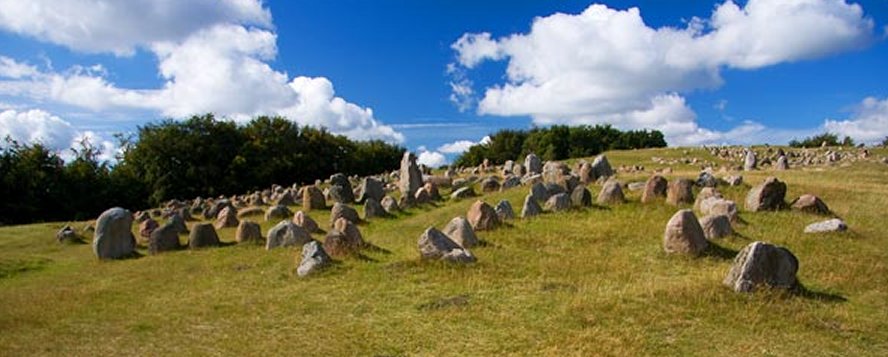
Some of the Viking age graves in Lindholm Hoeje in Nørresundby.
The graves are shaped differently depending on whether it contains a man or a woman. The graves containing men are shaped pointy like viking ships or as a triangle, while women's graves are round or oval.
Depending on the burial customs of the time of each burial, the Iron Age grave was covered with a mound, and the Viking Age grave was a cremation grave with a stone surrounded perimeter, inside which the deceased was cremated.
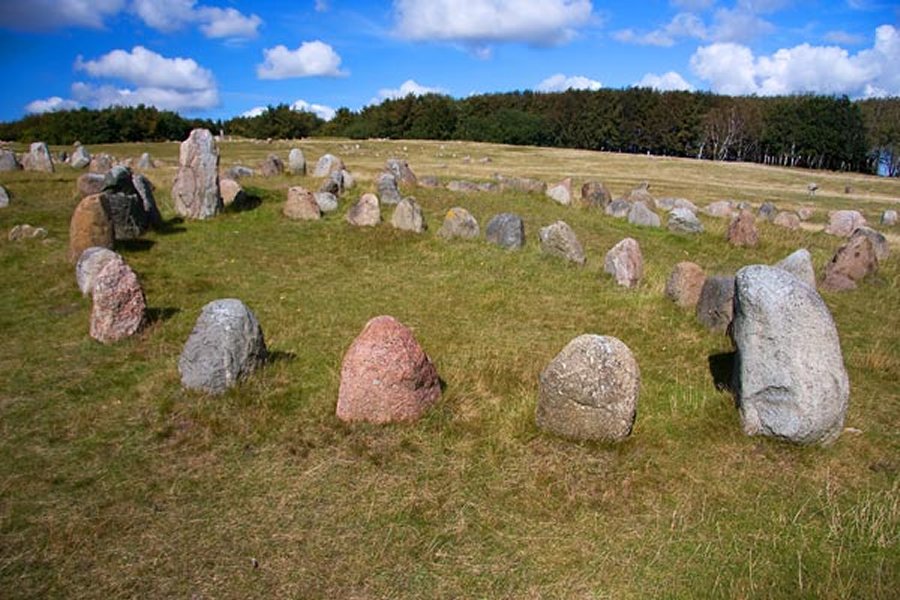
Graves of men are shaped pointy like Viking ships or as a triangle, while women's graves are round or oval.
This is a typical man's ship shaped cremation grave, where a man was put on top of a fire within the stone circumference and cremated. It was thought that cremation set free the spirit of the man from his body - the cremation started his voyage to join the gods. People were buried with effects that was thought to be put to good use in the spirit world, and the fire didn't help conserve them too well till today, but the oriental coins and accessories excavated show that the vikings had widespread trade connections.
See also:
Vikings: Facts And History About The Tough Norse Seafaring People
Why Did Vikings Burn And Bury Their Longhouses?
Viking Burial Rituals: High Ancient Funeral Pyre Reflected High Social Status
Throughout the time Lindholm Høje was in use, a village was located close to the burial site. The concrete outline shows the outline of a hut which was built next to the graves. The sand that constantly blew in over and covered different parts of the hillside also forced the village, which was probably called Vendel, to move around in the area to avoid it.

Excavations show that the village has been moved from top of the hill to the bottom of the hill, and up North of the hill entirely in the period between 700 AD and 1100 AD.
The Lindholm Høje museum Northwest of the burial site was built and given to the City of Aalborg presents information about the burial site related to the Iron and Viking Ages.
Written by A. Sutherland - AncientPages.com Staff Writer
Copyright © AncientPages.com All rights reserved. This material may not be published, broadcast, rewritten or redistributed in whole or part without the express written permission of AncientPages.com
More From Ancient Pages
-
 Ajanta Caves: Incredible Accomplishment Of India’s Ancient Stonecutters
-
 Unexpected And Surprising Results Of Ancient DNA Study – Who Were The First People In South America?
-
 Wonderful And Unique Viking Silver Treasure Uncovered In Täby In Stockholm, Sweden
-
 Ancient DNA Reveals Bronze Age Women Altered Genetic Landscape Of Orkney
-
 Long-Lost Wreck Of Crusader Ship And Gold Coins Discovered
-
 A 5,000-Year-Old Anatolian Sword Identified In Armenian Monastery In Venice
-
 What Was The Extreme Ritual Of Sokushinbutsu?
-
 Native American Population Does Not Originate In Japan – Genetics And Skeletal Biology Questioned
-
 Expressive Beautiful And Celebrated Bowls Created By Mimbres Artisans From Distant Past
-
 10 Magnificent Ancient Libraries
-
 The Incas Used Stringy Objects Called ‘Quipus’ To Record Data – We Just Got A Step Closer To Understanding Them
-
 Boxer At Rest – Rare Sculpture And Masterpiece Of Hellenistic Bronze Art
-
 Ancient Inscriptions Of Babylonian King Nabonidus Discovered In Saudi Arabia
-
 New DNA Study Links Early Europeans’ Cultural And Genetic Development Over Several Thousand Years
-
 Oldest Case of Decapitation In the New World – Lapa do Santo, East-Central Brazil
-
 Horses In Florida Did Not Travel Far Distances – New Study Suggests
-
 New Dating Of Intriguing Cave Art Reveals History Of Puerto Rican People
-
 Great Wall Of Gorgan: One Of The World’s Most Sophisticated Frontier Walls Ever Built Is Now Examined
-
 Graeae: Three Sisters Of Fate Who Shared One Eye And Tooth In Greek Mythology
-
 Eridu: Pre-Flood City That Belonged To Enki, God Of Creation, Intelligence, Wisdom And Magic

