
Secret Underground Ancient Teotihuacan Tunnel May Solve A Long-Standing Mystery And Reveal Royal Tombs
AncientPages.com - Many secrets are hidden in Teotihuacan, northeast of Mexico City, Mexico.
Aztecs and the Toltecs, reached a place called Teotihuacan that was already enshrined in myth. In Nahuatl, the Aztec language still spoken in many parts of Mexico, Teotihuacan means "the place where men become gods."
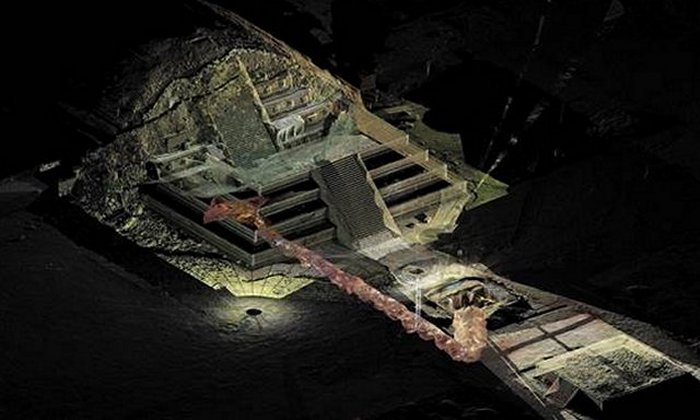
Teotihuacan, Mexico: Tunnel discovered under pyramid in Teotihucan archaeological site. A scanner view of a tunnel under a pyramid at the archaeological site of Teotihuacan, Mexico. INAH/Handout/EPA
Kings reigned at Teotihuacan and were buried there, for to be buried in Teotihuacan was to join the gods in an afterlife.
One of Mexico's most-visited ancient sites, Teotihuacan is home to massive pyramids, temples and elite residences including many adorned with colorful murals. Teotihuacán has long stood as the greatest of Mesoamerican mysteries.
The city reached its peak between 100 B.C. and 650 B.C. with a population as large as 200,000, growing rich from a wide-ranging trade in obsidian that in pre-Columbian times was used to make knives and other weapons.
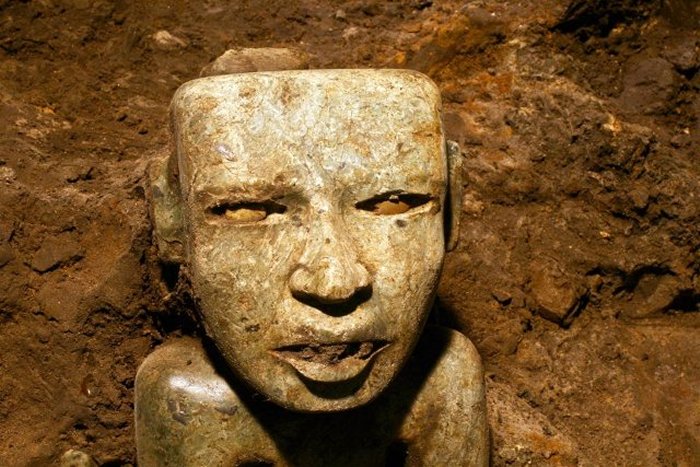
A sculpture unearthed at the Teotihuacan archeological site in Mexico. Mexican archaeologists have concluded a yearslong exploration of a tunnel sealed nearly 2,000 years ago at the ancient city of Teotihuacan and found thousands of relics. Teotihuacan dominated central Mexico centuries before the rise of the Aztecs in the 14th century. (AP Photo/Proyecto Tlalocan, INAH)
In designing Teotihuacan (pronounced tay-oh-tee-wah-KAHN), the city’s architects had arranged the major monuments on a north-south axis, with the so-called “Avenue of the Dead” linking the largest structure, the Temple of the Sun, with the Ciudadela, the southeasterly courtyard that housed the Temple of the Plumed Serpent.
According to Clemency Coggins, a professor emerita of archaeology and art history at Boston University, the ancient city was designed as a physical manifestation of its founders’ creation myth. Not only was Teotihuacán laid out in a measured rectangular grid, but the pattern was oriented to the movement of the sun, which was born there, Coggins pointed out.
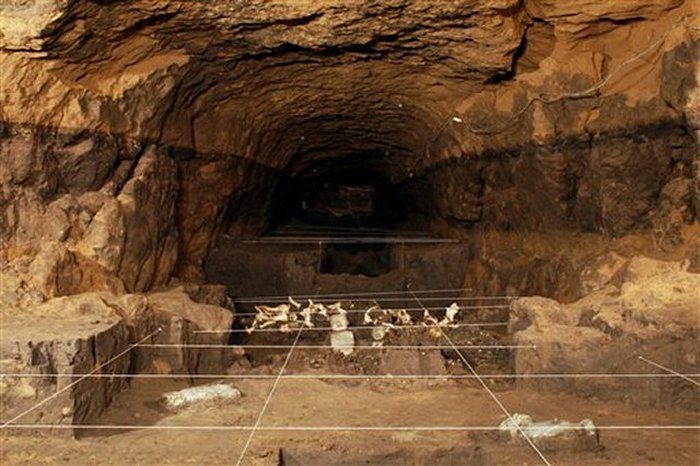
Sculptures and shells unearthed by investigators at the Teotihuacan archeological site in Mexico. Mexican archaeologists have concluded a yearslong exploration of a tunnel sealed nearly 2,000 years ago at the ancient city of Teotihuacan and found thousands of relics. Teotihuacan dominated central Mexico centuries before the rise of the Aztecs in the 14th century. (AP Photo/Proyecto Tlalocan, INAH)
Archaeologists have conducted long-term archaeological research in the City of the Gods and a chance discovery beneath a nearly 2,000-year-old pyramid may soon lead to the heart of a lost civilization.
See also:
Great Pyramid of Cholula: World’s Largest Pyramid
Mysterious Teotihuacan ‘Host’ Figurines From Metepec, Mexico
The structure is filled with thousands of ritual objects and may lead to royal tombs, according to Sergio Gomez the lead Mexican archaeologist working with the project.
The entrance to the 1,800-year-old tunnel was first discovered in 2003, and its contents came to light thanks to excavations by remote-control robots and then human researchers.
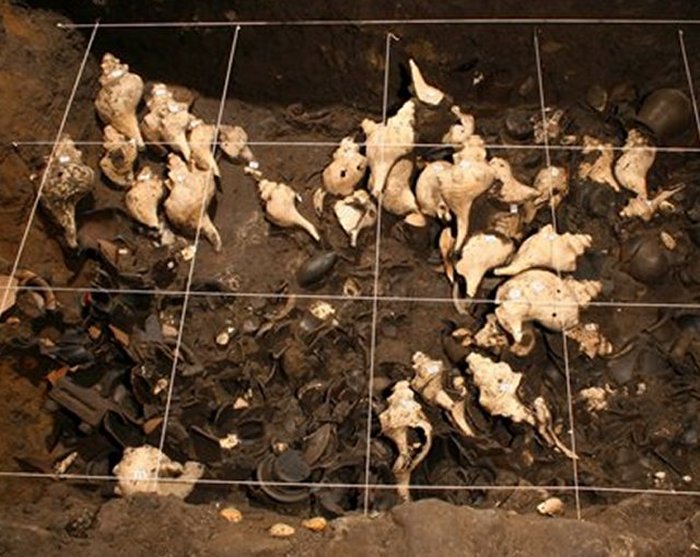
Shells unearthed at the Teotihuacan archeological site in Mexico.
The site is located approximately 30 miles (50 kilometers) northeast of Mexico City. The ruins have long been shrouded in mystery because its inhabitants did not leave behind written records.
The artifacts found inside the tunnel, located below the Temple of the Plumed Serpent, include finely carved stone sculptures, jewelry and shells. The tunnel ran approximately 330 feet from the Ciudadela to the center of the Temple of the Plumed Serpent. The hole that had appeared during the 2003 storms was not the actual entrance; that lay a few yards back, and it had apparently been intentionally sealed with large boulders nearly 2,000 years ago.
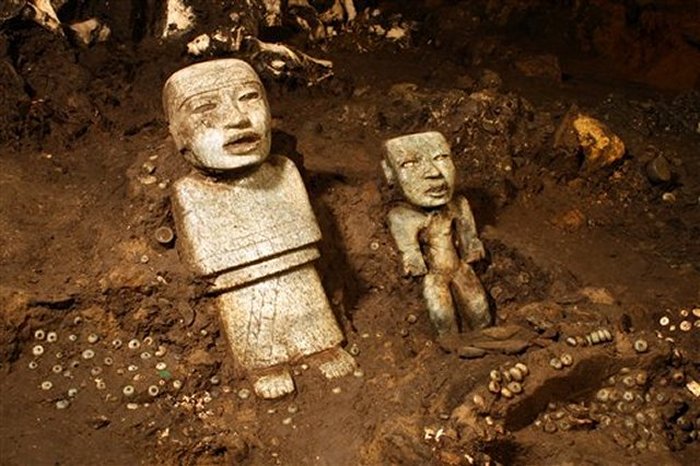
Sculptures unearthed by investigators at the Teotihuacan archeological site in Mexico. Mexican archaeologists have concluded a years long exploration of a tunnel sealed nearly 2,000 years ago at the ancient city of Teotihuacan and found thousands of relics. AP Photo/Proyecto Tlalocan, INAH
About 50,000 objects, of which 4,000 made of wood as well as scores of obsidian blades and arrow heads, provide clues into how the city's priests and rulers conceived the underworld.
Researchers hope to find a royal tomb at the end of the tunnel and as Gomez says, due to the magnitude of the offerings that have been found, it can't be in any other place.
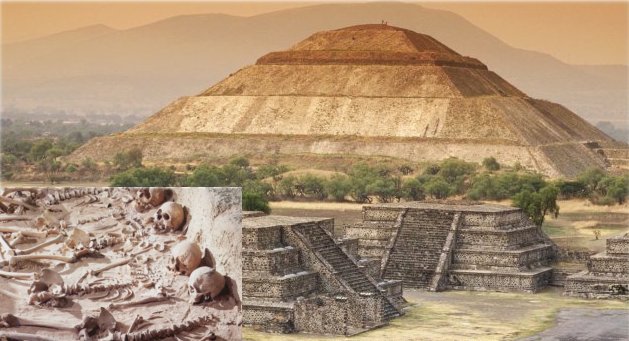
Teotihuacan
"We've been able to confirm all of the hypotheses we've made from the beginning," he added, saying ongoing excavations could yield more major discoveries.
Teotihuacan was settled as early as 400 B.C., but it was only around A.D. 100, an era of robust population growth and increased urbanization in Mesoamerica
The city had long been abandoned by the time the Aztecs came to power in the Valley of Mexico in the 14th century, yet it continued to play an important role as a destination for religious pilgrimages.
AncientPages.com
More From Ancient Pages
-
 Ancient DNA Reveals: Iberian Males Were Almost Completely Replaced Between 4,500 And 4,000 Years Ago
-
 Why Was This Eerie Castle With Frightening Underground Secrets Really Constructed?
-
 Caribbean Cannibalism Theory – Debunked By Researchers
-
 Strange Medieval Figurine With A Crown On The Head And A Falcon On The Arm – Is It A King Or A Queen?
-
 Ancient Roman Portable Toilets Studied By Scientists
-
 On This Day In History: ‘The Wars Of The Roses’ – Fighting For The Throne Of England At Tewkesbury – On May 4, 1471
-
 Biblical City Of Tarsus: Excavations Reveal Its Secrets From Paul the Apostle’s Times
-
 Mysterious Cave With Giant Skulls Decorated By The Neanderthals Discovered In Spain
-
 Unique Maya Center Of Copán With History Recorded In 2500 Hieroglyphics
-
 The Romans Spread Parasites – Their Hygienic Innovations Gave No Health Benefit
-
 Ancient DNA Sheds New Light On Easter Island Mystery
-
 Rare Discovery: Remains Of An Avar Warrior And A Belt Unearthed In Vinkovci, Croatia
-
 Cuchulainn: Irish Mythical Hero And His Cruel Magical Spear Gae Bolg
-
 Tiny Points Made By Homo Sapiens 54,000 Years Ago Found In Mandrin Cave
-
 Remains Of Colonnaded Hall Of 26th Dynasty Found At Ancient Buto Temple, Northern Nile Delta
-
 Pakhet ‘Night Huntress’: Egyptian War-Like Lioness Goddess Associated With Artemis
-
 On This Day In History: John Dee, English Mathematician, Occultist, Astrologer, Astronomer Was Born – On July 13, 1527
-
 Rare Six-Foot-Tall Female Statue Accidentally Unearthed By Mexican Farmers
-
 Xiahou Dun ‘The One-Eyed’: Faithful Warrior, One Of Cao Cao’s Talented Officers
-
 Dozens Of Ancient Villages Discovered In British Columbia – The Pit Houses ‘Older Than The Pyramids’!

