
Manco Capac: Legendary Founder Of The Inca Dynasty Of Peru
A. Sutherland - AncientPages.com - According to Inca mythology, the Inca are the direct descendants of a mythical first Inca, named Manco Capac, who emerged from one of the three openings in the mountain Tambotoco, near Pacaritambo (or Pacariqtambo) (‘tavern of the dawn’), located some six leagues (approximately 33 km) to the south-southwest of Cuzco, Peru.

Manco Capac came to found the Inca civilization. Even though his figure is mentioned in several chronicles, his actual existence remains unclear. While he remains a semi-mythical figure whose actual time period cannot be clearly pinpointed, he is regarded as an Inca hero and many ancient legends connect Manco Cápac to the foundation of Cuzco.
There are several versions of the origin of the Inca, which were described in a number of different Spanish chronicles.
One version of this prevalent belief of Andean people in origin places for their mythical ancestors is that of Pedro Sarmiento de Gamboa (1532–1592), a Spanish explorer, historian, author, astronomer, and scientist.
He meticulously collected first-hand oral accounts from Inca informants and produced a history (commonly titled ‘The History of the Incas’) that describes the violent conquest of the region. Written in Cuzco, just forty years after the arrival of the first Spaniards in the city, Sarmiento's The History of the Incas contains extremely detailed descriptions of Inca history and mythology
In his version of the legendary Manco Capac’s story, four men and four women, the first Inca, are said to have emerged from the central cave of Capac-toco, two other cave openings were called Sutic-toco and Maras-toco and from them emerged then other non-Inca groups.
These two cave openings were connected by a golden and silver tree that represented Manco Capac's paternal and maternal ancestors, respectively.
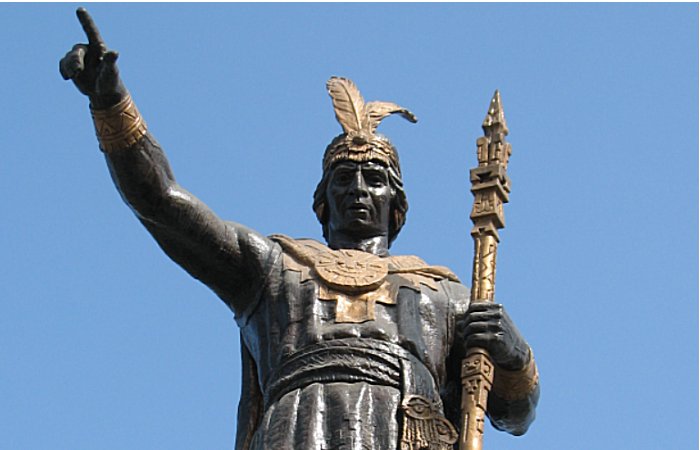
Statue of Manco Cápac in Plaza Manco Cápac, La Victoria district (Lima), Peru. Image credit: I, AgainErick - CC BY-SA 3.0
The Inca ancestors consisted of men named Manco Capac, Ayar Auca, Ayar Cache, and Ayar Ucho and four women called Mama Ocllo, Mama Guaco, Mama Ipacura, and Mama Raua.
Sarmiento de Gamboa wrote that these eight Inca left Tambotoco and walked to Guanacancha (or Waynakancha) where Manco Capac and his sister-wife Mama Oqllu conceived a child.
Then they walked to several other villages; in Tambo Oir (Tamboquiro), their son Sinchi Roca was born and grew up to succeed his father Manco Capac as the second king of the Inca Empire.
In Haysquisrro, seven of the Inca decided to kill their brother Ayar Cache, a great trickster who was very cruel and handy with a sling. In order to achieve this, Manco Capac sent Ayar Cache, with a helper called Tambochacay, back to Tambotoco to retrieve various items said to be left in the cave. When Ayar Cache entered the cave, he was immediately sealed in with a large boulder. Tambochacay was, however, then transformed into stone by the entombed Ayar Cache.
After the death of Ayar Cache, the seven remaining Incas left Haysquisrro and walked to the mountain of Guanacauri (or Huanacauri), where the second brother of Manco Capac was transformed into stone. It is said that Manco Capac then descended from the mountain of Huanacauri into the valley of Cuzco.
After considerable fighting, Manco Capac and his sister/wife Mama Ocllo defeated the indigenous settlers of the Cuzco Valley and established a new dynastic order in Cuzco.
The ruling elite of Cuzco at the time of the Spanish conquest was thought to be the direct descendants of Manco Capac and Mama Ocllo and thus they were considered the legitimate rulers of the Inca state.
According to the most frequently told story, the first Inca ruler Manco Capac, his sister-wife Mama Ocllo, and six siblings were sent down to the earth by the sun god Inti, to teach the people how to improve their way of life.
The sun god was very concerned that the people of earth did not live in a civilized way. He gave his children a goldenrod ('tapac-yauri'), and told them to push it into the ground wherever they stopped to rest. When they reached a spot where the rod sank completely into the ground with a single push, they should build a sacred city of the sun, to be named Cuzco.
He also instructed them to build a Temple of the Sun in honor of their father Inti.
Given the lack of a written tradition confirming this tale before the publication of ‘The Royal Commentaries of the Inca’ ('Comentarios Reales de Los Incas') by Garcilaso de la Vega in the year 1609, the authenticity of this story cannot be proven.
Still another tale says that Manco Capac deceived people into believing that he was the son of the sun god. He did this by standing on a mountain wearing silver plaques that shone in the sun and made him look like a god.
Written by A.Sutherland - AncientPages.com Staff Writer
Updated on July 26,2024
Copyright © AncientPages.com All rights reserved. This material may not be published, broadcast, rewritten or redistributed in whole or part without the express written permission of AncientPages.com
Expand for referencesReferences:
de Gamboa, Pedro Sarmiento. History of the Incas
Huber S. Państwo Inków
More From Ancient Pages
-
 Archaeologists Investigate The Mysterious Disappearance Of Human Skeletons In England And Wales During The 5th Century
-
 Ancient Petroglyphs In Toro Muerto Are Not What We Thought – Archaeologists Say
-
 Unexpected Discovery Of Europe’s Oldest Vanilla Pod In Prague Castle – Was It Used For Alchemical Experiments?
-
 Viking Grave And Sword Discovered In Norwegian Garden
-
 Aluminum Was Used At Least 7,000 Years Ago – Long Before The Metal’s Official Invention In 1825
-
 Beautiful Legend Of Maneki-neko – The Japanese Good Luck Charm Cat Raising A Paw
-
 Smuggled 1,800-Year-Old Lydian Atonement Inscription Sent Back To Turkey By Italy
-
 Extraordinary 5,000-Year-Old Astronomical Event Depicted On Indian Rock Carving
-
 Knights Templar’s Mysterious Underground Chambers Hidden In The Caynton Caves Discovered
-
 Chartres – Symbol Of Power And Secret Ancient Knowledge
-
 Mystery Of Doppelgangers And Spirit Doubles – From Ancient To Modern Times
-
 Neanderthals Are Not The Only Species Whose Dentition Is Characterized By The Possession Of Thin Enamel
-
 Can You Help Identifying This Strange Bamboo Cart Found In A Melted Glacial Path In Switzerland?
-
 Brain Development Differs Between Neanderthals And Modern Humans – New Study
-
 Unusual Ancient Creatures Discovered In The Grand Canyon
-
 Mausoleum Modeled After Roman Emperor Augustus’ Tomb Discovered Near Lyon, France
-
 Ancient Underwater ‘Lion City’ Rests Beneath The Thousand Island Lake
-
 Ancient DNA Reveals How People Migrated During The Roman Empire
-
 Lost Villa Of First Roman Emperor Augustus Found At Somma Vesuviana In Southern Italy
-
 Mystery Of Ancient Sami People Buried Underwater – New DNA Breakthrough

