
Dunstanburgh Castle: Underground Passageways And The Legend Of Sir Guy The Seeker
A. Sutherland - AncientPages.com - Dunstanburgh Castle was once one of the largest and most imposing fortresses located over the Northumberland coastal line, in a remote headland and proximity to the Anglo-Scottish border.
Medieval castles were usually built to be as defensive as possible. The naturally defensive solid location of Dunstanburgh Castle - with the north side defended by high cliffs – was certainly a wise choice by its builder.

In the 1380s, the castle was further fortified, but it was besieged with cannon fire multiple times during the Wars of the Roses and finally, after these devastating experiences, fell into ruin. Credits: English Heritage
The castle was built between 1313 and 1322 by one of England's key magnates, Thomas Plantagenet, Second Earl of Lancaster, who strongly opposed his cousin King Edward II and was involved in diverse political activities in England.
The castle, located far from the King of England and political instability in southern England, was intended as Thomas' secure refuge, a symbol of his opposition to the king, rather than as a military stronghold.
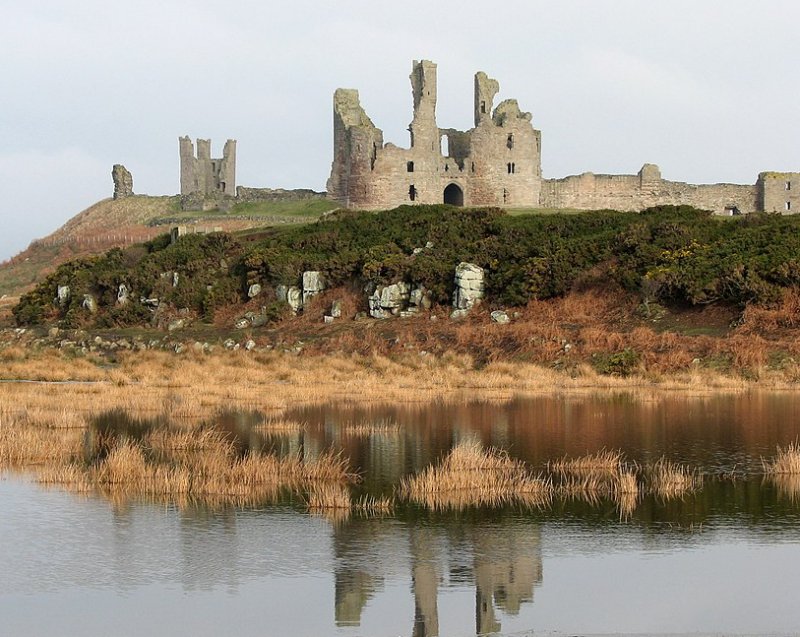
Dunstanburgh Castle, reflected in the remains of the southern mere. Image credit: John Sutton - CC BY-SA 2.0
Thomas Lancaster led two rebellions against Edward. The first, in 1310, Parliament imposed restraints on Edward's wasteful spending and the imposition of a supervisory council, which Thomas headed.
In 1321, he again headed a revolt. This time, he and his supporters were defeated. Thomas was found guilty of treason and executed in 1322.
In the 1380s, the castle was further fortified. Still, it was besieged with cannon fire multiple times during the Wars of the Roses and finally fell into ruin after these devastating experiences.
Except for its ruined gatehouse, today, there is not much left of the fortress, but there is plenty of legends, myths, and stories, including the story of Sir Guy the Seeker: a knight cursed to roam the fort forever.
Different versions of the story vary slightly in their details but typically involve a knight, Sir Guy, arriving at Dunstanburgh Castle, where he is met by a wizard and led inside.

Dunstanburgh Castle. Courtesy of Bootneck Photography, Creative Commons: http://goo.gl/TMuKul
Sir Guy finds himself outside Dunstanburgh Castle and spends the rest of his life attempting to find a way back inside. He comes across a noble lady imprisoned inside a crystal tomb guarded by a sleeping army. The wizard offers Guy a sword or a hunting horn to help free the lady; he incorrectly chooses the horn, which wakes the sleeping knights.
It is unclear when the story first emerged, but it is undoubtedly related to Dunstanburgh Castle and, like many other similar tales, possibly inspired by medieval Arthurian legends.
Another persistent legend is that beneath Dunstanburgh Castle, there are a lot of hidden passageways connecting the castle with nearby hamlets and villages. The passages can be reached through trap doors and barns.
The castle is the largest in Northumberland, and the site shows traces of much earlier occupation. The erection of the structure started in 1313 by the Earl of Lancaster.
Written by – A. Sutherland - AncientPages.com Senior Staff Writer
Updated on January 27, 2023
Copyright © AncientPages.com This material may not be published, broadcast, rewritten or redistributed in whole or part without the express written permission of AncientPages.com
Expand for referencesMore From Ancient Pages
-
 Pancho Villa: Mexico’s Robin Hood – A Ruthless Bandit Or A Hero?
-
 Magnificent Skellig Michael And A 1,400-Year Old Christian Monastery
-
 The Burnt City And Its Mysterious Prehistoric Inhabitants
-
 Why Did Ancient Egyptians Fear The Vizier?
-
 Fascinating Ancient History Of Roman Shields
-
 There Is A Problem With The Footprints Claimed As Evidence Of Ice Age Humans In North America – Scientists Say
-
 Two-Story Houses With Balconies Unearthed In Ancient City Of Pompeii, Italy
-
 Thousands Of Ignored ‘Nummi Minimi’ Coins Found In Ancient Marea, Egypt With Hidden Fascinating History
-
 Location of Roman Ballista Machines During The Siege Of Jerusalem – Uncovered
-
 Ife Head: Significance Of The Head ‘Ori’ In Yoruba Ancient And Present Beliefs
-
 1,750-Year-Old Fresco Travertines Buried Underground – Recovered In Ancient Laodicea
-
 Peculiar Millennia-Old Genetic Mystery Traced To One Individual From The Black Sea Solved
-
 Why Was Dorset Ancient Mega Henge Built In Such A Hurry?
-
 Long-Lost Roman Bridge Re-Discovered In Chepstow River Wye Mud, UK
-
 Mysterious Stone Spheres Could Be From Ancient Greek Board Game – Scientists Say
-
 What Caused The Year Without A Summer In 1816?
-
 On This Day In History: William I ‘The Lion’ Was Crowned At Scone – On Dec 24, 1165
-
 Modern Humans Used Favorable Climatic Conditions On Their Long Way From Africa To Europe
-
 3,000-Year-Old Nimrud Lens Could Re-Write The History Of Science – Was The World’s Oldest Telescope Developed By Ancient Assyrian Astronomers?
-
 Why Didn’t The Spartans Build City Walls?

