
Sharkalishharri Cylinder Seal From The Fifth King Akkad Dynasty
A. Sutherland - AncientPages.com - The Sharkalishharri cylinder seal, like many other similar objects from the Uruk period, is an impressive example of the technical performance and the complex motives presented on it.
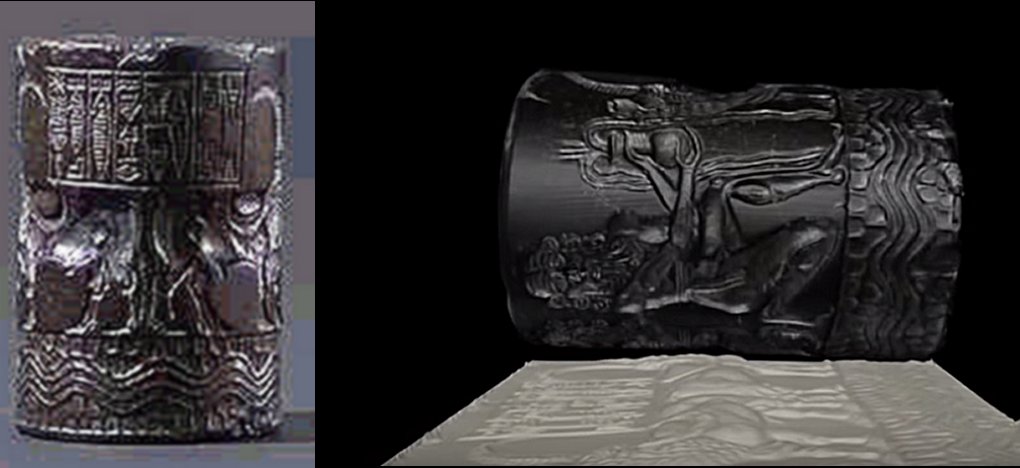 Cylinder-seal of Sharkalisharri, Akkadian period (23rd century BC), Mesopotamia – made of chlorite. Credits: Louvre Musée
The cylindrical seals that appeared at the end of the Uruk period (c.3500-3100 BC) began to be used to seal the first written documents.
This chlorite cylinder seal from about 2300 BC reveals the 5th King of Akkad and other scenes. The inscription reads, "the divine Sharkalisharri, king of Akkad, Ibni-sharrum, the scribe, is his servant."
Sharkalishharri (Shar-Kali-Sharri) was the king of the Akkadian dynasty, the son and successor of Naram-Sin, who reigned from C. 2217-2193 BC. He took over the Akkadian Empire after the 37-year reign of his father, Naram-Sin. At that time, his people were harassed by the constant invasions of the Guti (also known as Gutians or Guteans. These people specialized in the war of the driveway.
During his 25-year reign that lasted until 2193 BC, Sharkalishharri did not have any success during the invasions of the Guti people.
This type of struggle was due to the geographical location of the place of settlement of the Guti people - the Zagros Mountains. Their main target was the large herds of Akkadian cattle.
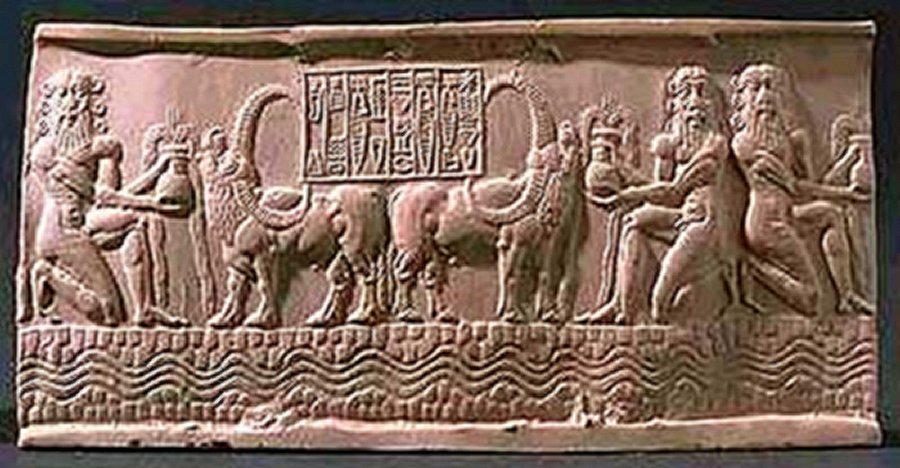 The impression of the Sharkalisharri cylinder seal, ca. 2183- 2159 BC during Akkadian, reign of Shar-kali-sharri. Mesopotamia. Cuneiform inscription in Old Akkadian. Credits: Louvre Musée
The cylinder seal is tiny (only 3.9 cm high, (1 1/2 in.); 2.6 cm in diameter (1 in.), still, it carries an important message because it's a unique signature of its owner, the divine protection or
Filling motifs – figures or objects depicted in the spaces around the main scene – are another common feature of cylinder seals.
The print left by the rolling of these miniature bas-reliefs on the soft clay of the tablet reveals a rich iconography that varies with the different epochs.
Thus the dynasty of Akkad (2340-2200 BC), stone-cutters displayed a certain tendency for mythological scenes. The seal depicts two naked figures (heroes) looking straight at us and holding two jars, and between the individuals, there are standing two water buffalos carrying the inscription.
Cylinder seals were usually made of stone. They were engraved and specially designed to be rolled into clay to leave impressions. The engraved images, and usually text, were carved in reverse so that they faced the correct direction when rolled out onto clay. Engraved cylinder seals were very popular and frequently used in the ancient Near Eastern world.
Their earliest examples used mainly magical, geometric, or animal patterns. Later seals incorporated the owner's name and depicted a variety of motifs. Both their use and fashioning were widely adopted by surrounding civilizations, including Egypt and the Indus valley.
It had several functions, such as a protective amulet function regarding persons and property, authentication of written and significant text and contracts, or as an identity mark of the sender to prevent tampering with containers and sealed doors which were often worn on a necklace or a pin.
The loss of a cylinder seal had serious consequences.
Written by – A. Sutherland AncientPages.com Staff Writer
Updated on October 8, 2022
Copyright © AncientPages.com All rights reserved. This material may not be published, broadcast, rewritten or redistributed in whole or part without the express written permission of AncientPages.com
Expand for referencesMore From Ancient Pages
-
 Recently Found ‘Neanderthal Footprints’ In the South Of Spain Could Be 275,000 Years Old
-
 Mysterious Ancient Village In A Prehistoric Anomalous Zone – Dangerous Underground Secret – Part 2
-
 Riddle How Human’s Uniquely DNA Evolved Solved By Scientists
-
 Oldest Footprints Of Pre-Humans Discovered In Crete – They Are 6 Million-Year-Old!
-
 Ancient Maya Used An Unknown And Ingenious Method To Prevent Tooth Decay And Infections – Scientists Say
-
 Denisovan Genetic Heritage Could Affect The Mental Health Of European And Asian Populations
-
 Headless Statue Of Life-Size Ancient Mayan Warrior Discovered In Mexico
-
 Mummy Of Pharaoh Amenhotep I Digitally Unwrapped For The First Time In 3,000 Years
-
 Tower Of The Winds And Daydreaming Of Andronicus Of Cyrrhus
-
 On This Day In History: Vädersol Painting Depicting ‘Sun Dog’ Phenomenon Observed Over Stockholm – On Apr 20, 1535
-
 ‘Joyeuse’ – Legendary Sword With Relics Of Saints Was A Private Treasure Of Emperor Charlemagne
-
 What Happened To Drunken Women In Ancient Rome?
-
 This Is The Mysterious Hilltop Where Civilization Began Scientists Say
-
 Mysterious Biblical Celestial City And Its Connection To The North Star – Nonhuman Hands – Part 1
-
 Unexplained Mystery Of The Untraceable Stone-Throwers – Strangeness In North America, Belgium And Indonesia – Part 1
-
 Ancient Egyptian Capital Tell El-Amarna Mapped Through Satellite Imagery System
-
 Ancient Secrets Of The Theopetra Cave: World’s Oldest Man-Made Structure And Home To Humans 130,000 Years Ago
-
 Invisible Ink On Antique Nile Papyrus From The Island Of Elephantine – Revealed
-
 Struggle To Get Mail On Time Has Lasted More Than 5,000 Years – Part 3
-
 Library Of Celsus: Beautiful Classic Monument In Ephesus That Stored 12,000 Scrolls

