
Great Wall Of India: Massive Structure That Surrounds Ancient Fort Of Kumbhalgarh
A. Sutherland - AncientPages.com - This massive structure, called the Great Wall of India, surrounds the ancient Fort of Kumbhalgarh.
Kumbhalgarh - the second most important Fort of Rajasthan after Chittorgarh - is located in Rajasthan in western India. It is a World Heritage Site initially built in the 15th century by Rana Kumbha, ruler of Mewar, between 1433 and 1468 AD.

Walls of Kumbhalgarh fort in Rajasthan, India. iMAGE CREDIT: Shivam Chaturvedi – CC BY-SA 3.0
The massive wall at Kumbhalgarh took nearly a century to construct, making the Fort virtually impenetrable.
Located at a distance of 64 km from Udaipur in the Rajasmand district, Kumbhalgarh Fort is easily accessible from the city of Udaipur.
The massive wall at Kumbhalgarh took nearly a century to construct Built on a hilltop 1,100 m (3,600 ft) above sea level on the Aravalli range, the fort of Kumbhalgarh has perimeter walls that extend 36 km (22 mi), making it among the longest walls in the world. The frontal walls are fifteen feet thick.

Aerial view of a portion of the Kumbhalgarh wall. Image credit: - CC BY-SA 3.0
Kumbhalgarh Fort was built by Maharana Rana Kumbha, the ruler of Mewar, a state in western India, between 1433 AD and 1468 AD. This ruler was also a patron of art, music, and architecture.
The impregnable Fort has seven massive gates and seven ramparts folded with one another and equipped with designed walls toughened by curved bastions and huge watch towers. Thanks to its strong structure and solid foundation, the fort made unbeatable to date. The fort's walls are broad enough to stand eight horses side by side. There are not less than 360 temples inside the complex.
The Fort is also known for its famous palace - the Palace of Cloud ('Badal Mahal') - on top of the structure. This beautiful palace has beautiful rooms with a color combination of green, turquoise, and white, presenting a bright contrast to the earthy colors of the Fort. This place gives the appearance of wandering in the world of clouds. Cloud Palace also offers a fantastic panoramic vista of the downtown.
According to popular folklore, Maharana Kumbha used to burn massive lamps that consumed fifty kilograms of ghee – a special butter that originated in ancient India - and a hundred kilograms of cotton to provide light for the farmers who worked during the nights in the valley.
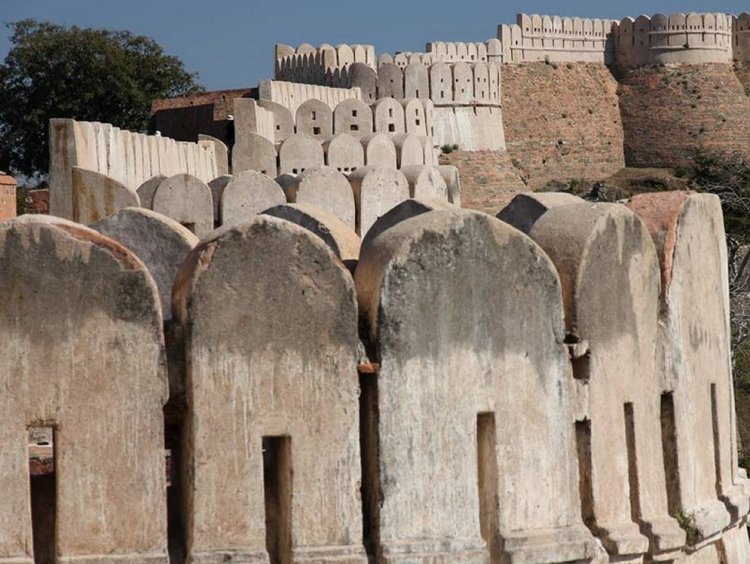 Great Wall, Kumbhalgarh, India. Photo credit: flickr.com/photos/kittell
The Fort is constructed on the topmost ridges around 1,914 meters above sea level. The fortifications extend to a length of 36 kilometers, which has made this Fort in the international records.
It is stated to be the second-longest wall in the world, after ''the Great Wall of China''. The complex of the Fort has numerous palaces, temples, and gardens making it more magnificent.

General view of the fort at night. Image credit: Kunal 3405 - CC BY-SA 3.0
The hefty walls of the Fort are broad enough to stand eight horses side by side. There are not less than 360 temples inside the Fort complex, including the Shiva Temple.
The robust structure and solid foundation of the Fort made it safe during times of battles and unbeatable.
Yet, despite its magnificence, it is still little known to the outside world.
Written by – A. Sutherland - AncientPages.com Senior Staff Writer
Updated on February 18, 2023
Copyright © AncientPages.com All rights reserved. This material may not be published, broadcast, rewritten or redistributed in whole or part without the express written permission of AncientPages.com
Expand for referencesMore From Ancient Pages
-
 Ancient Knowledge About Horse Taming Is Rewriting Our Picture Of The Past
-
 Florentine Codex: Remarkable Manuscripts About Life Of The Aztecs
-
 Lao Tzu: Legendary Thinker And Founder Of Taoism Who Advocated Modesty, Self-Restraint And Balance
-
 Viking Sword Unearthed In Grave Excavated by Archaeologists In Central Norway
-
 Sun Chariot – Powerful Symbol Of Bronze Age Cosmology
-
 Largest Ever Human Family Tree: 27 Million Ancestors Mapped
-
 X-Ray Reveal Ghostly Portrait Of Mary Queen Of Scots Hidden Underneath 16th Century Painting
-
 Hundreds Of Burials Discovered In Northern Lazio, The Home Of The Etruscan Civilization – Digitized
-
 Mummy Of Pharaoh Amenhotep I Digitally Unwrapped For The First Time In 3,000 Years
-
 Ancient Astronomical Structure Predating The Solar Observatory Of Chankillo Discovered In Peru
-
 Mystery Of King Solomon’s Temple
-
 Mysterious Greyfriars Kirkyard: A Cemetery In Edinburgh With Dark And Spooky History
-
 For The Ancient Maya, Cracked Mirrors Were A Path To The World Beyond
-
 Magnificent 1,800-Year-Old Rock Tombs Beautifully Decorated Discovered In The Ancient City Of Blaundus
-
 Evidence Of Extensive Human Fire Use 50,000 Years Ago
-
 Iron Age Site Of Khok Phutsa Excavated In Thailand
-
 Silver Jewelry Buried In Leather Purse Discovered In Bulgaria
-
 Ancient Giants In Ecuador Were Killed By Fire From The Sky – Indian Legends Reveal
-
 1,600-Year-Old Pendants Depicting Humans And Animals Excavated In Ancient Port-City Of Assos
-
 Has The Mystery Of The Secret Sarcophagus Found At Notre-Dame Cathedral Been Solved?

