
The Olmecs – Who They Were, Where They Came From Still Remains A Mystery
A. Sutherland - AncientPages.com - Of all the lost civilizations of Mesoamerica, that of the Olmec is the oldest and the most perplexing. We know very little about the Olmec - a mysterious culture considered by many as the Mother Civilization of Mesoamerica that laid the foundation for the Mesoamerican cultural traditions.

Olmec Head No. 3 from San Lorenzo-Tenochtitlán; 1200–900 BCE; basalt; height: 1.8 m, length: 1.28 m, width: 0.83 m; Xalapa Museum of Anthropology (Xalapa, Mexico). - Flickr - CC BY 2.0
They arose suddenly and with no app
They arose suddenly and with no apparent prior gradual development. It is challenging to locate the Olmec civilization in time precisely.
Their beginnings have traditionally been placed between 1400 and 1200 BC, and Olmec remains discovered at the Preclassic shrine, El Manatí, near San Lorenzo moved further back to "at least" 1600–1500 BC. The Olmec seemed to have roots in early farming cultures, which began between 5100 BC and 4600 BC.
The Mesoamerican Olmec flourished around 1400 BC near the Bay of Campeche off the Gulf of Mexico. They inhabited the southeastern part of the state of Veracruz and Tabasco's western part of the state, with the three most important centers of La Venta, San Lorenzo, and Tres Zapotes.
Other evident signs of their presence are related to Puebla, Morelos, and Guerrero, which means that they occupied the area from the Atlantic to the Pacific coast. Most likely, their expansion reached up to the countries of Central America: Guatemala, Belize, El Salvador, Honduras, Nicaragua, and Costa Rica.
Nicknamed Olmeca ('Rubber People') because they lived in the area known for its rubber trees, the Olmec were strangers.
In addition to building huge thrones and monuments, the Olmec carved colossal-sized heads weighing up to fifty tons and transported them nearly sixty-two miles to the Olmec heartland.

Head of Olmeca in Villhermosa Museum. Image credit: Glysiak - CC BY-SA 4.0
Who they were and where they came from is uncertain. The generally accepted belief is that the culture arose from people in the area. However, many believe they represent Mongoloid people, while others suggest the Olmec have originally come from Africa.
But who were these unknown Africans? Did they arrive from the lands of North Africa?
In fact, there are several issues related to the Olmec civilization, one of which is the Olmec true origin.
The Olmec portrayed Africans (perhaps African rulers) who must have played an essential role among ancient people who carved gigantic depictions to honor them.
The African descent and possible transatlantic crossings of people millennia ago seem too controversial to accept, but is there any other explanation?
According to Mexican anthropologists having difficulties accepting the Africans' presence and importance in this part of the world, the so-called Olmec were not strangers from across the seas, but indigenous people, Mesoamericans, with facial characteristics similar to Africans.

Olmec colossal head discovered by Stirling at La Venta , Tabasco. Image credit: H. Grobe - CC BY 3.0
Ivan Van Sertima (1935-2009), a Guyanese-born associate professor of Africana Studies at Rutgers University in the United States and the foremost authority on the African presence in ancient America, proved that many Olmec cultural traits were of African origin:
"A study of the Olmec civilization reveals elements closely parallel to ritual traits and techniques in the Egypto-Nubian world of the same period that it is difficult to maintain [that] all these are due to mere coincidence."
Who were the Africans who sailed to America before Columbus and introduced a calendar, writing, pyramid and tomb construction, mummification, and specific political systems and religious traditions to the native Americans?
Indian scholar R.A. Jairazbhoy states that the earliest settlers were ancient Egyptians led by King Rameses III during the 19th dynasty. Van Sertima also believes most explorers sailed from Egypt during the much later 25th dynasty. Many other scholars insist that the navigators came from West African nations, such as Mali and Ghana.
The Olmec influence spread throughout much of Mesoamerica. It is particularly noted for its ceremonial centers and distinctive art style, like were-jaguars being a combination of a snarling jaguar and a weeping human infant, but first of all, 17 colossal stone heads - never with bodies.
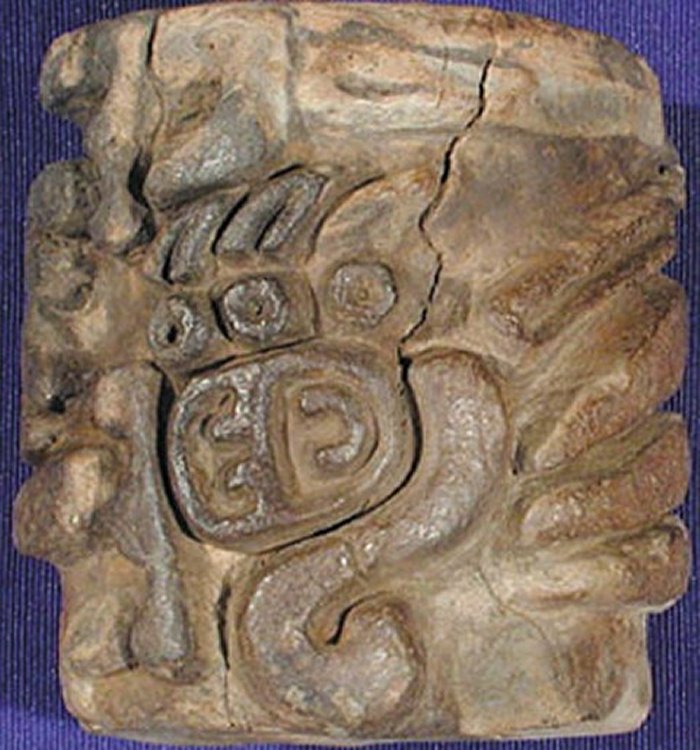 Symbols on this Olmec seal are similar to later Mayan glyphs. Credits: Christopher von Nagy.
Giant monolithic heads - weighing up to 24 tons, with a height of up to 3.5 meters - differ from each other. Yet, they are all alike with flaring nostrils, thickened lips, and a helmet or a helmet-like headdress believed to be the characteristic "football helmet." At San Lorenzo, ten of them have been found, four in La Venta, two in Tres Zapotes, and one in La Cobata.
The heads - one of the most controversial scientific issues - are made of hard volcanic basalt mined in the mountainous region of the Sierra de Los Tuxtlas along the southeastern Veracruz Gulf coast in Eastern Mexico.
As skilled engineers, the Olmec managed to transport huge blocks of basalt and other stone from quarries more than fifty miles away from their sculpted heads and other monuments.
The first of the monolithic heads accidentally discovered a Mexican traveler Jose Maria Melgar y Serrano, in the hacienda Hueyapán (Tres Zapotes, Veracruz), in 1862.
Given the physical features of the Olmec head, Serrano was sure that it was the depiction of an African. The discovery testified to the existence of an unknown, sophisticated culture.
Popol Vuh, Sacred Book of the Quiché Maya People, claims that the Olmec came to Mexico in 'ships of bark.' It means that black Africans sailed across the Atlantic Ocean long before Columbus.
But how long ago did this journey happen?
At first, the suggested oldest date for the Olmec origin was 250 BC. Still, when one Olmec site after another was excavated, 'the oldest date' shifted to 500 BC and even 1250 BC.
The archaeological discoveries prove that the Olmec built complex urban centers with large pyramidical structures and astronomical alignments. The Olmecs engaged in mining, produced high levels of art, introduced hieroglyphic writing to Mesoamerica, the concept of Zero and positional numbers, and impressive public buildings.
They were the first in Mesoamerica to have a calendar, religion, the study of astronomy and mathematics, stone masonry, and farming.
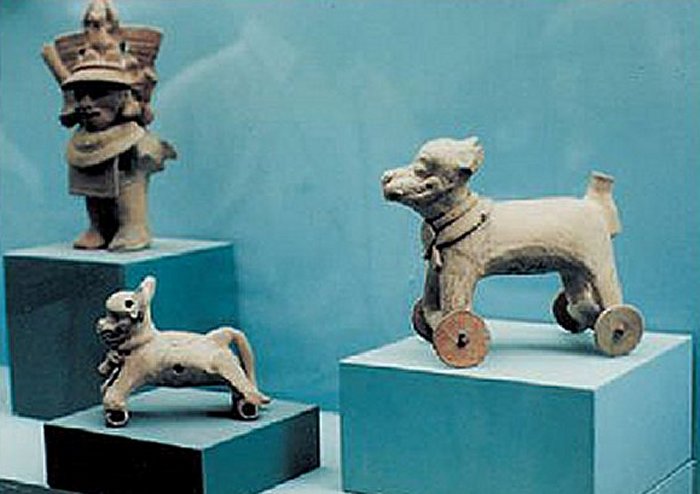 Olmec clay toys, equipped with wheels, Anthropological Museum of the University of Veracruz, Jalapa, Mexico
'From an ancient stela found in Izapa, it is clear that the Olmec recognized the Tree of Life. The tree also depicts seven branches and twelve roots,' wrote Sabas Whittaker, M.F.A., in his book 'Africans In The Americas Our Journey Throughout The World.' This stela also confirms that the Olmec were some black people who came to Mexico in ships made of barks and landed at Pontochan. These people are frequently depicted in the Mayan books and writings carrying trade goods.
'The seven branches probably represent the seven major clans of the Olmec people.
The twelve roots of the tree extending into the water from the boat probably signifies the 'twelve roads through the sea.'
Friar Diego de Landa (1524 – 1579), known as an early destroyer and preserver of knowledge on the preconquest Maya of Yucatán, wrote:
"Some old men of Yucatan say that they heard from their ancestors that this country was peopled by a certain race who came from the EAST, which God delivered by opening for them twelve roads through the sea."
The Olmec culture in Old Mexico has always posed a problem. They vanished without any hint as to where they went and why.
Written by – A. Sutherland AncientPages.com Staff Writer
Updated on October 13, 2022
Copyright © AncientPages.com All rights reserved. This material may not be published, broadcast, rewritten or redistributed in whole or part without the express written permission of AncientPages.com
Expand for referencesReferences:
Sitchin, Z. The Lost Realms
Whittaker S, 'Africans In The Americas Our Journey Throughout The World'
Popol Vuh, Sacred Book of the Quiché Maya People
More From Ancient Pages
-
 Cernunnos ‘Horned One’ – Powerful Continental God Preserved In Celtic Beliefs As Master Of Animals
-
 Discovered 3,700-Year-Old Clay Tablet Shows Babylonians Used Geometry Long Before Pythagoras
-
 Ancient Mystery In The Alpes Remains Unsolved Because Of Contradicting Information
-
 On This Day In History: Reginald Walter Bonham Was Born – On Jan 31, 1906
-
 Riddle Of The Indo-European Language – Which Of The Two Hypotheses Is Correct?
-
 Circe: Powerful Divine Sorceress Who Mastered Healing, Miracles And Transforming People Into Animals In Greek Mythology
-
 Largest And Most Complete Ancient Egyptian Workshops Found In Saqqara
-
 Ancient Mystery Of Leti – A Homo Naledi Child Of Darkness Discovered In The Rising Star Cave System
-
 Takshashila: Renowned Learning Center That Attracted Buddhist Masters, Disciples And Students Of The World
-
 Gilmerton Cove: Mysterious Cave System Still Keeps Its Centuries-Old Secrets
-
 Secrets And Lies: Spies Of The Stuart Era Played A Dangerous Game In The Shadows Of An Unstable Europe
-
 Unexpected Discovery Of Huge Iron Age Roundhouse At Dinas Dinlle, Wales
-
 Treasure Coins Dated To 15th And 16th Century Unearthed In Historical Region Of Slovakia
-
 6,000-Year-Old Discovery Of Artifacts Associated With Ancient Lengyel Culture
-
 Unexplained Teleportation Cases Of People – Ancient Times – Part 1
-
 A 19th-Century Sailing Ship Loaded With Champagne, Wine, Porcelain And Mineral Water Found At The Bottom Of The Baltic Sea
-
 Unique Ancient Map Depicting The Earth As Seen From Space Restored Digitally
-
 Shining Swords: Magical Artifacts That Symbolized Power, War, Punishment And Righteousness
-
 Strange Mummies Of Venzone: Ancient Bodies That Never Decompose Remain An Unsolved Mystery
-
 Negev Desert’s Ancient Site Tells Story About Humans, Neanderthals Coexistence

